

Selliera
Botanical name: Goodenia radicans
Synonyms: Selliera radicans
Common name(s): Selliera, Remuremu, Half-star, Bonking grass, Swampweed
About:
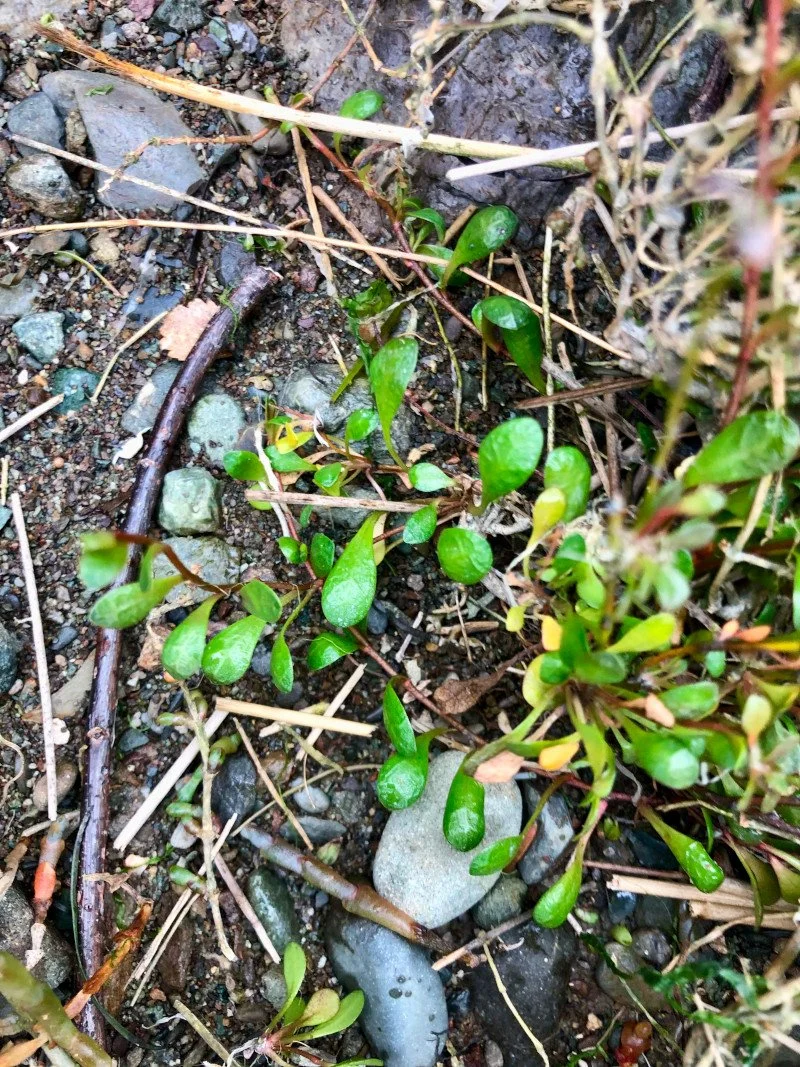
A low-growing, creeping perennial herb that forms dense, glossy green mats across damp open ground. Formerly widely known as Selliera radicans, this highly variable species spreads through long stems that root at the nodes and can form patches a metre or more across. Its small white to pale blue, distinctly one-sided flowers and fleshy spoon-shaped leaves make it an attractive native ground cover, particularly for wet or coastal sites.
Natural habitat:
Found from coastal environments to alpine areas, although it is most common near the coast. It occupies permanently or seasonally damp, open habitats including coastal turf, sand-dune swales, salt pans, cliff tops, talus slopes, wet depressions and the marginal turf surrounding lakes and ponds. Inland populations occur in parts of the South Island and central North Island, including around Lake Taupō.
Growing environment:
Sun, Wet, Coastal, Salt & Wind tolerant. Performs particularly well in permanently damp, open sites in full sun and tolerates soils of relatively low fertility.
Endemic distribution:
Indigenous but not endemic to New Zealand. Within New Zealand it occurs on Manawatāwhi / Three Kings Islands, the North Island, South Island, Stewart Island/Rakiura and Chatham Islands. The species also occurs naturally outside New Zealand.
Height:
Usually forms a very low carpet approximately 2–10 cm tall, although ascending shoots can occasionally reach higher.
Width:
Individual colonies commonly spread 50 cm–1 m or more across, with established plants capable of merging into extensive mats.
Flowering:
August – April
Produces small white to pale blue flowers, usually singly from the leaf axils. The flowers are approximately 8–16 mm across and characteristically asymmetrical or half-star-shaped, with five narrow petals fused near their bases. The outer petal surfaces may be white, pinkish-white or flushed pale red.
Fruiting:
October – June
Produces small green, obovoid to ovoid fruits containing flattened, pale orange-yellow to pale brown seeds with narrow translucent wings.
Uses:
• Native no-mow lawn
• Ground cover
• Coastal gardens
• Wetland margins
• Pond and lake-edge planting
• Damp swales and depressions
• Coastal and ecological restoration
• Turf and naturalistic planting
• Erosion and surface stabilisation
Appearance:
Growth habit:
A perennial, somewhat succulent creeping herb forming dense mats. White to yellowish stems, approximately 1–4 mm thick, spread horizontally at or immediately below the ground surface and root readily at their nodes. Branch tips occasionally turn upward.
Leaves:
Leaves occur singly or in small clusters of up to four along the stems. They are somewhat fleshy, leathery, glossy and dark green to yellow-green. Leaf shape is extremely variable, ranging from rounded or rhomboid to obovate, spoon-shaped or almost linear. Blades range from approximately 3–50 mm long and 1–10 mm wide and are carried on flattened petioles up to about 40 mm long.
Flowers:
Flowers are usually solitary, occasionally paired, and carried on fleshy stalks arising from the leaf axils. The five petals form a distinctive asymmetrical flower approximately 4–11 mm long and 8–16 mm across. The inner surface is white to pale blue, while the outside may be white, pinkish or pale reddish. The style is purple-red with an orange-brown stigma.
Fruit:
Fruit is green, approximately 3–6 mm long and obovoid to ovoid with a truncate end. Seeds are approximately 1–1.8 mm long, broadly oval to almost circular, pale orange-yellow to pale brown and surrounded by a narrow, irregular translucent wing.
Ecology:
An important component of open coastal turf, wetland margins and seasonally inundated habitats. Its creeping, node-rooting stems enable it to rapidly occupy exposed ground and form resilient low mats. These mats help cover and stabilise damp substrates while providing habitat amongst the foliage for small invertebrates. Goodenia radicans has also been suggested as an important host plant for some indigenous moths.
Associated habitats:
Coastal turf, salt pans, dune swales, damp sand flats, cliff tops, talus slopes, wet depressions, lake and pond margins, freshwater turf, seasonally inundated ground and damp open alpine or inland sites.
How to grow:
An easy and adaptable native ground cover. Plant in full sun in permanently or consistently damp soil for the strongest, densest growth. It is relatively tolerant of soil fertility and can establish on comparatively poor substrates.
Once established, creeping stems root as they spread and gradually form a continuous carpet. This makes selliera particularly useful as a native lawn substitute in appropriate damp situations. It can be left largely unmown, although occasional trimming can maintain a particularly even surface if desired.
Propagation:
Easily propagated by division. Lift rooted sections of established creeping stems, ensuring each piece retains several healthy leaves and roots, and replant directly into moist soil. Keep consistently damp until established. It can also be raised from fresh seed.
Cultural use:
Remuremu is a recorded Māori name for this species. Specific traditional practical uses are not well documented in the supplied botanical literature, so these should not be inferred without supporting ethnobotanical evidence.
Garden value:
An excellent native alternative to conventional lawn or low ground-cover plants, particularly for damp, sunny sites. Its glossy foliage forms attractive dense carpets while the small white to pale blue half-star flowers provide seasonal interest. Its tolerance of coastal exposure, wet soils and relatively infertile conditions makes it particularly valuable for coastal gardens, pond margins, wetland landscaping and naturalistic native plantings.