
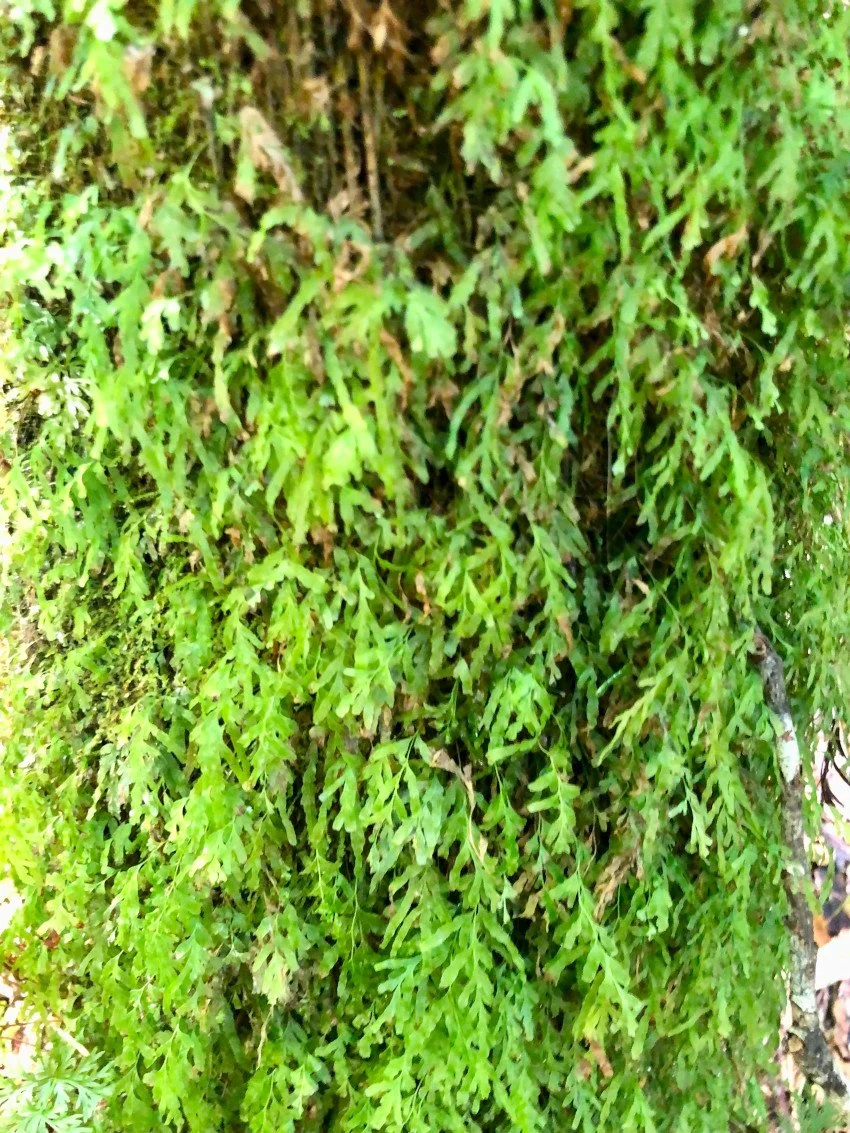
Veined Bristle Fern
Botanical name: Polyphlebium venosum
Common name(s): Veined Bristle Fern, Veined Filmy Fern
Plant facts:
A delicate native filmy fern that forms dense green carpets in damp forests. This species is extremely thin and translucent, with fronds only one cell thick. Most commonly found growing as an epiphyte on tree fern trunks in cool, humid environments.
Natural habitat:
Typically found in wet forest environments growing on tree fern trunks, mossy rocks, boulders, logs, and shaded cliff faces.
Growing environment:
Shade, Moist, Humid & Free draining tolerant.
Endemic distribution:
Widespread throughout New Zealand including the Kermadec, North, South, Stewart, and Chatham Islands. Also found in Australia.
Height:
Fronds typically 20–180 mm long
Flowering:
Not applicable — spore-producing fern.
Fruiting (spores):
Produces minute spores within narrow tubular reproductive structures along the leaf margins.
Uses:
• Suitable for humid fern collections
• Adds texture to shaded forest gardens
• Excellent species for terrariums and mossy displays
Appearance:
Growth habit:
Forms dense creeping mats from thin, interwoven rhizomes covered in golden-brown hairs. Usually grows epiphytically on tree ferns but may also establish on rocks and damp surfaces.
Fronds (leaves):
Bright green, translucent, and extremely delicate, with very visible branching veins. Fronds are narrow and irregularly divided with softly rounded or slightly scalloped edges.
Structure:
Fronds are finely textured with slender stems and winged central axes. The plant has a soft, hanging appearance in humid environments.
Reproductive structures:
Spores are produced in narrow, trumpet-shaped structures embedded along the frond margins, with fine bristle-like receptacles extending outward.
How to grow:
Difficult to cultivate and highly sensitive to drying out. Best suited to consistently humid, shaded conditions with excellent moisture retention and airflow. Should not be removed from the wild.