


Crepe Fern
Botanical name: Leptopteris hymenophylloides
Synonyms: Todea hymenophylloides, Todea marginata, Todea pellucida, Leptopteris marginata, Osmunda hymenophylloides
Common name(s): Crepe fern, single crepe fern, heruheru
About
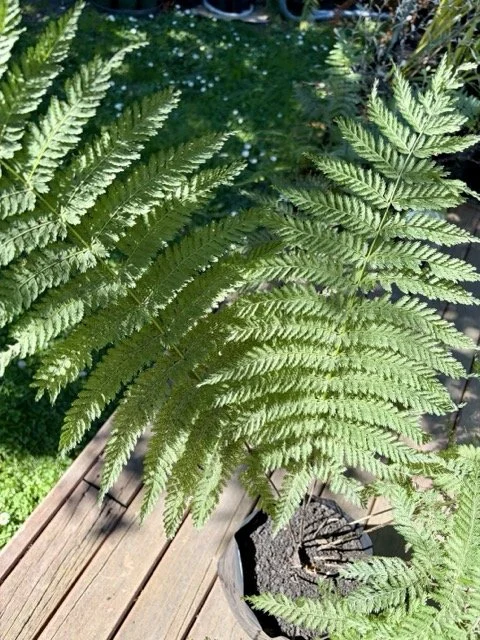
Leptopteris hymenophylloides is an elegant terrestrial fern endemic to New Zealand. It is immediately recognisable by its exceptionally thin, soft and translucent green fronds, which have a delicate crepe-like texture resembling those of much smaller filmy ferns. The finely divided fronds arise from a short, erect rhizome that can eventually develop into a small woody trunk. Unlike most familiar ferns, its sporangia are scattered directly across the undersides of the fertile fronds rather than being grouped into distinct sori. It is widespread through New Zealand’s damp lowland and montane forests and is particularly characteristic of shaded stream margins and moist forest banks.
Natural habitat
Occurs primarily in lowland to montane forest, including kauri, podocarp, broadleaved and southern beech forest. It is especially common along streams, damp banks, shaded gullies and moist valley floors, although established plants may also occur on comparatively dry valley sides and forested ridges. It is rarely found in gumland scrub and coastal forest. Although normally associated with moist forest environments, established plants can be surprisingly persistent following increased exposure caused by windthrow or forest disturbance.
Growing environment
Prefers cool, humid and shaded conditions with consistently moist, humus-rich soil. It performs best beneath a forest canopy or in sheltered gullies where direct sunlight and drying winds are limited. Soil should remain moist but free-draining, with abundant organic matter resembling natural forest litter. Once well established, plants can tolerate somewhat greater light levels and periods of reduced moisture than their delicate fronds might suggest, although consistently dry conditions should be avoided.
Endemic distribution
Endemic to New Zealand and found throughout the North Island, South Island, Stewart Island/Rakiura and Chatham Islands. In the North Island it occurs from North Cape southwards and is widespread through Northland, Auckland, the Volcanic Plateau, Gisborne, Taranaki and the southern North Island. In the South Island it occurs through Western Nelson, Sounds–Nelson, Marlborough, Westland, Canterbury, Otago, Southland and Fiordland. Its recorded altitudinal range is approximately 10–950 m. It has a predominantly northern distribution and becomes less frequent through parts of the South Island, particularly the drier high country.
Height
Fronds are generally approximately 220–980 mm long, although particularly vigorous specimens may produce fronds approaching or exceeding 1 m. Mature plants may develop a short woody trunk approximately 500 mm tall and occasionally considerably taller.
Width
A mature crown can spread approximately 0.5–1 m or more across as its long, arching fronds develop. Individual laminae reach approximately 95–330 mm wide.
Flowering
Not applicable. Leptopteris hymenophylloides is a fern and does not produce flowers.
Fruiting
Not applicable. It reproduces by spores rather than fruits or seeds. Sporangia are produced on the undersides of fertile fronds and are dispersed principally by wind.
Uses
Shaded native woodland gardens
Fern gardens and ferneries
Damp banks and gullies
Streamside planting
Underplanting beneath established native trees
Naturalistic forest restoration
Native fern collections
Shaded courtyard and sheltered garden planting
Feature fern for its exceptionally delicate foliage
Suitable for recreating cool New Zealand forest-floor environments
Appearance
Growth habit: A terrestrial fern arising from a short, erect rhizome. Older specimens can gradually develop a woody trunk, usually up to approximately 500 mm tall but occasionally approaching 1 m. Fronds form an upright to spreading crown and arch outward as they mature.
Leaves: Fronds are approximately 220–980 mm long overall, with pale brown stipes approximately 110–480 mm long. The stipes are sparsely covered with soft woolly hairs and may have distinctive ear-like lobes around their bases.
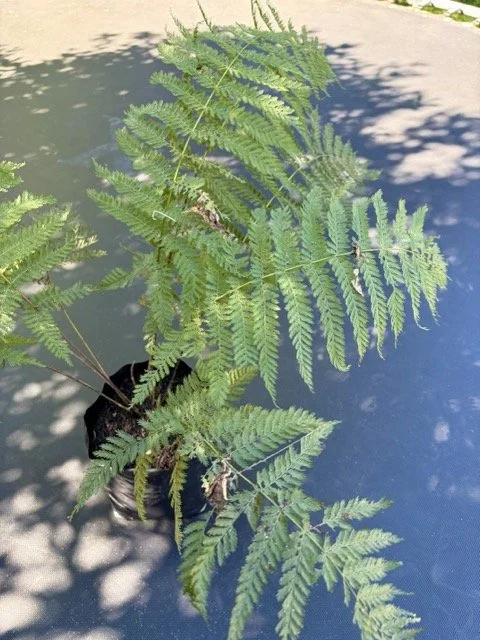
The lamina is approximately 140–725 × 95–330 mm and varies from elliptic and ovate to broadly triangular. It is extremely thin, membranous and translucent, ranging from light emerald-green to darker green. This delicate, almost filmy texture is one of the species’ most distinctive characteristics.
Fronds are highly divided, generally 2-pinnate-pinnatifid to approximately 3-pinnate in overall appearance. There are approximately 15–30 pairs of primary pinnae, which are widely spaced along the rachis. The longest are approximately 60–180 mm long, while the basal pair is typically 50–120 mm long. Secondary pinnae are approximately 14–28 × 5–10 mm and are deeply divided. The ultimate segments are narrow, linear and attenuate, lying flattened within the plane of the frond.
Flowers: None. As a fern, Leptopteris hymenophylloides does not produce flowers.
Fruit: None. Sporangia are scattered individually over the lower surfaces of fertile pinnae rather than being grouped into discrete sori. They tend to be concentrated toward the proximal portions of the primary and secondary pinnae and are usually more abundant toward the central portion of the fertile frond.
Ecology
A characteristic fern of cool, humid New Zealand forest interiors. Its exceptionally thin fronds are adapted to environments where atmospheric humidity and soil moisture are generally high. It is particularly associated with damp banks and stream margins, although established plants have considerably greater tolerance of temporary dryness and increased light than their delicate appearance suggests.
Minute spores are dispersed by wind. The species frequently occurs alongside the closely related Leptopteris superba. Where the two grow together they can naturally hybridise, producing Leptopteris × intermedia.
Associated habitats
Occurs beneath kauri, podocarp, broadleaved and southern beech forest, particularly along streams, damp banks, valley floors and shaded gullies. It can also occur on comparatively dry valley sides and forested ridges. Common associates vary substantially across its wide distribution but include other moisture-loving native ferns, mosses, liverworts and shade-tolerant forest-floor herbs.
Within Nelson–Tasman it occurs in suitable damp forest throughout Western Nelson and Sounds–Nelson, particularly in sheltered gullies, stream systems and moist forest interiors.
How to grow
Grow in partial to deep shade in a sheltered position with moist, free-draining and humus-rich soil. Incorporating leaf mould or well-decomposed organic matter helps reproduce the conditions of a natural forest floor. Maintain reliable moisture during establishment and avoid exposing young plants to hot sun or persistent drying winds.
Despite the extremely delicate appearance of the foliage, established plants are reasonably resilient and can tolerate some periods of dryness and increased light. However, the best specimens develop where roots remain cool and moist and atmospheric humidity is reasonably high.
It is particularly effective planted beneath native trees, beside shaded streams or ponds, on damp banks or amongst other native ferns where its translucent foliage can contrast with heavier-textured species.
Propagation
Propagation is principally from spores. Mature sporangia can be collected from fertile fronds and the spores sown onto a sterile, moist, humus-rich medium. High humidity and stable moisture are important during germination and development of the gametophytes and young sporophytes.
Established plants may occasionally be divided where the rhizome structure permits, but spore propagation is generally the more appropriate method. Young plants should be kept shaded and continuously moist until well established.
Cultural use
The name heruheru is associated with native ferns in te reo Māori and is recorded as a common name for this species. Specific traditional uses attributable solely to Leptopteris hymenophylloides should be treated cautiously where historical sources do not clearly distinguish it from other ferns. Today the species is valued as a distinctive component of Aotearoa’s endemic forest flora.
Garden value
One of New Zealand’s most beautiful foliage ferns for a cool, shaded garden. The large yet extraordinarily delicate translucent fronds create a soft, almost feathery appearance, with the finely divided emerald-green foliage particularly effective against darker forest vegetation.
Unlike many delicate-looking ferns, established Leptopteris hymenophylloides can be surprisingly resilient. It is an excellent specimen for shaded Nelson–Tasman gardens where summer moisture can be maintained, particularly beneath established trees, beside streams, on shaded banks and in dedicated ferneries. Its combination of large size and almost filmy foliage makes it particularly valuable for adding a fine-textured understory layer to naturalistic native forest plantings.