
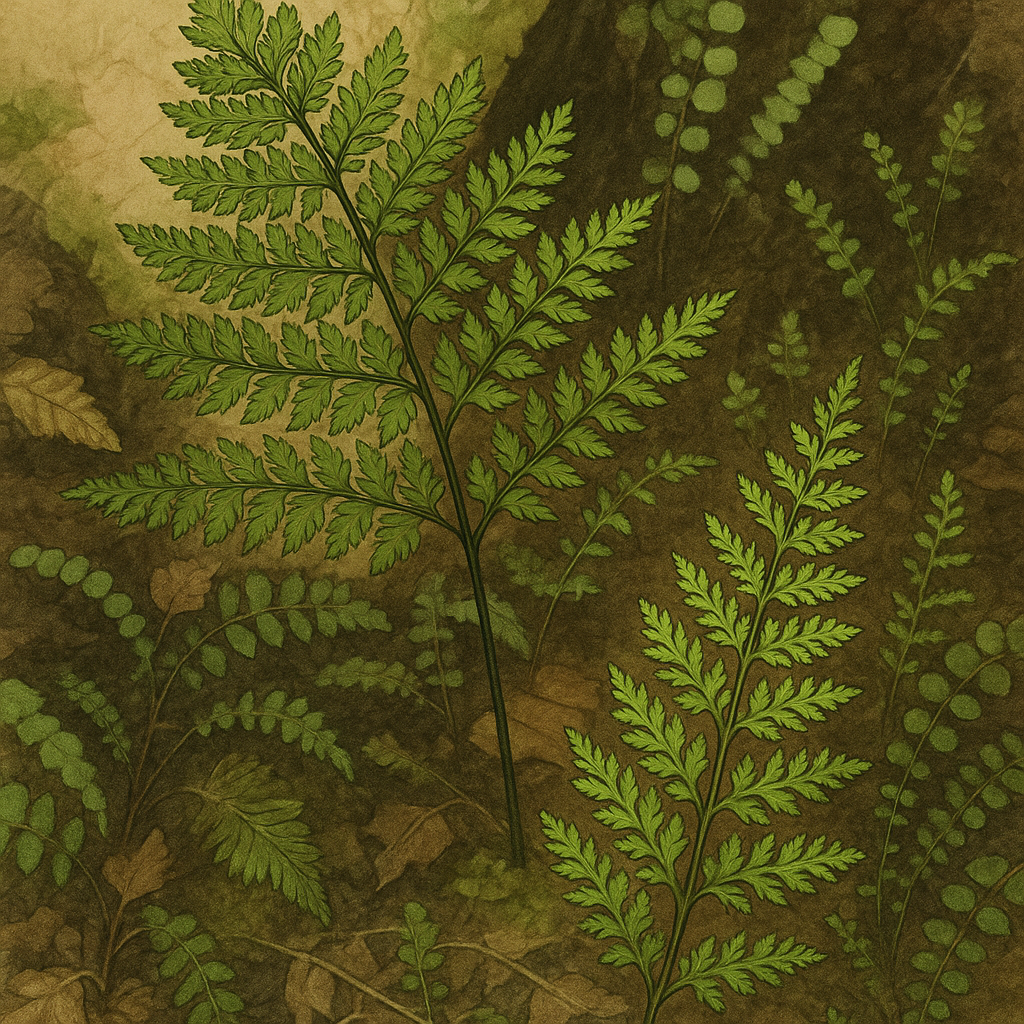
Lace Fern
Botanical name: Leptolepia novae-zelandiae
Synonyms: Dennstaedtia novae-zelandiae, Microlepia novae-zelandiae, Acrophorus hispidus, Davallia novae-zelandiae
Common name(s): Lace fern
About
Leptolepia novae-zelandiae is a distinctive, large, finely divided terrestrial fern endemic to New Zealand and the sole species of the endemic genus Leptolepia. Its broad, dark green fronds are divided three to four times into delicate, sharply pointed segments, creating the intricate lace-like appearance responsible for its common name. The reddish-brown to chestnut-brown polished stalks and rachises contrast attractively with the foliage. It is a fern of cool, deeply shaded and consistently damp forest habitats and can produce fronds approaching or exceeding 1 m long under favourable conditions.
Natural habitat
Occurs from coastal and lowland forest into montane environments, particularly in deeply shaded, damp sites. It grows in podocarp, broadleaved and beech forest and favours gullies, stream and river banks, river terraces, seepages, springs, shaded banks and damp tracksides. It is also occasionally found growing amongst rocks or on decaying logs. Plants are often scattered and uncommon, although substantial colonies can develop where conditions are particularly favourable.
Growing environment
Best suited to cool, deeply shaded or heavily filtered-light positions with consistently moist soil and high surrounding humidity. It tolerates a broad range of soil types provided moisture remains available and drainage is adequate. It has very poor drought tolerance and should not be allowed to dry out for prolonged periods. Sheltered south-facing slopes, shaded gullies, stream margins and damp woodland gardens closely reproduce its natural environment.
Endemic distribution
Endemic to New Zealand and widespread through the North Island, South Island, Stewart Island/Rakiura and Chatham Islands. In the North Island it occurs from Te Paki south to Wellington. In the South Island it is widespread through Western Nelson, Sounds–Nelson, Marlborough, Westland, Canterbury, Otago, Southland and Fiordland, although it becomes much scarcer through the drier eastern districts. Its recorded altitudinal range is approximately 30–900 m.
Height
Fronds generally range from approximately 135 mm to over 1 m long, with particularly large plants reaching around 1.15 m. The stipes alone may reach approximately 40–675 mm long.
Width
Individual frond blades may reach approximately 500 mm wide. The creeping rhizome gradually spreads laterally, with individual fronds arising at intervals of approximately 20–175 mm, allowing mature plants to develop into broad colonies where conditions remain favourable.
Flowering
Not applicable. As a fern, Leptolepia novae-zelandiae does not produce flowers.
Fruiting
Not applicable. Reproduction is by spores rather than fruits or seeds. Fertile fronds carry rounded to oblong sori on their undersides, positioned toward the margins of the ultimate leaf segments.
Uses
Shaded native woodland gardens
Fern gardens and ferneries
Damp gullies and shaded banks
Stream and pond margins above the permanently saturated zone
Underplanting beneath native trees and shrubs
Naturalistic forest restoration
Native fern collections
Groundcover for large, permanently shaded areas
Provides delicate foliage texture in sheltered gardens
Appearance
Growth habit: A terrestrial, rhizomatous perennial fern with fronds arising at relatively wide intervals from slender, creeping rhizomes approximately 1–3 mm in diameter. The rhizomes carry chestnut-brown multicellular hairs and gradually spread through suitable damp substrates.
Leaves: Fronds are approximately 135–1,150 mm long overall. The lamina is broadly ovate, elliptic or broadly ovate and approximately 65–530 × 40–500 mm. It is highly divided, ranging from 3-pinnate-pinnatifid to 4-pinnate-pinnatifid, producing an exceptionally delicate, lace-like appearance. The foliage is normally dark green but may occasionally be yellow-green.
Primary pinnae occur in approximately 15–27 pairs below the divided apex. Secondary and tertiary divisions progressively reduce toward the tips, with the ultimate segments narrow and sharply pointed. The frond surface is generally almost hairless or carries only scattered fine hairs.
The stipes are approximately 40–675 mm long and characteristically red-brown to chestnut-brown. The rachises are similarly chestnut to yellow-brown, smooth and polished, with occasional hairs particularly around the pinna junctions.
Flowers: None. Leptolepia novae-zelandiae is a spore-producing fern and does not produce flowers.
Fruit: None. Fertile fronds develop round to oblong sori near the margins of the ultimate segments. Each sorus is protected by a distinctive ovate, broadly ovate or triangular indusium with toothed to finely divided margins opening toward the edge of the frond. This structure is an important diagnostic feature of the species.
Ecology
A characteristic fern of moist, shaded New Zealand forest interiors. Its preference for stream margins, seepages, gullies and other reliably damp microsites reflects its sensitivity to drought. The creeping rhizomes allow established plants to gradually colonise suitable forest-floor habitat, while the highly divided fronds create a broad photosynthetic surface in the low-light conditions beneath the forest canopy. Minute spores are dispersed by wind and can potentially colonise suitable damp substrates away from established plants.
Associated habitats
Occurs in podocarp, broadleaved and southern beech forests, particularly where the canopy provides substantial shade and the ground remains consistently moist. Typical microsites include shaded stream banks, river terraces, forested gullies, seepages, springs, rock piles, damp banks and occasionally rotting logs. Within Nelson–Tasman it is particularly associated with moist forest and gully environments where summer drought is moderated by shade and reliable soil moisture.
How to grow
Plant in partial to deep shade in consistently moist but reasonably aerated soil. A humus-rich forest soil containing leaf mould and organic matter is ideal, although the species is tolerant of a surprisingly broad range of soil types. Maintaining moisture is much more important than soil composition.
Water regularly during establishment and during prolonged dry periods. Avoid exposed positions, hot afternoon sun and sites that dry substantially during summer. Once established, the creeping rhizomes can spread strongly through favourable shaded ground and may eventually form sizeable colonies. In particularly favourable garden conditions it can become vigorous enough to require occasional control.
Propagation
Can be propagated by division of established rhizomes or from spores. Division is the simplest method for cultivated plants: healthy sections of creeping rhizome carrying established roots and developing fronds can be separated and replanted into a shaded, consistently moist growing medium.
Spore propagation is possible but considerably slower. Mature spores should be collected from fertile fronds and sown onto a sterile, moist medium under humid conditions. Young plants should remain protected from drying throughout establishment. Although generally easy to cultivate once growing strongly, newly established plants can initially be slow.
Cultural use
No specific traditional Māori use for Leptolepia novae-zelandiae is well documented. Its significance today is primarily botanical, ecological and horticultural as both an endemic New Zealand fern and the sole representative of an endemic genus.
Garden value
An excellent fern for cool, damp and shaded New Zealand gardens. The large, finely divided fronds have an exceptionally delicate lace-like texture despite the plant developing into a substantial fern. Dark green foliage combined with polished reddish- to chestnut-brown stalks provides attractive colour and structural contrast.
It is particularly valuable for shaded Nelson–Tasman gardens, woodland plantings, ferneries and damp gullies where reliable moisture can be maintained. Once established it can spread into an impressive natural-looking colony, making it useful for recreating the lush forest-floor character of New Zealand’s wetter native forests. Its major limitation is drought intolerance, so it is unsuitable for dry woodland or exposed sites.