
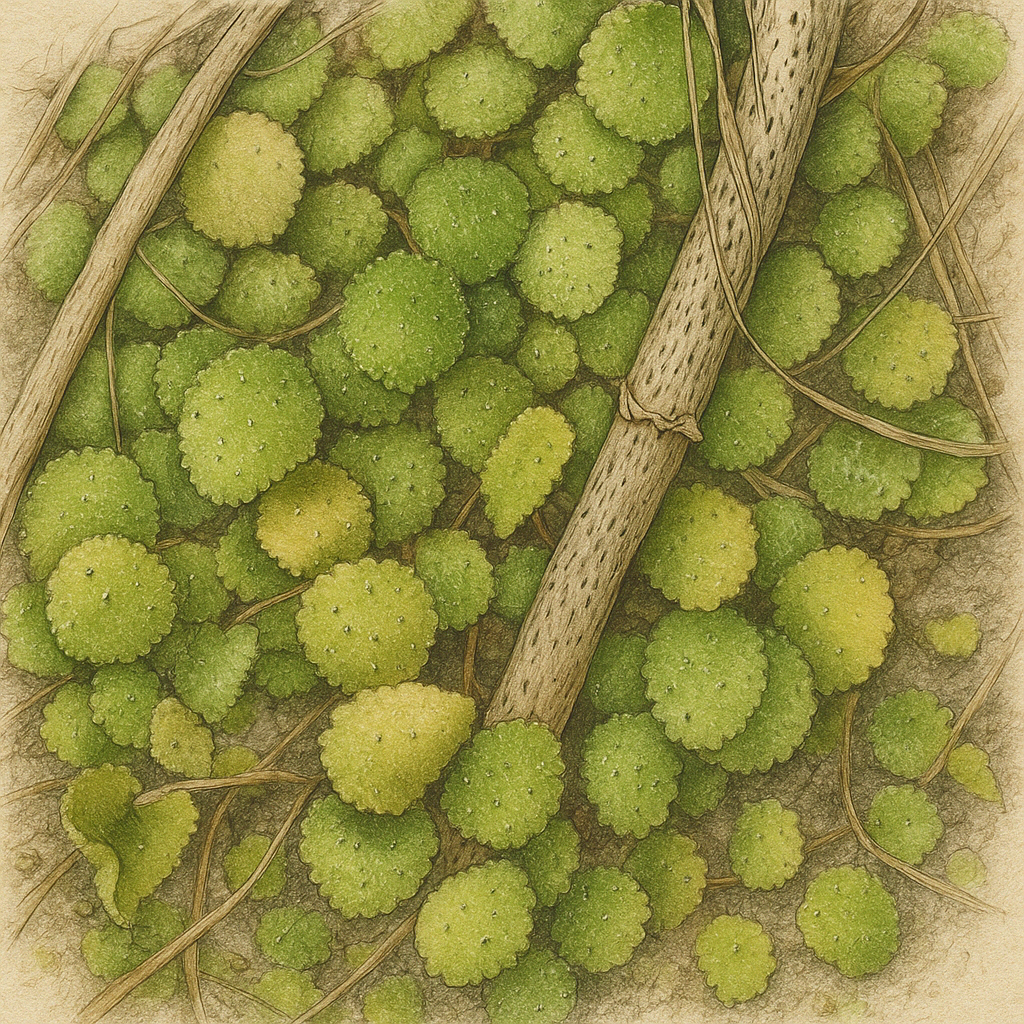
Round-leaved Button Daisy
Botanical name: Leptinella rotundata
Synonyms: Cotula dioica var. rotundata, Cotula rotundata
Common name(s): Round-leaved button daisy, button daisy
About
Leptinella rotundata is a distinctive creeping perennial herb endemic to the western coastline of the northern North Island. It forms loose, diffuse patches through slender surface-running rhizomes, with small, almost circular yellow-green leaves that immediately distinguish it from most other New Zealand Leptinella. Its unusual reproductive biology, high chromosome number and restricted northern distribution have led botanists to suggest that it may represent a relict member of section Elongata. It is naturally very localised and occupies a narrow ecological niche on exposed, salt- and wind-blasted coastal cliffs and boulder falls.
Natural habitat
Restricted to coastal cliff faces and associated boulder falls. It typically occupies the exposed margins of vegetated cliffs where strong winds, salt spray and physical disturbance suppress larger competing vegetation. Even at known sites the plant tends to occur sparsely and in scattered patches rather than forming extensive continuous colonies.
Growing environment
Naturally adapted to exposed maritime conditions with strong wind, salt spray and relatively open vegetation. It grows on cliff faces, ledges and amongst coastal boulders where drainage is excellent and competition from taller plants is limited. In cultivation it requires good drainage, adequate moisture without prolonged waterlogging, and protection from being overwhelmed by vigorous neighbouring plants.
Endemic distribution
Endemic to New Zealand and naturally restricted to the western coast of the northern North Island. Recorded from Scott’s Point and the Te Paki region south to the Waitākere Ranges. Its distribution is remarkably restricted, and suitable coastal cliff habitat within this area may still support undiscovered populations. The species was rediscovered in the Waitākere Ranges in April 2010, approximately 113 years after it was first collected there.
Height
A very low-growing groundcover, with most foliage remaining approximately 1–5 cm above the substrate. Flowering peduncles rise approximately 20–60 mm above the creeping rhizomes.
Width
Spreads indefinitely by creeping rhizomes to produce loose, irregular patches. Individual leaves are spaced approximately 10–30 mm apart along the main rhizomes, while short lateral shoots carry small clusters of leaves.
Flowering
August–January, although sporadic flowering may occur at virtually any time of year. Flower heads are small, approximately 5–7 mm diameter, hemispherical and predominantly yellow-green, with green involucral bracts often conspicuously edged with brown.
Fruiting
October–April, although fruiting material may occasionally be present outside this period. Fruits are small brown cypselae approximately 1.9 × 1.1 mm. Seed production in wild populations can be very limited because of the reproductive structure and separation of compatible plants.
Uses
Specialist native groundcover
Coastal rock and crevice gardens
Native plant collections
Conservation cultivation
Educational and botanical collections
Exposed coastal gardens where appropriate conditions can be provided
Preservation of threatened and geographically restricted New Zealand flora
Appearance
Growth habit: A creeping perennial forming loose, diffuse turf-like patches. Rhizomes run across the soil surface and are slender, flexible and dark green to purple-green. They are sparsely clothed in long silky hairs. Branching is uncommon and generally occurs at flowering nodes. Short shoots alternate along either side of the main rhizome and usually carry three or four leaves.
Leaves: Simple rather than finely divided like many other Leptinella, approximately 10–50 × 5–15 mm. The blade is suborbicular or almost circular, thin and membranous, usually yellow-green and sometimes developing purple-brown pigmentation toward the base. Both surfaces are sparsely covered with long silky hairs. The veins are inconspicuous and the margins are shallowly crenate, generally with approximately 9–15 broad teeth around the outer half to two-thirds of the blade.
Flowers: Flower heads arise directly from the rhizomes on stout, hairy peduncles approximately 20–60 mm long. Capitula are approximately 5–7 mm across and hemispherical. Each head is surrounded by 6–12 broadly elliptic green phyllaries arranged in one or two rows. These are hairy and have conspicuous papery margins that may be brown-edged or brown-tipped. Staminate florets are much more numerous, generally 40–90 per head, while pistillate florets are usually absent or fewer than five, although occasionally as many as 12 may occur.
Fruit: Cypselae reach approximately 1.9 × 1.1 mm and are only slightly compressed or almost circular in cross-section. Their initially pale, papery surface becomes smooth and brown as the fruit matures.
Ecology
A highly specialised component of northern New Zealand’s exposed coastal cliff vegetation. Its low creeping growth allows it to occupy places subjected to persistent wind and salt spray, while the harsh environment restricts taller plants that might otherwise outcompete it. Papery cypselae are dispersed principally by wind and potentially through attachment to animals or other moving material. The combination of its restricted geographic range, specialised habitat and reproductive limitations makes maintenance of existing populations particularly important.
Associated habitats
Occurs amongst sparse coastal cliff vegetation, cliff ledges and boulder banks exposed to maritime winds and salt spray. The nationally distinctive coastal shrub Veronica speciosa has been recorded at several known L. rotundata sites, demonstrating an interesting overlap between these two restricted western coastal species.
How to grow
Grow in a bright, open position in a very free-draining medium while maintaining adequate moisture during active growth. A gritty mix containing coarse sand, fine gravel and modest organic matter should approximate the aerated conditions of its natural habitat. Avoid rich, permanently wet soils and competition from vigorous groundcovers. Some exposure to airflow is beneficial, but cultivated plants should be monitored during prolonged drought until well established. Because the species can be comparatively short-lived in cultivation, colonies are best periodically divided and rejuvenated rather than being left undisturbed indefinitely.
Propagation
Very easily propagated by division of established plants. Sections of healthy rhizome carrying rooted shoots can be separated and replanted into a moist but freely draining medium. Regular division is particularly useful because cultivated plants may become short-lived or lose vigour with age. Seed propagation is theoretically possible, but natural seed set is often extremely limited. Consequently, most cultivated material is maintained vegetatively through division.
Cultural use
No specific traditional Māori use for Leptinella rotundata is well documented. Its contemporary significance lies primarily in conservation, botanical research and the preservation of New Zealand’s distinctive northern coastal flora. Collection of material from wild populations should only occur with appropriate permission and conservation consideration.
Garden value
An unusual collector’s native rather than a conventional landscaping groundcover. Its almost circular, softly crenated leaves are markedly different from the finely divided foliage associated with many other Leptinella, giving it considerable botanical interest. It is particularly suited to specialist native collections, coastal rockeries, troughs and conservation gardens where its open creeping habit can be maintained without competition. Regular propagation by division is advisable to maintain vigorous backup plants, particularly given the species’ restricted natural distribution and vulnerability in the wild.