
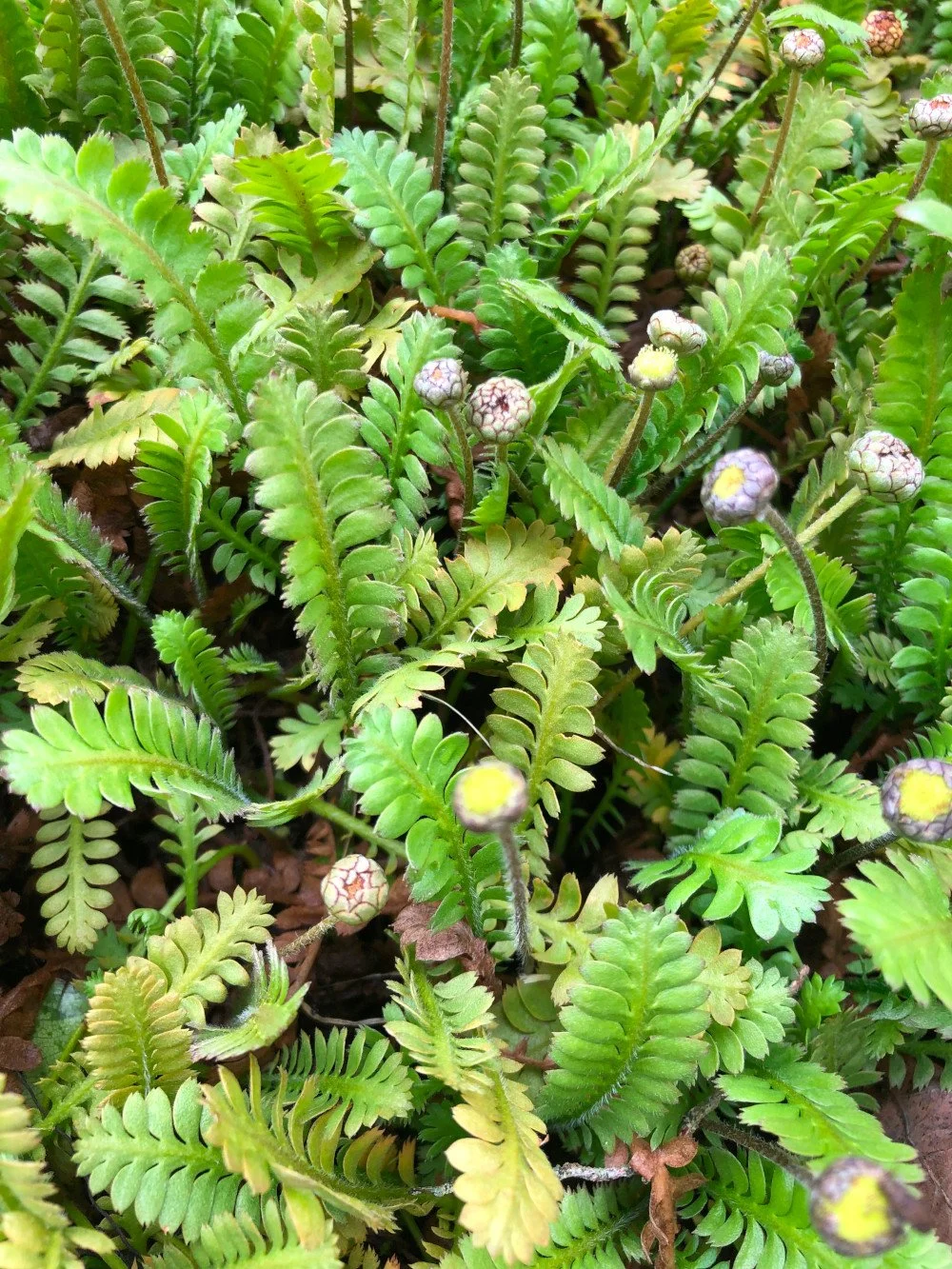
Shore Cotula
Botanical name: Leptinella dioica
Synonyms: Cotula dioica, Cotula dioica subsp. dioica, Cotula dioica var. crenatifolia, Cotula obscura, Cotula dioica var. obscura, Leptinella dioica subsp. dioica, Cotula dioica subsp. monoica, Leptinella dioica subsp. monoica
Common name(s): Shore cotula, Hairless leptinella
About:
Leptinella dioica is a highly variable endemic New Zealand creeping perennial that forms low, spreading mats in damp coastal and inland habitats.
It is particularly characteristic of saltmarsh margins in the northern part of its range, while farther south it extends well inland into permanently damp turf, seepages and other open wet ground.
Its fleshy leaves vary remarkably between populations, ranging from almost entire blades to distinctly lobed or pinnatifid forms. Plants spread readily through creeping surface rhizomes, making the species an effective natural groundcover.
Plants are usually dioecious, with male and female flower heads occurring on separate individuals, although monoecious plants also occur.
Natural habitat:
Coastal and inland damp habitats from near sea level to approximately 1,000 m elevation.
In northern parts of its distribution it occurs primarily around saltmarsh margins and other damp coastal ground.
Farther south it extends well inland into seepages, wet hollows, permanently open damp turf and other areas where soil moisture remains relatively high.
Growing environment:
Full Sun, Partial Shade, Wet Soil, Seasonally Wet Soil, Poor Drainage, Coastal Exposure, Saltmarsh Margins, Frost & Wind tolerant.
It performs particularly well in open sites where moisture remains reliable and taller vegetation does not overwhelm its low-growing foliage.
Its FAC wetland indicator rating reflects its ability to occur naturally in both wetland and non-wetland environments.
Endemic distribution:
Endemic to New Zealand.
Occurs naturally in the North Island, South Island and Stewart Island/Rakiura.
Despite its broad overall distribution, it is not known naturally from Northland or Fiordland.
Height:
Usually approximately 2–8 cm tall, with flowering peduncles reaching approximately 1–8 cm.
Width:
Spreads indefinitely through creeping rhizomes and can form mats many tens of centimetres across or considerably wider where conditions are suitable.
Flowering:
August–January.
Female heads are approximately 2–10 mm across, while male heads are approximately 3–8 mm.
The individual florets are small and yellow-green.
Fruiting:
October–June.
Female heads may expand to approximately 12 mm across as the fruits mature.
Cypselae reach approximately 1.9 × 1 mm and mature from pale and papery to smooth brown.
Uses:
• Native groundcover
• Damp lawns
• Lawn alternatives
• Wetland margins
• Rain gardens
• Coastal gardens
• Saltmarsh restoration
• Riparian planting
• Damp rock gardens
• Between paving and stepping stones
• Native turf restoration
• Revegetation of open damp ground
Appearance:
Growth habit:
A low, creeping, somewhat fleshy perennial herb forming spreading mats.
Plants spread through flexible rhizomes that run at or immediately beneath the soil surface.
Short shoots occur alternately along the rhizomes and carry clusters of up to five leaves.
These shoots can occasionally transform into new creeping rhizomes, allowing colonies to expand across suitable ground.
Plants are usually dioecious but may occasionally be monoecious.
Rhizomes/Stems:
Exposed rhizomes are green, dark green or purple-green, flexible and sparsely to densely hairy.
When buried they become pale, wiry and hairless.
Branching is relatively uncommon and usually occurs singly around flowering nodes.
Leaves are arranged in two rows along the rhizome and are generally spaced approximately 3–30 mm apart.
Roots are slender and relatively weak, reaching approximately 0.8 mm in diameter.
Flowering peduncles are approximately 10–60 mm long, occasionally reaching 80 mm. They are sparsely to densely hairy and usually lack bracts or carry a single simple bract.
Leaves:
Leaves are extremely variable, ranging from approximately 7–130 mm long and 3–20 mm wide.
The blade itself is usually approximately 5–70 mm long, occasionally reaching 90 mm.
Shape varies from lanceolate and narrowly oblong through elliptic and oblanceolate to almost circular.
Leaves are fleshy and may be light green, green, glaucous or wine-red.
They are generally hairless but dotted with small sunken glands.
Some leaves are almost completely undivided, while others are incised, lobed or pinnatifid.
Where divided, there are generally 4–12 pairs of lobes, pinnae or teeth, occasionally as many as 30.
These may be widely separated, closely spaced or overlapping and range from oblong to almost circular.
The lower divisions are generally cut more deeply toward the rachis than those toward the leaf tip.
Small triangular to rounded teeth may occur along the outer margins.
Dark pigmentation is generally absent or confined to the tips of the divisions, although some plants develop stronger pink or brown pigmentation.
Flowers:
Flowers are grouped into small yellow-green button-like capitula.
Female heads are approximately 2–10 mm across and have a convex surface with an urn-shaped involucre.
Approximately 10–30 broadly elliptic involucral bracts occur in three or more rows. They are green and hairless to sparsely hairy, with broad papery margins that are often tipped brown.
Female heads contain approximately 10–80 or more curved yellow-green florets, each around 2–5 mm long.
After flowering, the inner involucral bracts elongate and surround the developing fruiting head.
Male capitula are approximately 3–8 mm across, hemispherical and contain more numerous florets. Their 5–10 involucral bracts do not enlarge after flowering.
Bisexual flower heads occasionally occur but are predominantly male in structure.
Fruit:
The fruit is a small dry cypsela reaching approximately 1.9 × 1 mm.
It is slightly compressed and initially has a pale, unwrinkled, papery surface.
At maturity the surface becomes smooth and brown.
Seeds:
Each cypsela contains a single seed.
The lightweight papery fruits are dispersed principally by wind and may also be transported through incidental attachment to animals or other moving material.
Because many populations are dioecious, successful seed production depends on male and female plants occurring sufficiently close together for pollination.
Ecology:
Leptinella dioica is an adaptable component of New Zealand’s open damp-ground vegetation.
Its creeping rhizomes allow it to rapidly occupy small gaps in turf and other low vegetation, while its low profile enables it to tolerate wind, grazing and periodic disturbance.
The fleshy foliage and ability to root repeatedly along spreading rhizomes are advantageous in habitats where soil moisture fluctuates.
Its ecological preferences change geographically. Northern populations are particularly associated with coastal saltmarsh margins, whereas southern populations extend much farther inland into damp turf and seepages.
It can resemble Leptinella squalida subsp. squalida, but L. dioica generally has less deeply divided, more or less hairless leaves and usually lacks the conspicuous dark pigmentation of the basal pinnae characteristic of L. squalida.
Associated habitats:
Saltmarsh margins, coastal turf, estuarine margins, damp pasture, seepages, wet hollows, permanently damp turf, wetland margins, open riparian ground and moist inland grassland.
Associated plants vary considerably across its broad range and may include native sedges, rushes, low grasses and other creeping wetland and turf herbs.
How to grow:
Shore cotula is easy to cultivate and makes an excellent low native groundcover.
Grow in full sun to partial shade in soil that remains consistently moist or becomes seasonally wet.
It is particularly useful in areas that are too damp or poorly drained for conventional lawn grasses.
Plants spread naturally through creeping rhizomes and can gradually knit together into a dense turf.
It tolerates regular trimming and can be incorporated into informal native lawns, between paving stones or around the margins of ponds and rain gardens.
Its considerable natural variation in leaf size, shape, colour and growth habit also provides excellent potential for horticultural selection.
Propagation:
Very easily propagated from rooted pieces.
Small sections of established mat containing healthy rhizomes and roots can be separated and replanted directly into moist soil.
Keep newly divided plants consistently moist until established.
Propagation from seed is also possible when viable seed is available, although vegetative division is substantially quicker and reliably preserves the characteristics of selected forms.
Cultural use:
No specific traditional Māori material use is well documented for Leptinella dioica.
Its significance lies particularly in its widespread role within New Zealand’s coastal and damp-ground flora and the considerable diversity of forms that have evolved across its geographic range.
Garden value:
An excellent native groundcover and one of the more versatile Leptinella species for cultivation.
Its low creeping habit, attractive finely textured foliage and tolerance of damp or somewhat poorly drained soils make it particularly useful as a lawn alternative, between paving, around ponds and within rain gardens.
Different wild populations display considerable variation in leaf shape, size, division and colour, providing significant potential for ornamental selections and cultivars.
Once established, its ability to spread from rooted rhizomes makes it an effective living carpet for open, moist sites.