
Pygmy Pine
Botanical name: Lepidothamnus laxifolius
Synonyms: Dacrydium laxifolium
Common name(s): Pygmy pine, Mountain rimu
About:
Lepidothamnus laxifolius is a remarkable endemic New Zealand conifer and one of the smallest conifers in the world. Rather than developing into a tree, it forms a low, sprawling or scrambling shrub, sometimes remaining only a few centimetres high even when reproductively mature.
It is primarily a plant of cool, wet montane and subalpine environments, where its long flexible branches spread through bogs, low scrub and open alpine vegetation. Plants can be extremely inconspicuous, with slender stems weaving amongst mosses, other shrubs and ground vegetation.
Like the closely related yellow silver pine (Lepidothamnus intermedius), pygmy pine changes its foliage as it matures. Long, narrow juvenile leaves gradually become much smaller, overlapping, scale-like adult leaves, although several leaf forms are often present on the same branch.
Natural habitat:
Montane and subalpine shrubland, open scrub, bogs, wetland margins and other cool, persistently moist habitats, occasionally extending into the lower alpine zone.
It is especially characteristic of wet, open upland vegetation and high-altitude bog communities.
On Stewart Island/Rakiura, where climatic conditions are cooler at lower elevations, it can descend into lowland habitats.
Growing environment:
Full Sun, Partial Shade, Wet Soil, Moist Soil, Acidic Soil, Peaty Soil, Frost, Wind, Cold & Exposed Conditions tolerant.
Pygmy pine is strongly adapted to cool, humid environments with reliable moisture.
It performs particularly well in peaty or humus-rich soils and can tolerate the waterlogged or poorly drained conditions characteristic of many upland bogs.
It is classified as a FAC wetland indicator species, meaning it occurs naturally in both wetland and non-wetland habitats.
Endemic distribution:
Endemic to New Zealand.
In the North Island it has a scattered distribution from the Coromandel and Raukūmara ranges through Te Urewera, the Central Volcanic Plateau and Kāingaroa Plain south to the Ruahine Range.
In the South Island it occurs mainly west of the Main Divide, extending from the Kahurangi Range south through the western mountain systems to Fiordland.
Also present on Stewart Island/Rakiura, where it may occur at considerably lower elevations than on the main islands.
Height:
Usually approximately 5–50 cm, occasionally approaching 1 m where supported by surrounding vegetation.
Reproductively mature plants may be remarkably small, with fruiting individuals recorded at only around 8 cm high.
Width:
Individual branches may extend 1 m or more, allowing mature plants to form broad, low sprawling patches.
Flowering:
Not applicable in the flowering-plant sense.
As a conifer, Lepidothamnus laxifolius produces pollen cones rather than flowers.
Male pollen cones are produced mainly from October–December.
Fruiting:
February–April.
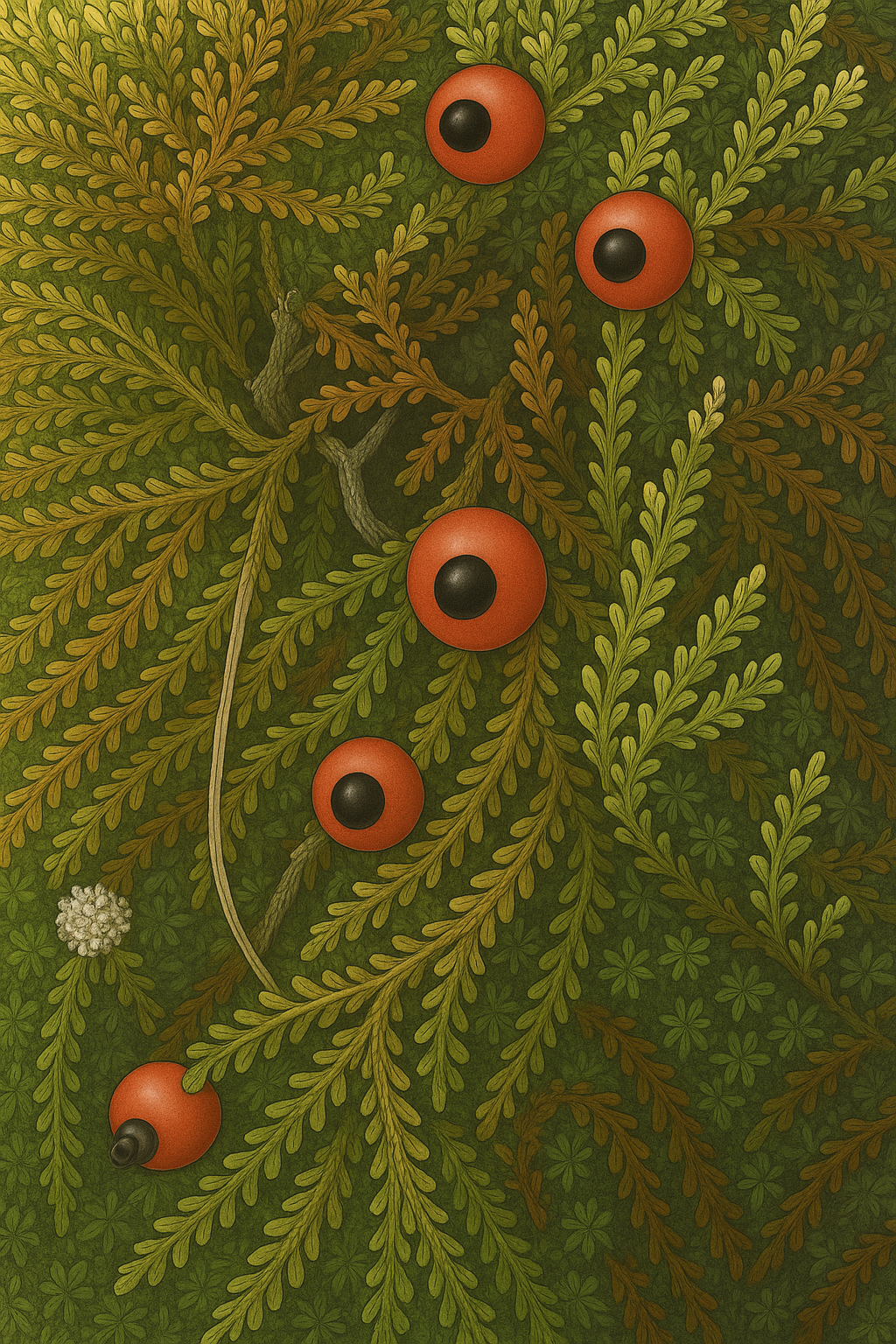
Mature reproductive structures consist of a solitary dark seed positioned above a conspicuous swollen red to crimson fleshy receptacle.
The fleshy tissues attract animals, particularly birds, which disperse the seeds.
Uses:
• Alpine and subalpine gardens
• Native rock gardens
• Bog gardens
• Cool-climate gardens
• Wetland restoration
• Montane and subalpine restoration
• Specialist native conifer collections
• Botanical collections
• Wildlife planting
• Naturalistic upland landscapes
Appearance:
Growth habit:
A low, sprawling, scrambling evergreen conifer.
Branches are flexible and generally horizontal or ascending through surrounding vegetation, sometimes producing broad mats only a few centimetres above ground level.
Main branches are approximately 2–5 mm in diameter near the base, occasionally reaching 10 mm, and may extend for 1 m or more.
Numerous very slender, flexible branchlets arise from the main stems.
Plants may be dioecious, with male and female reproductive structures on separate individuals, or monoecious, with both occurring on the same plant.
Trunk/Bark:
A conventional upright trunk is not normally developed.
Instead, the plant produces low, woody, spreading branches that creep or scramble amongst surrounding vegetation.
Older basal stems become woody but remain relatively slender, reflecting the species’ naturally prostrate habit.
Leaves:
Foliage is polymorphic and changes progressively as the plant matures.
Juvenile leaves are approximately 5–12 mm long, narrow-linear to awl-shaped, flat and pointed. They spread away from the branchlets and are often slightly curved.
Intermediate leaves gradually decrease to approximately 2–3 mm long. Plants can already produce pollen cones and seeds while carrying this intermediate foliage.
Fully adult leaves are only approximately 1–2 mm long. They are oblong-ovate, blunt, distinctly keeled and tightly appressed against the branchlets in overlapping rows.
It is common for a single branch to carry a mixture of juvenile, intermediate and adult foliage.
Flowers:
Absent.
Male pollen cones are solitary, terminal and sessile, reaching approximately 5–8 mm long.
Female seed cones are also terminal and highly reduced, with a single erect ovule associated with one fertile scale and several sterile bracts.
Male and female cones may occur on separate plants or on the same individual.
Fruit:
True fruit is not produced because pygmy pine is a conifer.
Following fertilisation, the bracts and surrounding tissues beneath the developing seed enlarge to form a conspicuous succulent receptacle.
This receptacle becomes bright red to crimson at maturity, although it may occasionally remain relatively dry.
A thin pinkish portion of the epimatium forms a small collar around the base of the seed.
Seeds:
Seeds are approximately 3–5 mm long, black to very dark brown, nut-like and oblong-cylindrical.
The tip is blunt with a stout, curved apiculus.
Most of the seed remains prominently exposed above the epimatium and contrasts strongly with the bright red or crimson fleshy receptacle beneath it.
Seeds are dispersed principally by frugivory, with birds and other fruit-eating animals consuming the fleshy tissues and carrying the seeds away from the parent plant.
Ecology:
Lepidothamnus laxifolius is a highly specialised component of New Zealand’s cool montane and subalpine vegetation.
Its extremely low growth habit allows it to survive strong winds, frost, snow and other harsh conditions encountered above or close to the treeline.
Long flexible branches spread amongst mosses, low shrubs and bog vegetation, while the small adult leaves reduce the amount of exposed foliage in cold and windy environments.
Its ability to grow in saturated, acidic and nutrient-poor ground enables it to occupy bogs and wet upland habitats where larger woody plants may struggle.
The fleshy red reproductive structures provide food for fruit-eating animals that, in turn, disperse the seeds.
Pygmy pine occasionally hybridises with Lepidothamnus intermedius where the two species grow together. These hybrids can be difficult to identify because they may display characteristics intermediate between both parents.
Associated habitats:
Montane shrubland, subalpine scrub, alpine bogs, peatlands, wet tussockland, open upland scrub, wetland margins and exposed mountain vegetation.
Common associates may include Halocarpus bidwillii, Podocarpus nivalis, Lepidothamnus intermedius, Dracophyllum species, native heaths, sedges, rushes, tussocks, mosses and other bog and subalpine plants.
How to grow:
Pygmy pine is best treated as a specialist plant for cool, moist gardens.
Grow in full sun to partial shade in acidic, humus-rich or peaty soil that remains reliably moist throughout the year.
Unlike many garden conifers, it is naturally adapted to wet ground and is an excellent candidate for cool bog gardens, damp rockeries and the margins of upland-style wetlands.
Avoid hot, dry sites and soils that dry completely during summer.
Its naturally prostrate habit should be allowed to develop without heavy pruning. Plants can be positioned amongst rocks, low native shrubs and tussocks where the slender branches can spread naturally through surrounding vegetation.
Lowland cultivation is likely to be most successful in cool southern or high-rainfall districts where summer temperatures and humidity resemble its natural habitat.
Propagation:
Propagation is principally from fresh seed.
Collect mature dark seeds when the supporting receptacle has become fully red or crimson.
Remove the fleshy material and sow into an acidic, moisture-retentive but aerated propagation medium.
Seed should be kept cool and consistently moist. Germination may be slow or irregular, so containers should be retained for an extended period.
Cuttings from suitable young growth may also be attempted, although seed is the most natural method for maintaining genetically diverse plants.
Cultural use:
No major traditional Māori material use specific to Lepidothamnus laxifolius is well documented.
Its significance lies particularly in its place amongst New Zealand’s distinctive endemic conifers and its extraordinary adaptation to cold, wet mountain environments.
The common name mountain rimu reflects the resemblance of its juvenile foliage to that of rimu, although the two belong to separate genera and pygmy pine remains a low shrub rather than developing into a forest tree.
Garden value:
A fascinating native conifer for specialist alpine, bog and rock gardens.
Its minute stature, trailing branches, changing foliage and bright crimson reproductive structures make it very different from conventional conifers.
Pygmy pine is especially valuable in naturalistic plantings representing New Zealand’s montane and subalpine landscapes, where it combines well with snow tōtara, bog pine, native tussocks, sedges and small alpine shrubs.
Its status as one of the world’s smallest conifers also makes it an exceptionally interesting addition to botanical and native plant collections.