


Kānuka
Botanical name: Kunzea robusta
Synonyms: None
Common name(s): Kānuka, rawirinui
About:
Kunzea robusta is the most widespread and one of the largest members of New Zealand’s kānuka complex. It is an endemic tree occurring through much of the North and South Islands, where it is an important component of regenerating shrubland, secondary forest and forest margins.
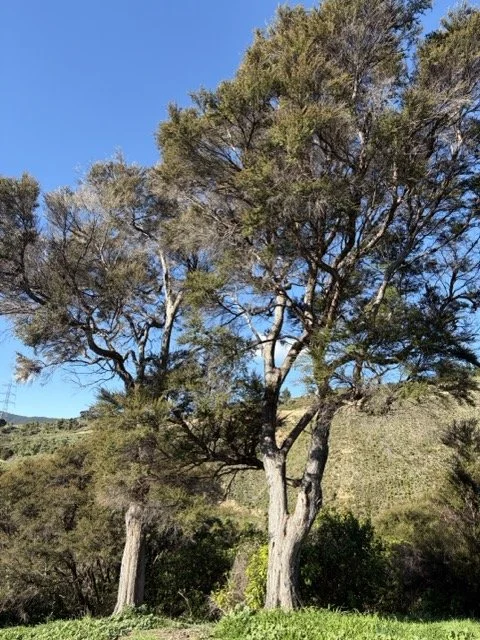
Mature trees can reach 30 m tall and develop broad spreading crowns, while younger plants are often more upright. The bark is particularly distinctive, peeling upward in long, tough, leathery strips that may remain partly attached to the trunk.
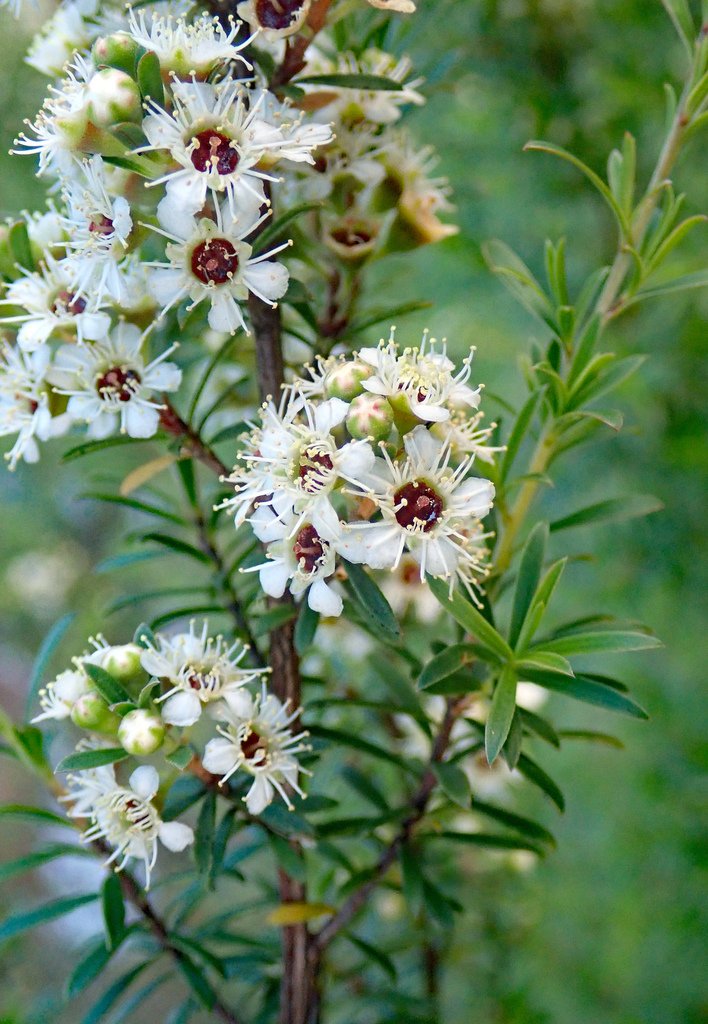
The foliage is soft to touch, with narrow green leaves and young branchlets usually densely covered in fine silky hairs. Small white flowers are produced in great numbers, often with pink to crimson centres, followed by small hairy capsules.
Natural habitat:
Coastal to montane shrubland, regenerating forest, forest margins and secondary forest.
It also occurs in ultramafic shrubland and occasionally reaches subalpine vegetation, generally to about 900 m elevation.
Kunzea robusta is particularly characteristic of disturbed or regenerating landscapes and often colonises abandoned farmland, slips, open hillsides and recently cleared areas.
Growing environment:
Full Sun, Partial Shade, Wind, Frost, Coastal Exposure, Poor Soil & Free-draining Soil tolerant.
It is highly adaptable and capable of growing on relatively infertile, dry or disturbed soils. Once established it is notably hardy and can withstand exposed conditions.
Young plants generally establish most rapidly in open situations with good light and reduced competition from grass and weeds.
Endemic distribution:
Endemic to New Zealand.
Widespread throughout the North Island and South Island.
It is considerably more broadly distributed than true Kunzea ericoides, which under current taxonomy is restricted to the northern South Island.
Height:
8–30 m.
Width:
Approximately 4–12 m at maturity.
Open-grown specimens may develop very broad, spreading crowns, while forest trees are usually taller and narrower.
Flowering:
August–June.
Flowering can occur across a remarkably long period, although the heaviest displays are generally through spring and summer.
Flowers are produced in compact clusters that may elongate later in the flowering season. Individual flowers are approximately 4.3–12 mm across, usually white but very rarely pink.
The green or pink floral centre commonly darkens to crimson after fertilisation.
Fruiting:
July–May.
The fruit is a small dry capsule approximately 2.2–4.6 mm long and 3.2–5.3 mm wide.
Capsules are usually hairy and mature to greyish-white, brown or grey-brown before splitting to release the tiny seeds.
Uses:
• Ecological restoration and revegetation
• Native shelter establishment
• Early-successional forest restoration
• Erosion control
• Windbreaks and shelter belts
• Difficult and low-fertility sites
• Wildlife and invertebrate habitat
• Nectar and pollen source for insects
• Firewood
• Hardwood for traditional and practical uses
• Large native gardens and lifestyle blocks
• Nurse tree for later-successional native species
Appearance:
Growth habit:
A robust shrub or tree, usually 8–30 m tall, with one to several trunks and a broad spreading canopy when mature.
Branches initially grow upright but soon arch outward and spread.
Young branchlets are slender and generally densely clothed in fine silky, forward-pointing hairs. These hairs may gradually be shed as the branchlets age.
Trunk/Bark:
The trunk can reach approximately 1 m in diameter.
Bark is stringy or coarsely tessellated and remains firmly attached higher on the trunk while separating near the base.
One of the most characteristic features is the formation of long, leathery strips that peel upward and may hang partly detached from the trunk. Individual strips can reach several metres in length.
Leaves:
Leaves are soft, narrow and variable in size, especially between juvenile, coastal and inland plants.
They range approximately 3–28 mm long and 0.7–3 mm wide and may be linear-lanceolate, lanceolate, broadly lanceolate or oblanceolate.
The upper surface is light to dark green and the underside slightly paler.
Mature leaf surfaces are largely hairless, although fine hairs remain along the margins and underside of the midrib. The marginal hairs usually do not meet at the leaf tip.
Flowers:
Flowers occur in compact, corymb-like clusters of up to around 30 flowers, with late-season clusters sometimes becoming more elongated.
Each flower usually has five white petals, occasionally six, surrounding approximately 15–58 white stamens.
The floral centre may be green or pink at first and commonly develops a stronger crimson colour after pollination.
Flowers are rich in pollen and nectar and can attract large numbers of insects.
Fruit:
The fruit is a dry, broadly cone-shaped to top-shaped capsule.
Capsules are generally hairy, approximately 3–5 mm wide, and usually contain five compartments, occasionally six.
As the fruit matures, the valves open and release numerous tiny orange-brown to dark brown seeds.
Seeds:
Seeds are approximately 0.9–1.1 mm long and have a coarse, reticulate surface.
Their very small size allows them to be dispersed readily by wind and enables kānuka to rapidly colonise open ground when suitable conditions occur.
Ecology:
Kunzea robusta is one of New Zealand’s most important pioneer and early-successional trees.
It readily establishes on disturbed ground, including slips, abandoned pasture, forest clearings and areas affected by fire or other disturbance. Dense stands can subsequently create a sheltered environment beneath their canopy, allowing shade-tolerant broadleaf trees, podocarps, ferns and shrubs to establish.
In this way, kānuka often acts as a nurse tree during the transition from open land back toward mature native forest.
Its prolonged flowering season provides an important nectar and pollen resource for native insects and other pollinators.
The rough bark, branching structure and mature canopy also provide habitat for epiphytes, lichens, mosses, invertebrates and birds.
As a member of the Myrtaceae family, Kunzea robusta is susceptible to myrtle rust, although the long-term impact of the disease on wild kānuka populations remains uncertain.
Associated habitats:
Kānuka woodland, regenerating scrub, secondary forest, forest margins, river terraces, coastal shrubland, rocky slopes, disturbed hillsides, ultramafic shrubland and lower montane forest.
Common associates can include mānuka, māhoe, wineberry, kōhūhū, Coprosma species, broadleaf, five-finger, cabbage tree, tree ferns and regenerating podocarps.
In older kānuka stands, seedlings of tōtara, mataī, kahikatea, rimu and other forest species may establish beneath the increasingly sheltered canopy.
How to grow:
Kunzea robusta is generally straightforward to establish and is particularly useful where a fast-forming native canopy is required.
Plant in full sun or light shade in almost any reasonably drained soil. It tolerates poor fertility, exposure and seasonal dryness once established.
Keep young plants free from heavy grass competition during establishment. Mulching can help conserve soil moisture and suppress weeds.
Water during prolonged dry periods in the first year or two, after which established plants normally require little supplementary care.
Minimal pruning is required, although formative pruning while young can encourage a single trunk if a specimen-tree form is desired.
Propagation:
Very easily propagated from fresh seed.
Collect mature capsules as they begin to dry and open. The extremely fine seed should be surface-sown over a fine, free-draining propagation mix and only lightly covered, if at all.
Maintain even moisture and good light without allowing the growing medium to become waterlogged.
Fresh seed generally gives the best germination.
Semi-hardwood cuttings can be attempted but are considerably more difficult and unreliable than propagation from seed.
Cultural use:
Kānuka has long been an important tree within Māori landscapes, although historical references usually do not distinguish between the individual Kunzea species recognised by modern taxonomy.
Kānuka wood is hard and strong and has traditionally been used for implements, construction, fuel and other practical purposes.
The bark, foliage and wood of kānuka have also been incorporated into various traditional practices.
Because Kunzea robusta was only formally described as a separate species in 2014, older cultural accounts referring simply to kānuka cannot always be confidently assigned specifically to this species.
Garden value:
An excellent large native tree for revegetation, lifestyle blocks, shelter planting and naturalistic gardens.
Its soft narrow foliage, attractive peeling bark, broad mature canopy and heavy displays of white flowers give it strong ornamental value while also providing major ecological benefits.
It is especially valuable where a tough, relatively fast-establishing native canopy is needed to begin the process of forest restoration.
Because Kunzea robusta can become a substantial tree, adequate space should be allowed for its mature height and spread.