


Rewarewa
Botanical name: Knightia excelsa
Synonyms: None
Common name(s): Rewarewa, New Zealand honeysuckle
About:
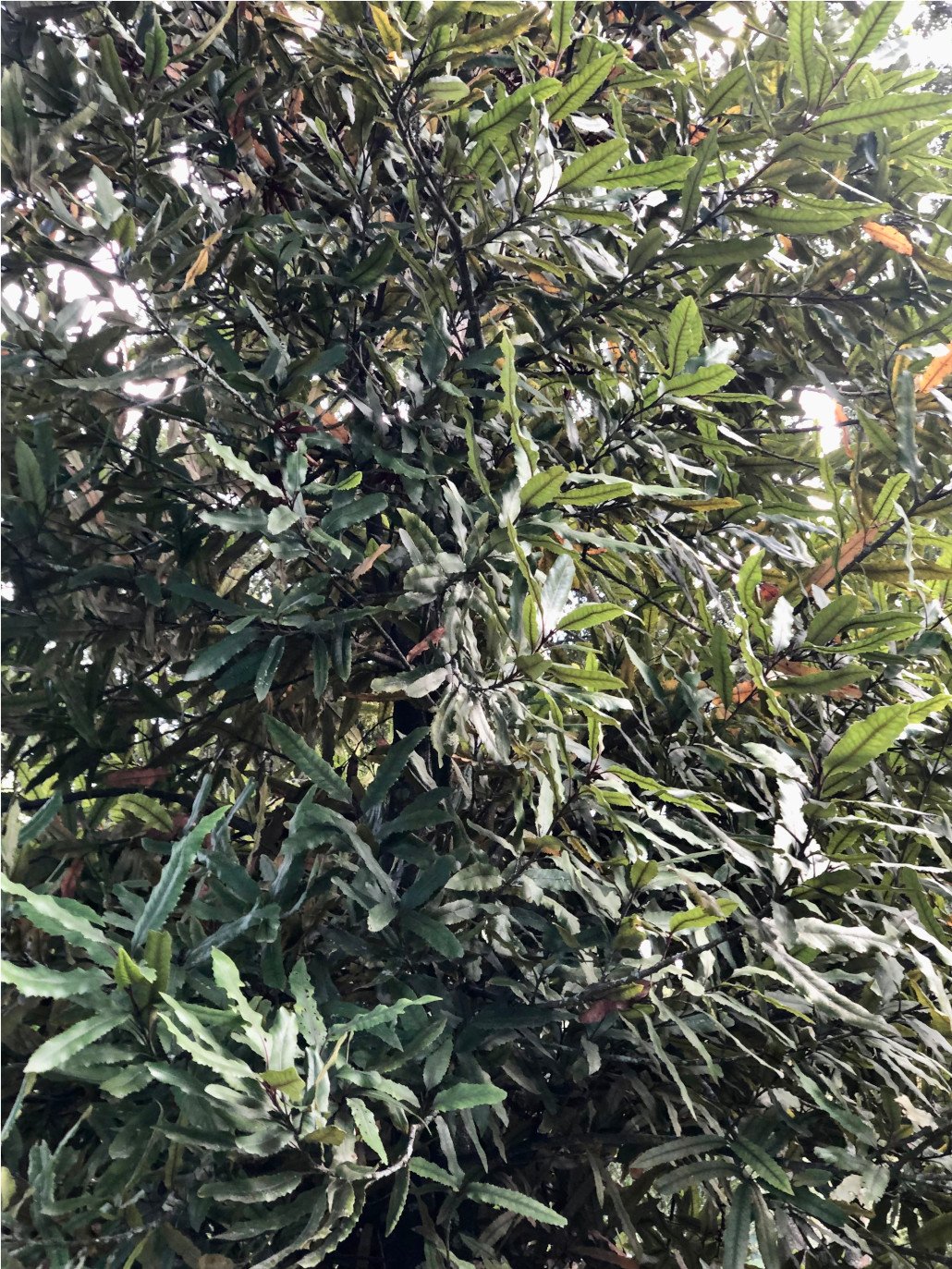
Rewarewa is a distinctive tall evergreen forest tree endemic to New Zealand and the sole New Zealand species of the genus Knightia. A member of the ancient Proteaceae family, it develops a characteristically narrow, columnar crown and can eventually reach around 30 m tall.
It is readily recognised by its tough, coarsely toothed dark green leaves, rusty reddish-brown new growth and spectacular crimson flower spikes. The unusual flowers form dense, bottlebrush-like racemes and produce abundant nectar, making flowering trees important seasonal food sources for native wildlife.
Rewarewa is a relatively fast-growing pioneer and secondary-forest tree when young. It is widespread through the North Island but reaches only the Marlborough Sounds in the South Island.
Natural habitat:
Coastal, lowland and lower montane forest, forest margins, shrubland and regenerating secondary forest.
Rewarewa is particularly characteristic of regenerating forest and disturbed forest environments, although it also occurs within mature forest.
It generally favours warmer sites and is less frequent in areas experiencing severe frost. Young plants are particularly frost-sensitive.
Growing environment:
Full Sun, Partial Shade, Coastal, Wind & Free-draining Soil tolerant.
Young trees establish well in sheltered positions with adequate moisture and can grow rapidly once established. Although mature trees are hardy, young rewarewa should be protected from severe frost.
It performs best in reasonably fertile, well-drained soils and is suited to warm temperate forest and restoration plantings.
Endemic distribution:
Endemic to New Zealand.
Widespread and common throughout much of the North Island.
In the South Island its natural distribution is restricted to the Marlborough Sounds, representing the southern limit of the species.
Height:
Up to 30 m.
Width:
Approximately 4–8 m when mature, although crown dimensions vary considerably with growing conditions.
The crown is characteristically narrow, upright and columnar rather than broadly spreading.
Flowering:
September–December, predominantly October–December.
Dense flower spikes may reach approximately 10 cm long, occasionally considerably longer.
The flowers are dark crimson to reddish-brown and surrounded externally by conspicuous rusty reddish-brown hairs. They produce abundant nectar and are highly attractive to wildlife.
Fruiting:
October–January, although the woody fruits take approximately a year to mature.
Developing fruit from the previous flowering season may therefore occur on a tree at the same time as new flowers.
Mature follicles split open to release winged seeds that are dispersed by wind.
Uses:
• Native forest restoration and revegetation
• Large specimen tree
• Wildlife and biodiversity planting
• Nectar source for native birds and other fauna
• Valuable bee forage
• Rewarewa honey production
• Māori traditional uses
• Traditional timber and construction uses
• Furniture, cabinetry and decorative interior timber
• Shelter and tall structural planting
• Regenerating forest establishment
• Educational and ecological planting
Appearance:
Growth habit:
A tall evergreen tree developing a strongly upright, fastigiate or columnar form.
Mature trees may reach 30 m tall with trunks approaching 1 m diameter. The bark is dark brown, while young branches are angular and densely covered in distinctive velvety rust-coloured hairs.
Branches tend to grow erect rather than spreading widely, contributing to the species’ characteristic narrow silhouette.
Leaves:
Adult leaves are tough, leathery and dark green, usually 100–150 mm long and 25–40 mm wide, occasionally reaching about 200 mm.
They range from broadly lanceolate to narrowly oblong or obovate and have conspicuous coarse, blunt serrations.
Fresh foliage is covered with velvety reddish-brown hairs which are gradually shed as the leaves mature.
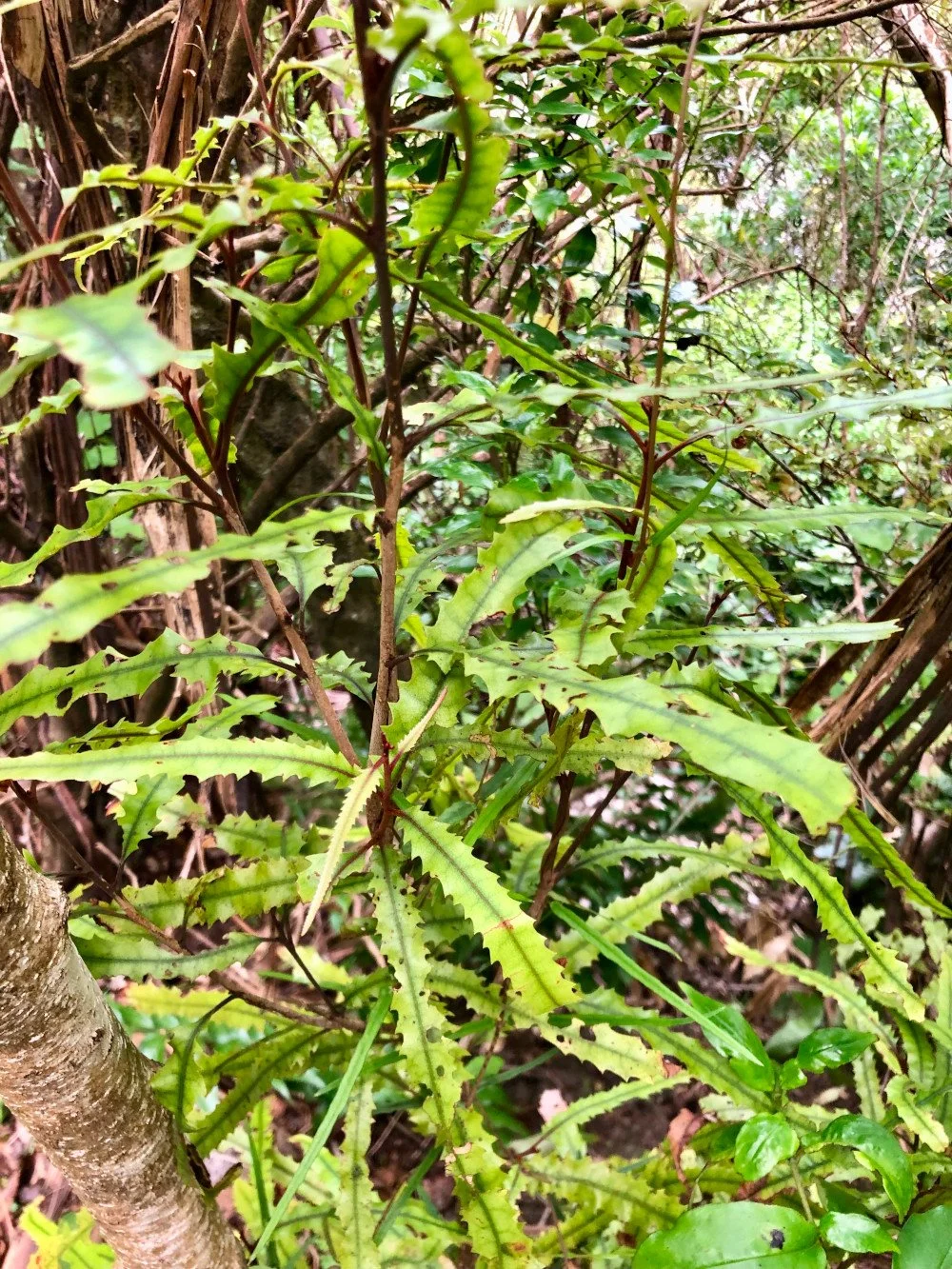
Juvenile foliage is markedly different. Juvenile leaves are yellow-green, extremely narrow and commonly 150–300 mm long, occasionally approaching 400 mm. Their margins are sharply serrated and some leaves may divide or fork two, three or even four times.
Flowers:
The flowers are arranged in stout, densely packed racemes generally up to about 100 mm long, occasionally reaching approximately 180 mm.
Flower buds, stalks and the outside of the perianth are densely covered in rusty reddish-brown hairs.
Each bisexual flower has four perianth segments. These initially form a narrow tube before separating and curling backwards into distinctive spirals.
The inner surfaces are dark crimson. Four short crimson filaments carry long, narrow, rich golden-yellow anthers, creating a striking contrast against the darker flowers.
A long crimson style projects prominently from each flower and persists as the fruit develops.
Fruit:
The fruits are hard, woody, two-valved follicles approximately 30–40 mm long.
Young fruits are covered with the same characteristic reddish-brown pubescence seen on new foliage and flowers.
Each follicle tapers toward the persistent style and eventually splits into two valves.
The seeds are approximately 10 mm long and terminate in a membranous wing around 15 mm long, enabling dispersal by wind.
Ecology:
Rewarewa is an important component of warm-temperate New Zealand forest and frequently participates in secondary forest succession.
Its relatively rapid juvenile growth allows it to establish effectively in regenerating vegetation, forest gaps and disturbed sites.
The nectar-rich flowers are particularly important ecologically. They are visited by native nectar-feeding birds and insects, while geckos and bats have also been recorded feeding around flowering rewarewa.
Its flowers are valuable to honey bees, producing the characteristically dark amber rewarewa honey.
The winged seeds are adapted for wind dispersal, allowing new plants to colonise forest margins, clearings and regenerating vegetation.
Associated habitats:
Coastal forest, lowland broadleaf forest, podocarp–broadleaf forest, lower montane forest, secondary forest, regenerating scrub, forest margins, gullies, slopes and disturbed forest clearings.
Rewarewa commonly grows alongside a diverse range of native trees and shrubs including kānuka, mānuka, māhoe, kāramu, wineberry, five-finger, tree ferns and podocarps.
How to grow:
Rewarewa is generally straightforward to establish provided young plants receive protection from severe frost.
Plant in full sun to partial shade in reasonably fertile, well-drained soil. Regular moisture during establishment encourages rapid growth, although established trees become considerably more resilient.
Young plants can grow quickly and are particularly useful where a tall native forest canopy is required over time.
Choose the planting position carefully. Rewarewa ultimately becomes a substantial forest tree and should be given sufficient space away from buildings, overhead services and other structures.
For ecological restoration, it works particularly well as part of mixed secondary-forest planting rather than as an isolated species.
Propagation:
Best propagated from fresh seed.
Collect mature woody follicles as they begin to open and release their winged seeds. Seed should be sown fresh into a free-draining propagation medium.
Germination is generally straightforward and young seedlings can grow rapidly under favourable conditions.
Protect seedlings and recently planted juveniles from hard frost.
Propagation from cuttings is considerably more difficult and is generally not recommended when viable seed is available.
Cultural use:
Rewarewa has a long history of Māori use.
Its timber was used for practical construction purposes, including posts and palisade structures. The wood also had applications associated with waka construction, including techniques involving controlled burning during the hollowing of large timber.
The abundant sweet nectar of the flowers was also utilised as a food.
Today rewarewa remains culturally and economically significant through its association with native forests, restoration planting, timber and the production of distinctive rewarewa honey.
Garden value:
An impressive native tree best suited to large gardens, lifestyle blocks, reserves, revegetation projects and restoration plantings.
Its narrow upright habit can be particularly useful where a tall tree is wanted without the exceptionally broad crown developed by many other large native trees.
The combination of strongly textured dark foliage, rusty new growth and spectacular reddish-crimson flowers gives rewarewa considerable ornamental value.
Its greatest garden value, however, comes from combining visual character with ecological function. A mature flowering rewarewa provides a substantial nectar resource while contributing the height and vertical structure characteristic of natural New Zealand forest.
