
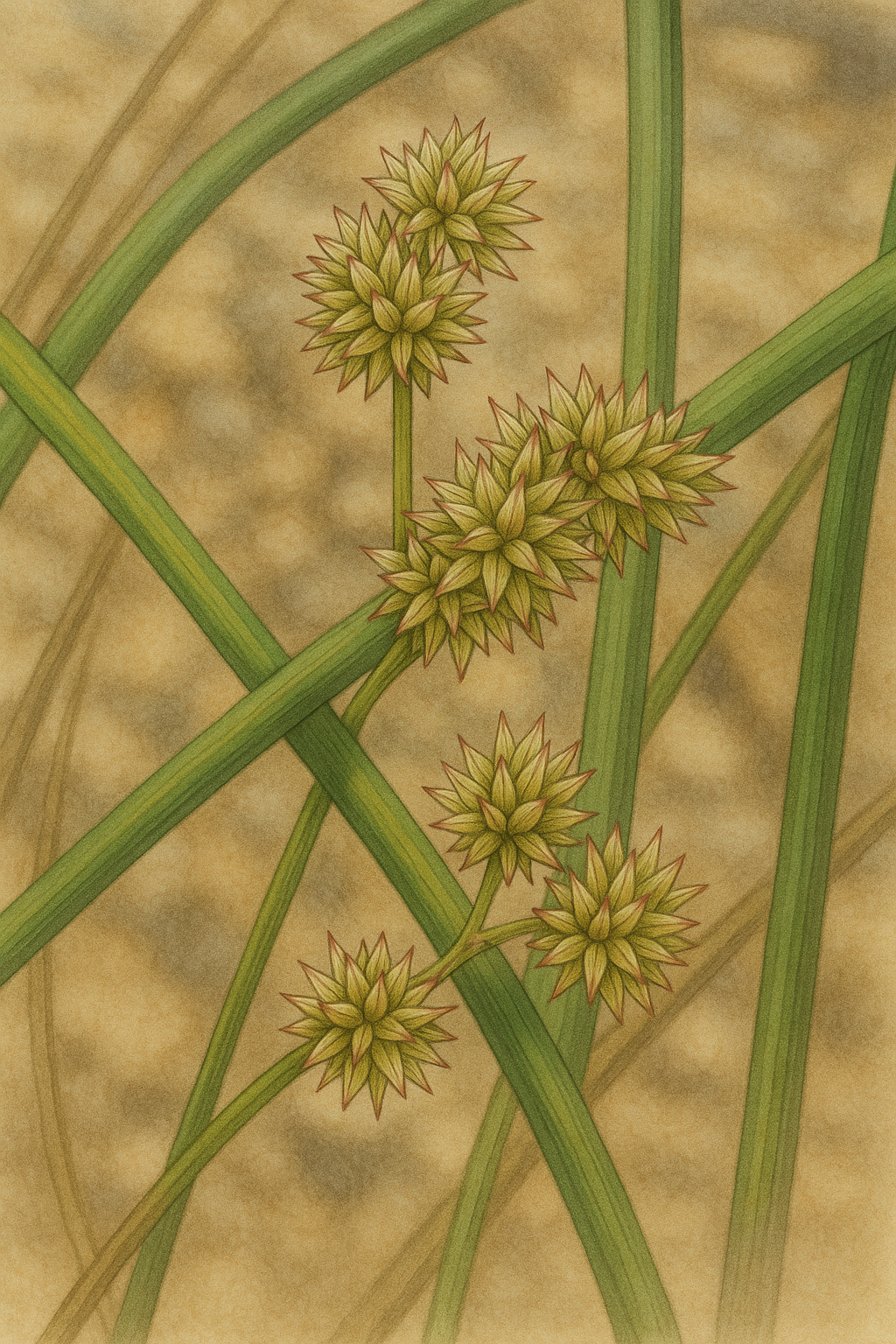
Leafless rush
Botanical name: Juncus australis
Synonyms: Agathryon australe
Common name(s): Leafless rush, wīwī, austral rush
About:
A robust indigenous perennial rush forming broad, loose, often circular clumps of distinctive dull blue-green to grey-green stems. Juncus australis is readily recognised by its hard, strongly ridged, non-shiny stems and internal pith that is usually interrupted or almost completely absent.
The species is naturally associated with damp ground and wetlands but is particularly successful in disturbed environments such as wet pasture, drainage areas and poorly drained clay soils. Its ability to spread into modified habitats means it is sometimes regarded as a pasture weed, although it can also be useful for wetland restoration and stabilising damp ground.
Natural habitat:
Coastal to lower montane.
Commonly occurs in damp pasture, swampy ground, wet grassland, drainage channels, stream and river margins and other seasonally or permanently wet areas.
It particularly favours poorly drained clay soils and disturbed wet ground. It occurs less frequently within open shrubland and forest.
Growing environment:
Full Sun, Partial Shade, Wet Soil, Poor Drainage, Periodic Inundation, Frost & Exposure tolerant.
Best growth occurs in open, sunny positions with permanently or seasonally moist soil. It tolerates heavy, poorly drained ground particularly well and can withstand periods of considerably drier conditions once established.
Endemic distribution:
Indigenous but not endemic to New Zealand.
Occurs on the Kermadec Islands and throughout the North and South Islands.
Also indigenous to Australia and present on Norfolk Island.
Height:
60–120 cm.
Width:
Approximately 40–100+ cm, gradually expanding through its horizontal rhizomes and potentially forming broad colonies in favourable wet ground.
Flowering:
September–December.
The numerous small flowers are pale green when young, becoming light brown with age. They are arranged in an apparently lateral, usually much-branched inflorescence.
Flower clusters may occasionally be condensed into a rounded head more than 15 mm across, sometimes accompanied by smaller lateral clusters.
Fruiting:
November–May.
Produces small, pale greenish-brown capsules approximately 2.3–3 mm long, containing numerous small seeds.
Uses:
• Wetland restoration
• Riparian planting
• Stream and waterway margins
• Pond and dam margins
• Bank stabilisation
• Erosion control on wet ground
• Stormwater and rain gardens
• Wildlife habitat
• Naturalistic wetland landscapes
• Revegetation of poorly drained sites
It should be used carefully around productive pasture, where vigorous colonies can become troublesome.
Appearance:
Growth habit:
A rhizomatous perennial rush forming broad, loosely packed, usually circular clumps.
The rhizome is approximately 3–5 mm in diameter, horizontal and positioned just beneath the soil surface. This strong rhizomatous growth makes established plants surprisingly difficult to pull from the ground.
Clumps frequently contain a few old or living stems toward their centre, although occasional plants produce only a small number of stems and have a less obviously clumping habit.
Leaves:
True leaves are absent.
Instead, the base of each stem is surrounded by numerous loose basal sheaths. These are chestnut-brown toward the base, becoming progressively paler and eventually straw-coloured in the upper sheaths.
The upright flowering stems perform the primary photosynthetic role normally carried out by leaves.
Flowers:
Flowering stems are approximately 0.6–1.2 m tall and 1.5–4 mm in diameter. They are hard, distinctly longitudinally ridged and characteristically dull blue-green, glaucous or grey-green rather than glossy.
Internally, the pith is generally strongly interrupted, sparse or almost completely absent. Continuous pith occurs only rarely.
The apparently lateral inflorescence is generally many-flowered and extensively branched, with flowers concentrated toward the ends of stout branchlets.
Individual flowers are approximately 2.2–3 mm long. Their tepals are initially pale green before ageing to light brown. Flowers usually contain three stamens.
Fruit:
The fruit is an ovoid to obovoid capsule approximately 2.3–3 mm long, usually about equal to or slightly longer than the surrounding tepals.
Capsules are pale greenish-brown and blunt, sometimes appearing slightly indented at the apex.
The small mucilaginous seeds may be dispersed by water, wind and by adhering to animals or other moving objects.
Ecology:
Juncus australis is primarily a wetland and damp-ground species, although it is capable of surviving occasional periods in considerably drier conditions.
Its extensive rhizome system helps bind wet and unstable soils while its dense upright stems add structural complexity to wetland margins and provide cover for small wetland animals and invertebrates.
The species responds particularly well to disturbance. Drainage systems, pasture development and other human modification have created additional suitable habitat, and its New Zealand distribution may consequently have expanded following human settlement.
Its ability to tolerate wet, compacted and poorly aerated soils allows it to occupy sites unsuitable for many woody native plants.
Associated habitats:
Freshwater wetlands, swamp margins, damp pasture, wet grassland, poorly drained clay flats, drainage channels, stream margins, river margins, pond and dam edges, shrubland margins and occasionally open forest.
It commonly occurs alongside other native rushes, sedges and wetland herbs adapted to periodically saturated soils.
How to grow:
A very easy species to establish where adequate soil moisture is available.
Plant in full sun or partial shade in damp to permanently wet soil. Heavy clay and poorly drained soils are suitable and generally require little preparation.
Plants can be positioned around ponds, swales, drainage channels and wetland margins where their rhizomes help consolidate the substrate.
Once established, Juncus australis is tough and requires little maintenance. However, its ability to spread by rhizomes and seed means it should be given sufficient room and monitored where unrestricted expansion is undesirable.
Propagation:
Easily propagated from fresh seed.
Seed can be surface-sown onto consistently moist growing media and should not be allowed to dry during establishment.
Established clumps can also be propagated vegetatively by dividing sections of rhizome carrying healthy stems and roots. Divisions establish readily when replanted into wet soil.
Cultural use:
Wīwī is a Māori name applied to several native rushes, including species of Juncus. Rushes and other fibre-producing wetland plants have long formed part of the useful vegetation of Aotearoa, although specific traditional uses should not automatically be attributed to Juncus australis where species-level identification is uncertain.
The species remains ecologically valuable as part of indigenous wetland and riparian vegetation.
Garden value:
A hardy architectural rush particularly useful for naturalistic wetland and waterside planting.
Its upright, strongly ridged blue-grey to grey-green stems provide year-round vertical structure and contrast well with broader-leaved wetland plants, sedges and low groundcovers.
It is particularly suitable for large rain gardens, ponds, swales and restoration projects where tough vegetation is needed to tolerate fluctuating water levels and poorly drained soils.
Because it can spread vigorously and is sometimes considered a weed of wet pasture, it is generally better suited to ecological, wetland and larger naturalistic plantings than small formal gardens.