


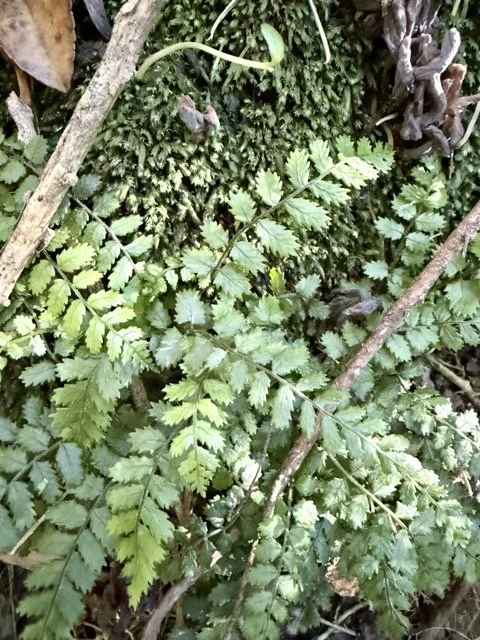

Thread Fern
Botanical name: Icarus filiformis
Synonyms: Blechnum filiforme, Struthiopteris filiformis, Spicanta filiformis, Stenochlaena heteromorpha, Stenochlaena hügelii, Lomaria propinqua, Lomariopsis heteromorpha, Lomariopsis hügelii, Blechnum reptans, Lomaria filiformis, Lomaria pimpinellifolia
Common name(s): Thread Fern, Climbing Hard Fern, Climbing Blechnum, Pānoko
About:
A distinctive endemic climbing fern and the sole species of the New Zealand endemic genus Icarus. It begins life creeping across the forest floor, rocks and fallen logs before its long rhizomes climb tree trunks and tree ferns, sometimes forming dense tangled masses.
One of its most remarkable characteristics is its three distinctly different frond forms. Small juvenile sterile fronds occur on terrestrial rhizomes, much larger sterile fronds develop once the plant begins climbing, and specialised fertile fronds have extremely narrow, thread-like pinnae from which the common name “thread fern” is derived.
Natural habitat:
Coastal to montane, primarily in humid coastal and lowland forest.
Most commonly found in podocarp and broadleaf forest, but also occurs locally in beech forest, coastal scrub, mānuka and kānuka vegetation.
It inhabits river terraces, forested hillsides, banks and gullies. Young plants typically creep across damp ground, rocks and fallen logs before encountering a suitable tree or tree fern and climbing its trunk.
Growing environment:
Shade, Partial Shade, Shelter, High Humidity & Moist Soil tolerant. Performs best in cool, sheltered forest-like conditions with consistently moist, humus-rich soil and protection from drying winds and strong sunlight.
Endemic distribution:
Endemic to New Zealand.
Found on Manawatāwhi / Three Kings Islands and throughout coastal and lowland areas of the North Island from Te Paki south to Wellington, although uncommon in parts of the central and eastern North Island.
In the South Island it is restricted to the north, occurring from Cape Farewell and north-west Nelson through to the Marlborough Sounds.
Also present on the Chatham Islands.
Recorded from near sea level to approximately 780 m in the North Island and to around 400 m near Nelson.
Height:
A climbing fern rather than an upright plant. Its rhizomes can climb several metres up tree trunks.
Individual adult sterile fronds approximately 22–76 cm long.
Width:
Adult sterile fronds approximately 4.5–21 cm wide.
Individual plants can spread extensively across the forest floor and vertically over host trees.
Flowering:
Not applicable — fern species reproducing by spores.
Fruiting:
Not applicable — spore producing.
Fertile fronds are generally produced once the rhizome has climbed well above ground level, often around 2 m high.
Uses:
• Specialist native fern collections
• Shaded native gardens
• Fern gardens and ferneries
• Forest restoration
• Naturalistic woodland planting
• Tree-trunk and log colonisation
• Groundcover beneath established native trees
• Botanical and educational collections
Appearance:
Growth habit:
A long-creeping and climbing fern with slender, scaly rhizomes.
Young plants spread horizontally over the ground, rocks and fallen timber, producing relatively small juvenile fronds. When a rhizome encounters a tree trunk or similar support it can climb vertically and begins producing much larger adult foliage.
Well-established plants may develop into extensive tangled colonies and can densely cover sections of a host tree.
Leaves:
The species is trimorphic, producing three distinct types of frond.
Juvenile sterile fronds are approximately 3.5–38 cm long and occur mainly on terrestrial rhizomes. Their blades are narrow and pinnate, with 9–25 pairs of widely spaced, relatively small pinnae. These are ovate, elliptic or oblong with conspicuously serrated margins.
Adult sterile fronds develop on climbing rhizomes and are much larger, approximately 22.5–76 cm long. The narrow-elliptic blades bear approximately 20–30 pairs of closely spaced pinnae. Individual pinnae are narrow, pointed and serrated, reaching approximately 2.5–11.5 cm long.
Fertile fronds are approximately 17–61 cm long and strikingly different. Their pinnae are extremely narrow and linear, only about 0.5–2.5 mm wide, creating the characteristic thread-like appearance.
Flowers:
None.
As a fern, Icarus filiformis does not produce flowers or seeds.
Fruit:
None.
Spores are produced in sori on the specialised fertile fronds.
The sori form continuous rows on either side of the costa and extend along much of the length of the fertile pinnae.
Ecology:
Icarus filiformis occupies a specialised ecological niche as one of New Zealand’s few strongly climbing ferns.
Its life begins terrestrially, with creeping rhizomes spreading through moist forest litter and across rocks and logs. Once a suitable trunk is encountered, the rhizome climbs toward brighter conditions above the forest floor.
The change in environment is accompanied by a dramatic change in foliage, with small juvenile fronds replaced by substantially larger adult sterile fronds. Specialised fertile fronds are generally produced higher above the ground.
Dense colonies provide additional structural complexity and cover on forest floors, fallen timber and tree trunks.
Its spores are dispersed by wind.
Associated habitats:
Podocarp forest, broadleaf forest, mixed podocarp–broadleaf forest, beech forest, coastal forest, coastal scrub, mānuka and kānuka scrub, river terraces, shaded gullies, forest banks, damp hillsides, fallen logs, rocks, tree trunks and tree fern trunks.
How to grow:
Best regarded as a specialist fern requiring conditions resembling a moist native forest.
Plant in deep to partial shade in humus-rich, consistently moist but reasonably drained soil. A sheltered position with good atmospheric humidity is important, particularly while plants are becoming established.
Providing logs, rocks and eventually a rough-barked tree or tree fern gives the creeping rhizomes suitable surfaces to colonise and allows the characteristic climbing adult growth to develop.
Growth can be relatively slow, particularly during establishment. Avoid exposed, hot or dry sites and maintain a generous layer of organic litter or mulch around terrestrial growth.
Propagation:
Can be propagated from spores under controlled, consistently humid conditions.
Established plants may also be propagated from carefully separated rooted sections of creeping rhizome where these have developed independent roots and growing points.
Because it is a slow-growing forest fern, disturbance should be minimised and wild plants should not be collected for cultivation.
Cultural use:
Known in te reo Māori as pānoko.
No specific traditional practical use is widely documented in the supplied material. The species nevertheless forms part of the distinctive fern flora of Aotearoa and its Māori name reflects a long-standing recognition of the plant.
Garden value:
An exceptional collector’s fern and one of the most unusual climbing plants in New Zealand’s native flora.
Its progression from small, deeply toothed juvenile foliage to large climbing fronds and finally thread-like fertile fronds gives a mature colony several dramatically different appearances.
It is particularly valuable in established native gardens, shaded ferneries and forest-style plantings where it can be allowed to creep naturally across logs and eventually climb living trunks. In the right humid, sheltered environment, Icarus filiformis can create the tangled, layered vegetation characteristic of mature New Zealand forest.