
Filmy fern
Botanical name: Hymenophyllum rarum
Synonyms: Mecodium rarum, Hymenophyllum imbricatum, Hymenophyllum semibivalve
Common name(s): Filmy fern
About:
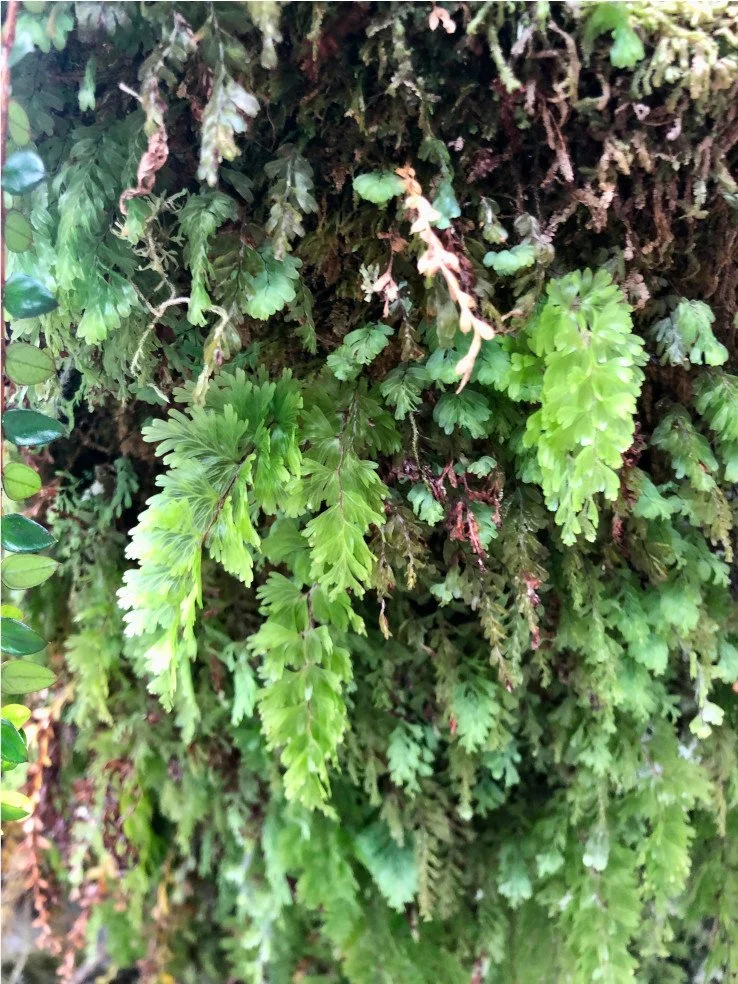
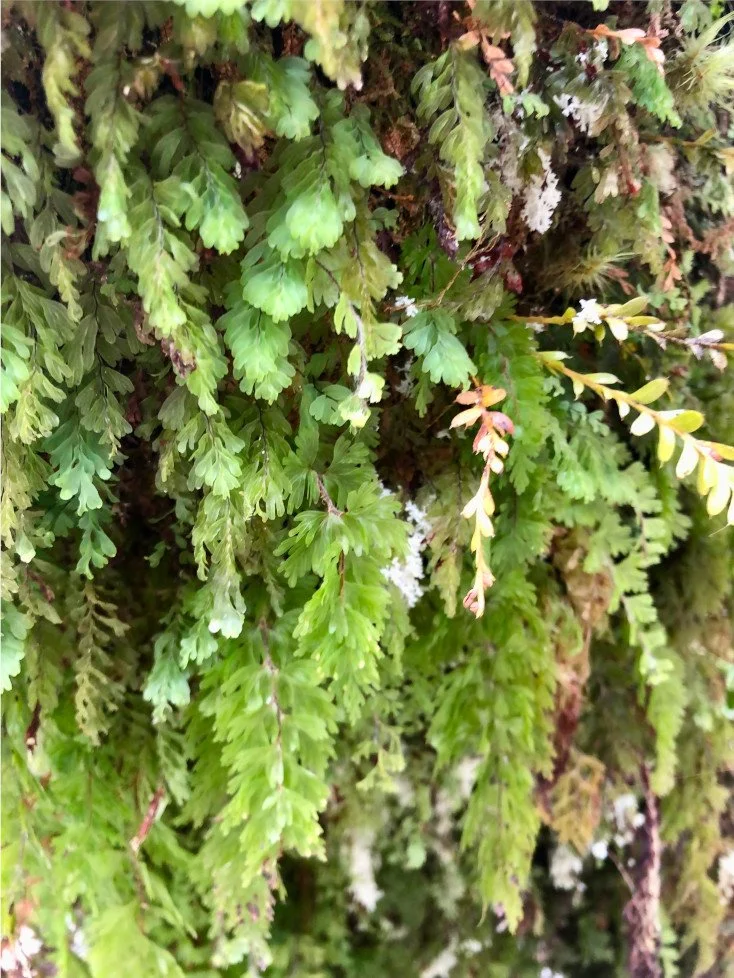
A small, delicate filmy fern with distinctive pale grey-green, almost glaucous fronds and a surprisingly high tolerance of dry conditions compared with many other members of the genus.
Hymenophyllum rarum spreads by extremely fine, long-creeping rhizomes to form extensive interwoven mats on the ground, rocks, logs and tree trunks. The fronds are thin, smooth-edged and usually twice divided, with the individual segments often overlapping closely.
Fertile plants are particularly distinctive because the sori are sunk into the uppermost frond segments rather than projecting conspicuously from the margins.
Natural habitat:
Coastal to montane forest and scrub.
Occurs in closed forest, mānuka and kānuka scrub, subalpine shrubland, shaded cliffs, rock faces, banks, boulder fields, rubble slopes, dead stumps and tree trunks.
It is often epiphytic but also grows terrestrially and directly on rock.
Unlike many filmy ferns, it can tolerate relatively exposed and periodically dry sites.
Growing environment:
Shade, Partial Shade, High Humidity, Sheltered & Moist conditions tolerant. More drought tolerant than most filmy ferns but still prefers cool, humid environments.
Endemic distribution:
Indigenous but not endemic to New Zealand.
Found in the North Island, South Island, Stewart Island/Rakiura, Chatham Islands and Auckland Islands, with a historic record from Raoul Island in the Kermadecs.
Also occurs in south-eastern Australia and Tasmania.
Height:
Fronds commonly approximately 2–12 cm long, occasionally much longer.
Width:
Individual fronds generally 1–4 cm wide.
Colonies may spread extensively through long-creeping rhizomes.
Flowering:
Not applicable — fern species reproducing by spores.
Fruiting:
Not applicable — spore producing.
Sori are produced mainly toward the upper portion of fertile fronds and are immersed in the terminal frond segments.
Uses:
• Humid fern gardens
• Moss gardens
• Shaded rock planting
• Log and stump planting
• Epiphytic displays
• Native forest-floor planting
• Specialist ferneries
• Restoration of shaded rocky habitats
Appearance:
Growth habit:
A terrestrial, epiphytic or rock-growing fern spreading through exceptionally thin, brittle, long-creeping rhizomes.
Colonies may become extensive and densely interwoven.
Leaves:
Fronds are pale grey-green, thin, membranous and hairless.
The lamina is usually narrowly ovate to narrowly elliptic, occasionally broader or more triangular, and generally divided two to three times.
Typical frond size is around 10–200 mm long and 8–40 mm wide, although smaller plants are common.
Primary pinnae are numerous and often overlap strongly, giving the frond a compact layered appearance.
Ultimate segments are oblong to linear, usually up to about 4 mm long and 1.2–2.7 mm wide.
Margins are completely smooth and lack the thickened border seen in some other filmy ferns.
The stipe is dark brown, unwinged and extremely fine, while the rachis develops only a very narrow wing.
Flowers:
None.
As a fern, Hymenophyllum rarum produces neither flowers nor seeds.
Fruit:
None.
Spores develop in sporangia grouped into sori.
The sori are few on each primary pinna and usually restricted toward the tips of the upper pinnae.
They are almost completely immersed within broadened terminal frond segments.
The indusia are two-valved, elliptic to almost circular, approximately 1.5–2.5 mm long and have smooth margins.
Ecology:
Hymenophyllum rarum is unusual among filmy ferns because its very thin fronds show considerable resistance to desiccation.
Even during relatively dry conditions the fronds often remain open rather than curling tightly.
This allows the species to occupy exposed banks, cliff faces and open scrub as well as humid forest interiors.
Its extremely small spores are dispersed by wind and can reach new rocks, trunks and forest surfaces where adequate moisture is available.
The creeping rhizome enables established plants to spread vegetatively across suitable substrates.
Associated habitats:
Kauri forest, podocarp forest, beech forest, broadleaf forest, mānuka scrub, kānuka scrub, subalpine scrub, shaded cliffs, scoria, clay banks, dead wood, mossy rocks, fallen logs and epiphytic vegetation.
How to grow:
Difficult in cultivation and best left undisturbed in the wild.
If cultivated, provide high humidity, cool temperatures, shade or filtered light and a substrate that remains moist without becoming stagnant.
It can be grown over mossy logs, rough bark, shaded rocks or humus-rich banks.
Compared with many filmy ferns it tolerates occasional drying somewhat better, but prolonged exposure to hot sun or drying wind should still be avoided.
Propagation:
Propagation is by spores.
Spores should be sown onto a sterile, moist medium and maintained under continuously humid, shaded conditions.
Established colonies may spread through rhizomes, but wild plants should not be removed or divided because of their sensitivity to disturbance.
Cultural use:
No specific traditional Māori use is widely documented for Hymenophyllum rarum.
Its botanical name rarum derives from the Latin rarus, referring to the delicate or thin nature of the fronds.
Garden value:
A subtle but highly attractive specialist fern for humid native gardens.
Its pale grey-green foliage contrasts strongly with the darker greens of many forest ferns, while its closely overlapping pinnae give established colonies a fine, layered texture.
Its greater drought tolerance makes it slightly more adaptable than some other filmy ferns, though it still performs best in sheltered, naturally humid environments.