
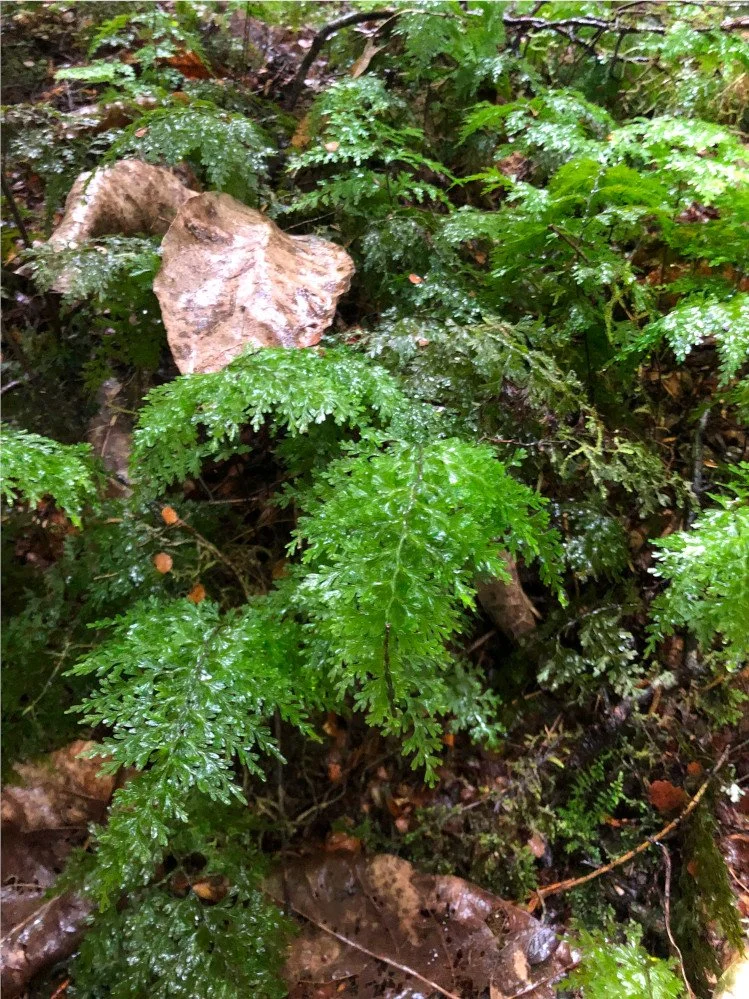


Drooping Filmy Fern
Botanical name: Hymenophyllum demissum
Synonyms: Mecodium demissum, Hymenophyllum australe var. aucklandicum, Sphaerocionium demissum, Trichomanes demissum, Hymenophyllum aucklandicum
Common name(s): Drooping filmy fern, Irirangi, Piripiri
About:
A delicate but often abundant endemic filmy fern of New Zealand’s humid forests, Hymenophyllum demissum forms dense carpets of finely divided, translucent green fronds. It is one of the most widespread and commonly encountered New Zealand filmy ferns.
The fronds are carried on tough, wiry stalks and are divided three to four times into narrow, smooth-edged segments. Unlike many other filmy ferns, its fronds usually remain relatively flat rather than curling tightly when conditions become dry.
It grows mostly on the forest floor, banks and decaying logs, but may also occur as an epiphyte on tree trunks and tree ferns.
Natural habitat:
Coastal to montane forest.
Most commonly terrestrial on damp forest floors, shaded banks, rotting logs, stumps, mossy boulders and rock faces.
It also grows epiphytically, especially around the basal trunks of tree ferns and mature forest trees.
Growing environment:
Shade, High Humidity, Moist Soil & Sheltered tolerant. Requires consistently humid conditions and protection from drying winds and direct sun.
Endemic distribution:
Endemic to New Zealand.
Found on the Kermadec Islands, North Island, South Island, Stewart Island/Rakiura, Chatham Islands and Auckland Islands.
Widespread throughout most of the country but less common in the drier eastern parts of the South Island.
Height:
Fronds typically approximately 7–27 cm long, occasionally longer.
Width:
Forms spreading colonies and dense mats through long-creeping rhizomes.
Flowering:
Not applicable — fern species reproducing by spores.
Fruiting:
Not applicable — spore producing.
Fertile fronds bear numerous sori along the terminal ends of the ultimate segments.
Uses:
• Shaded fern gardens
• Native forest-floor planting
• Moss and fern gardens
• Shaded banks
• Log and stump planting
• Epiphytic fern displays
• Terrarium or enclosed humid cultivation
• Native forest restoration in suitable microhabitats
Appearance:
Growth habit:
A terrestrial, epiphytic or occasionally rock-growing fern spreading by slender, long-creeping rhizomes.
It commonly forms extensive carpets composed of many densely packed fronds.
The fronds may arch or droop, particularly where plants occur on banks, logs or tree trunks.
Leaves:
Fronds are pale to dark green, very thin, translucent and membranous.
The lamina is approximately 45–270 mm long and 22–160 mm wide, elliptic to ovate or narrowly ovate in outline and divided three to four times.
The rachis is narrowly winged throughout, while the wiry stipe is generally unwinged.
Primary pinnae occur in numerous pairs and overlap to produce a finely textured, layered frond.
Ultimate segments are narrow and oblong, generally up to approximately 5 mm long and only 0.5–1.5 mm wide.
Their margins are smooth and bordered by a distinct thickened edge.
Flowers:
None.
As a fern, Hymenophyllum demissum does not produce flowers or seeds.
Fruit:
None.
Spores are produced within sporangia arranged in sori at the tips of short ultimate segments.
The sori are often narrow and paired.
Each is protected by a two-valved indusium whose margins are smooth or only slightly notched.
Ecology:
Hymenophyllum demissum is strongly associated with cool, humid forest microclimates.
Its exceptionally thin fronds have little protection against moisture loss and therefore rely heavily on atmospheric humidity and regular surface moisture.
Dense colonies help create and maintain humid microsites around logs, rocks and forest-floor debris and provide habitat for small invertebrates and microorganisms.
The minute spores are dispersed by wind and can colonise suitable moist surfaces some distance from the parent plant.
It occurs in a wide range of native forest types including kauri, podocarp, broadleaf and beech forest, as well as tall kānuka scrub and swamp forest.
Associated habitats:
Kauri forest, podocarp forest, beech forest, broadleaf forest, swamp forest, kānuka scrub, shaded gullies, forest banks, rotting logs, fallen trunks, mossy rocks, cliff faces and tree fern trunks.
How to grow:
Difficult in cultivation and best left undisturbed in the wild.
Where cultivation is attempted, success depends on reproducing the conditions of a humid forest floor.
Provide deep shade, constant atmospheric humidity and a moist, humus-rich substrate that never dries out completely.
Suitable surfaces include rotting wood, moss-covered logs, shaded rock faces or very organic woodland soil.
Avoid direct sun, strong wind, dry indoor air and repeated root disturbance.
Plants are often more successfully maintained in enclosed or naturally humid ferneries than in conventional garden beds.
Propagation:
Propagation is by spores.
Spores require consistently humid, sterile and shaded conditions to develop successfully through the fern life cycle.
Established colonies can theoretically spread from rhizome fragments, but this species strongly resents disturbance and division is not recommended.
Wild plants should not be removed for cultivation.
Cultural use:
Known in te reo Māori as irirangi and piripiri.
Historical records describe liquid from broken young shoots being applied to wounds, and the plant has also been recorded as having been used as a bitter tonic.
These traditional uses are historically documented but should not be interpreted as modern medical guidance.
Garden value:
A beautiful specialist fern for naturally humid, deeply shaded gardens.
Its translucent, finely divided fronds create an exceptionally delicate forest-floor texture and look especially effective growing over mossy logs, shaded banks and around the bases of tree ferns.
Its dependence on constant humidity makes it unsuitable for ordinary exposed garden conditions, but in a sheltered fernery, enclosed garden or permanently damp forest setting it can form impressive soft green carpets.