

Pigeonwood
Botanical name: Hedycarya arborea
Synonyms: Hedycarya dentata; Hedycarya scabra; Zanthoxylum novae-zelandiae
Common name(s): Pigeonwood, Porokaiwhiri, Pōporokaiwhiria, Kōporokaiwhiri
About:
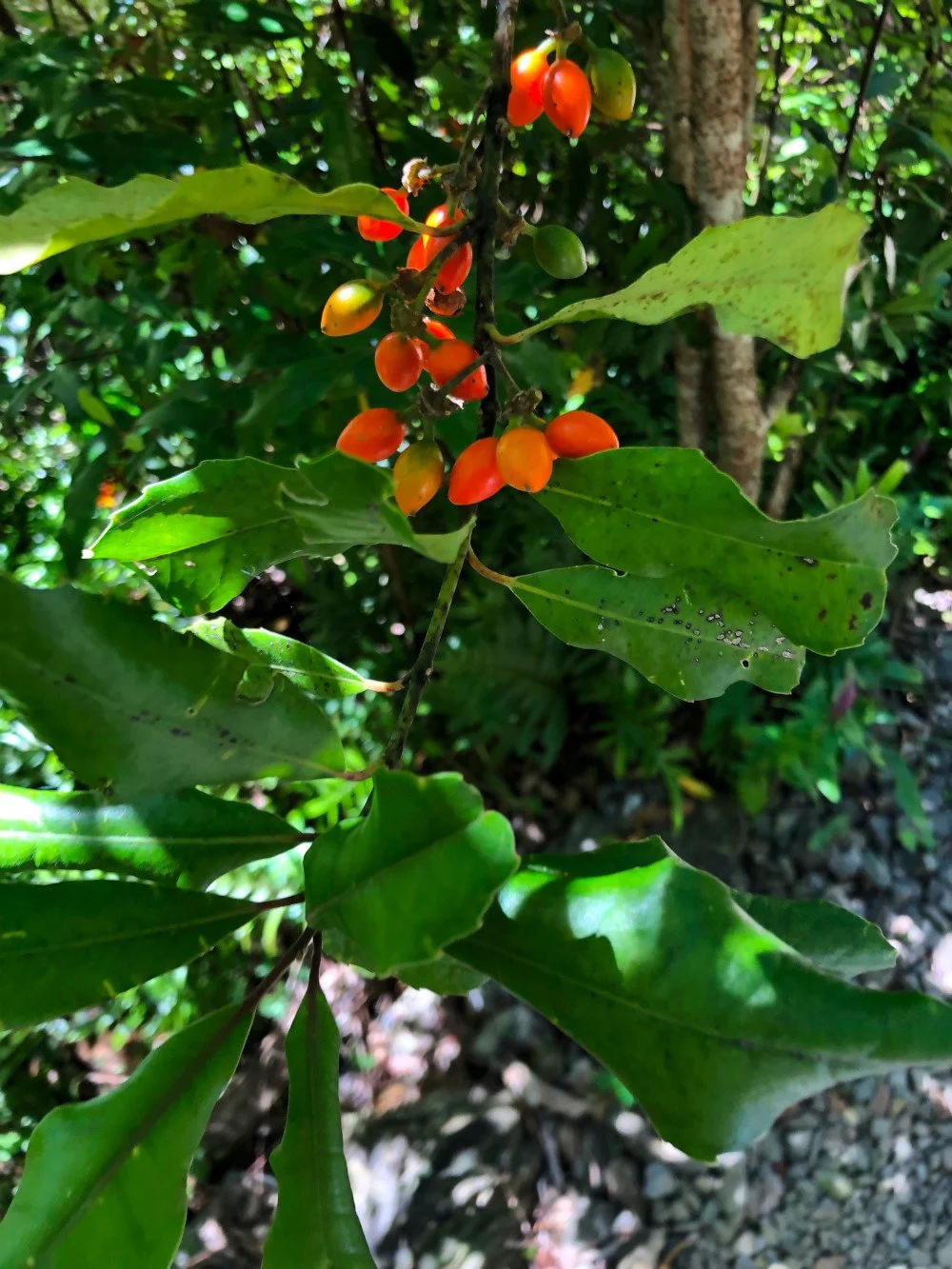
Pigeonwood is a common evergreen forest tree with glossy dark green leaves, pale undersides and clusters of bright orange-red fruit. It is an important understorey and subcanopy species in coastal and lowland forest and is particularly valuable as a food tree for kererū and other native birds.
The species is dioecious, meaning male and female flowers are produced on separate trees. Only female plants bear fruit, although both sexes are needed nearby for reliable pollination.
Natural habitat:
Occurs in coastal and lowland forest, forest margins, regenerating vegetation and, in warmer regions, lower montane forest.
It is especially common in moist broadleaved and podocarp forest, where it grows beneath taller canopy trees or along well-lit forest edges.
Growing environment:
Grows best in partial shade or filtered sun in fertile, moist, well-drained soil.
It is highly shade tolerant and establishes well beneath existing forest cover, although growth is faster where more light is available. Young plants prefer shelter from severe frost and drying winds, while established trees tolerate a reasonable amount of cold.
Endemic distribution:
Endemic to New Zealand.
Occurs on Manawatāwhi / Three Kings Islands and throughout the North Island. In the South Island it is uncommon in the east south of Kaikōura, reaching Banks Peninsula, but is more widespread in wetter western districts and extends into northern Fiordland.
Height:
Typically 5–12 m, occasionally taller in favourable forest conditions
Width:
Approximately 3–6 m
Flowering:
December–February
Fruiting:
March–June
Uses:
• Native forest restoration
• Understorey and subcanopy planting
• Bird habitat and food
• Forest-margin planting
• Shelter and screening
• Shade gardens
• Cultural planting
• Revegetation projects
Appearance:
Growth habit:
A small to medium-sized evergreen tree with numerous upright to spreading branches and a rounded crown.
The trunk is often clear of branches for the first few metres, particularly in forest-grown specimens, while open-grown trees develop broader, denser crowns.
Trunk/Bark:
The trunk may reach approximately 50 cm in diameter.
The bark is dark grey to brown-grey, firm and non-flaking, with a finely tessellated or lightly cracked surface.
Young branchlets are brownish and finely hairy near their tips.
Leaves:
Leaves are arranged in opposite pairs on short stalks and arise from slightly flattened sections of the dark twigs.
They are leathery, glossy dark green above and paler, duller green beneath. Leaf blades are usually 4–12 cm long, although larger leaves may occur in northern island populations.
Shape varies from elliptic and obovate to narrowly lance-shaped. The base narrows gradually, while the tip may be rounded, pointed or sharply acute.
Margins are distantly toothed or serrated, although occasional leaves may be almost entire.
Flowers:
Small cream, greenish-white or pale yellow flowers are produced in branched clusters from the leaf axils.
Male flowers are approximately 10 mm wide and contain numerous stamens. Female flowers are smaller, about 6 mm wide, and contain up to 20 separate carpels.
The flowers are slightly hairy and are pollinated primarily by wind.
Fruit:
Female trees produce groups of oval, one-seeded drupes on radiating stalks.
Each fruit is approximately 10–16 mm long and ripens from green to bright orange or orange-red. Up to ten fruits may occur within a cluster.
The fruit is strongly favoured by kererū and several other birds but should not be regarded as edible for people.
Seeds:
Each drupe contains a single hard stone approximately 9–14 mm long.
The stone is brown to grey-brown, usually elliptic or obovate, with a mostly smooth surface marked by occasional bumps or longitudinal ridges.
Seed is dispersed when birds consume the fleshy fruit and later pass or regurgitate the stones.
Ecology:
Pigeonwood is an important fruiting tree in New Zealand forest ecosystems.
Its orange-red fruit is eaten and dispersed by kererū, tūī, kōkako, weka, blackbirds, song thrushes and other frugivorous birds. The extinct huia was also recorded feeding on the fruit.
Kererū are particularly important dispersers because they can swallow the relatively large drupes.
The tree also supports native insects, including longhorn beetles and other species associated with its foliage and wood. Introduced deer and goats browse the leaves, while possums feed on buds and flowers and rats may consume the fruit.
Associated habitats:
Coastal forest, lowland broadleaved forest, podocarp–broadleaf forest, moist gullies, forest margins and regenerating woodland.
Common associates include tītoki, māhoe, ngaio, akeake, kawakawa, karamū, pigeonwood, kōhūhū, tree ferns, rimu, tōtara and kahikatea.
How to grow:
Plant in partial shade or filtered sunlight in fertile, moist, well-drained soil.
Water regularly during establishment and mulch around the root zone to conserve moisture and suppress weeds. Once established, it is reasonably adaptable and can tolerate more sun, provided the soil does not become excessively dry.
Because male and female flowers occur on separate trees, several seedlings should be planted where fruit production is desired.
Minimal pruning is required beyond removing damaged, crossing or poorly placed branches.
Propagation:
Propagation is readily achieved from fresh seed.
Collect fully ripe orange-red fruit, remove the flesh and wash the stones thoroughly. Soaking cleaned seed in cold water for 24–48 hours before sowing may assist germination.
Sow into a moist, freely draining seed-raising mix and keep in a sheltered, lightly shaded position. Germination may take time, but young plants generally grow quickly once established.
Cultural use:
Porokaiwhiri and related Māori names have long been applied to this tree.
Māori used the pale, straight-grained wood for digging sticks, musical instruments and other small implements. The leaves were also used in traditional vapour baths and medicinal preparations.
The fruit was not traditionally eaten and may be toxic. It should not be consumed despite its attractive appearance.
Garden value:
Pigeonwood is an excellent native tree for woodland gardens, restoration planting and bird-friendly landscapes.
Its glossy foliage, tidy evergreen form and bright orange-red fruit provide strong ornamental interest, while its ability to grow in shade makes it particularly useful beneath taller native trees.
It is best planted in groups where both male and female plants are likely to be present, ensuring fruit production and maximising its value to kererū and other native birds.