


Toatoa
Botanical name: Haloragis erecta subsp. erecta
Synonyms: Cercodia erecta, Haloragis colensoi
Common name(s): Toatoa, Fireweed, Shrubby haloragis
About:
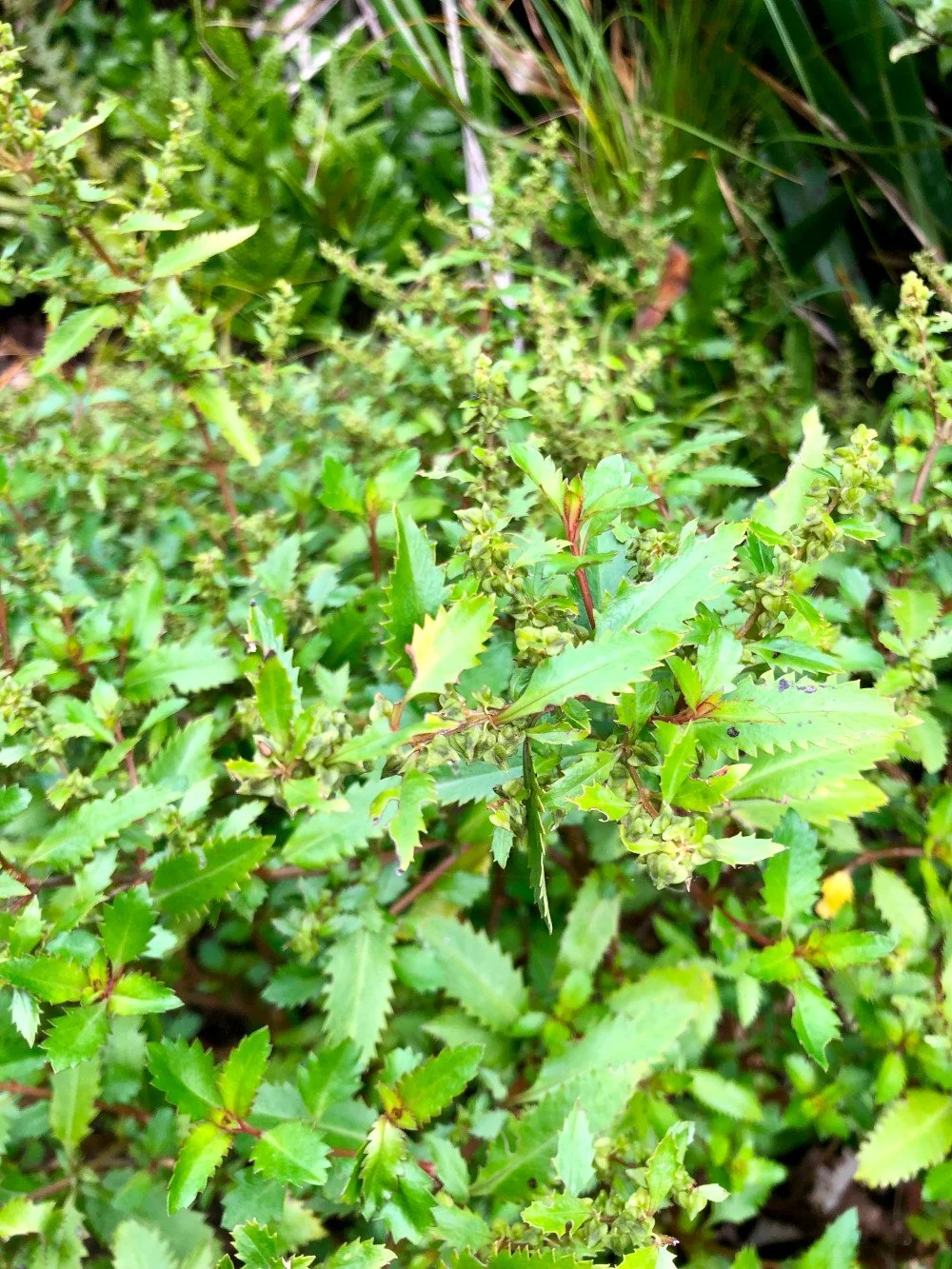
A hardy, fast-establishing perennial herb or subshrub endemic to New Zealand. Haloragis erecta is especially associated with disturbed ground, where it can appear quickly after fire, slips, vegetation clearance or other events that expose bare soil. It forms freely branched plants up to about 1 m tall, with reddish, four-angled stems, opposite sharply toothed leaves, and clusters of small reddish, pink or yellow flowers.
Its ability to colonise freshly disturbed ground gives rise to the common name fireweed. Some forms develop striking dark purple-red or maroon foliage and stems, giving the species considerable ornamental potential.
Natural habitat:
Found from coastal areas to montane forest and scrub. It commonly occurs on forest margins, in shrubland, on slip scars, road banks, recently cleared ground and other disturbed sites. It is particularly characteristic of open areas created after fire or soil disturbance.
Growing environment:
Sun, Partial Shade, Frost, Wind, Dry & Free Draining tolerant. Performs particularly well in open, disturbed ground with reasonable soil fertility.
Endemic distribution:
Endemic to New Zealand. Occurs on the Kermadec Islands, North Island, South Island, Stewart Island/Rakiura and Chatham Islands.
Height:
Up to approximately 1 m tall.
Width:
Approximately 0.5–1 m, depending on growing conditions and degree of branching.
Flowering:
Throughout the year.
Produces small four-petalled flowers, often reddish, pinkish or yellowish, in clusters of approximately 3–7 flowers.
Fruiting:
Throughout the year.
Produces small ribbed or narrowly winged fruits approximately 1.8–3 mm long. Mature fruits are dispersed primarily by wind.
Uses:
• Native restoration
• Early-successional revegetation
• Disturbed-site planting
• Forest-margin planting
• Wildlife and invertebrate habitat
• Native cottage gardens
• Colour and foliage contrast
• Educational planting
• Fast native cover on exposed soil
Appearance:
Growth habit:
A freely branched perennial herb or subshrub with stems that may be decumbent near the base or fully erect. Plants often develop numerous stems and an open, somewhat shrubby form.
The stems are characteristically four-angled and may be green, reddish or deep maroon. Their surfaces range from nearly smooth to slightly rough.
Leaves:
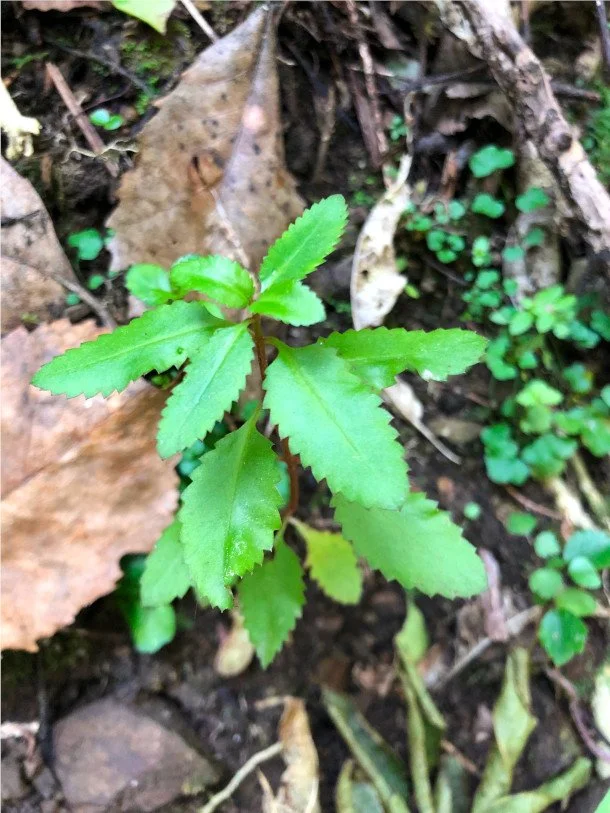
Leaves occur in opposite pairs and are borne on short petioles.
The blades are approximately 15–70 mm long, occasionally reaching around 90 mm, and are lanceolate, elliptic or oblong-elliptic. Their most conspicuous feature is the strongly serrated margin, with individual teeth reaching around 4 mm long.
The foliage may be green, bronze, reddish-purple or deep maroon depending on the plant and growing conditions.
Flowers:
The flowers are small, four-parted and produced in branching clusters. Each flower has four persistent sepals and four small petals.
Eight stamens are present, with the anthers ranging from yellow to red. The stigmas are often pink, adding subtle colour to the otherwise tiny flowers.
Fruit:
The fruit is small, usually ovoid and four-ribbed or variably winged. It may be smooth or slightly wrinkled between the ribs.
The fruits dry on the plant before dispersal and are light enough to be moved by wind.
Ecology:
Haloragis erecta is a classic early-successional species. Its seeds can persist until conditions become favourable, and plants often appear rapidly when canopy cover is removed or mineral soil is exposed.
Fire, landslides, logging, road construction and vegetation clearance can all create the open conditions that favour germination and establishment.
Its flowers support a range of native and introduced insects, including moths, butterflies, beetles, mites, thrips and sap-feeding insects. The plant is also associated with specialist native invertebrates, including the haloragis weevil.
Although naturally a coloniser, it does not usually persist indefinitely beneath a developing closed forest canopy. As taller vegetation establishes and shade increases, populations often decline.
Associated habitats:
Coastal scrub, lowland forest margins, montane forest, secondary scrub, slip scars, fire scars, road banks, disturbed ground, regenerating forest and urban wasteland.
How to grow:
Very easy to cultivate.
Plant in full sun or partial shade in ordinary garden soil. It tolerates a wide range of conditions but responds especially well to open sites with moderately fertile, free-draining soil.
Water during establishment, after which plants are relatively resilient to temporary dry periods.
Because it seeds freely and responds strongly to disturbance, it can become somewhat weedy in informal gardens. Removing spent seed heads can reduce unwanted seedlings where necessary.
Plants can be lightly trimmed to encourage bushier growth, particularly when ornamental purple or maroon forms are being cultivated.
Propagation:
Readily propagated from fresh seed or cuttings.
Fresh seed can be sown onto a fine, free-draining propagation mix and kept lightly moist. Germination is generally straightforward, particularly when seed is exposed to light and open conditions.
Softwood or semi-hardwood cuttings root readily and are useful for retaining desirable foliage colours or compact growth forms.
Because colour variation can be genetically influenced, vegetative propagation is preferable when maintaining a particularly dark maroon or purple selection.
Cultural use:
No major traditional Māori practical use is widely documented for Haloragis erecta. Its Māori name toatoa reflects its recognition within the indigenous flora of Aotearoa.
The species has particular ecological significance as a native coloniser of disturbed habitats and plays an important role during the early stages of forest and shrubland regeneration.
Garden value:
An underrated native plant with considerable potential in naturalistic and informal gardens. Green forms provide a fresh, textured shrub-like presence, while dark red, bronze and maroon forms can be especially attractive as foliage plants.
Its year-round flowering, tolerance of poor and disturbed conditions and ability to establish quickly make it useful in ecological gardens and restoration planting.
Because it can self-seed readily, it is best suited to naturalistic settings where spontaneous regeneration is desirable rather than highly formal garden beds.