
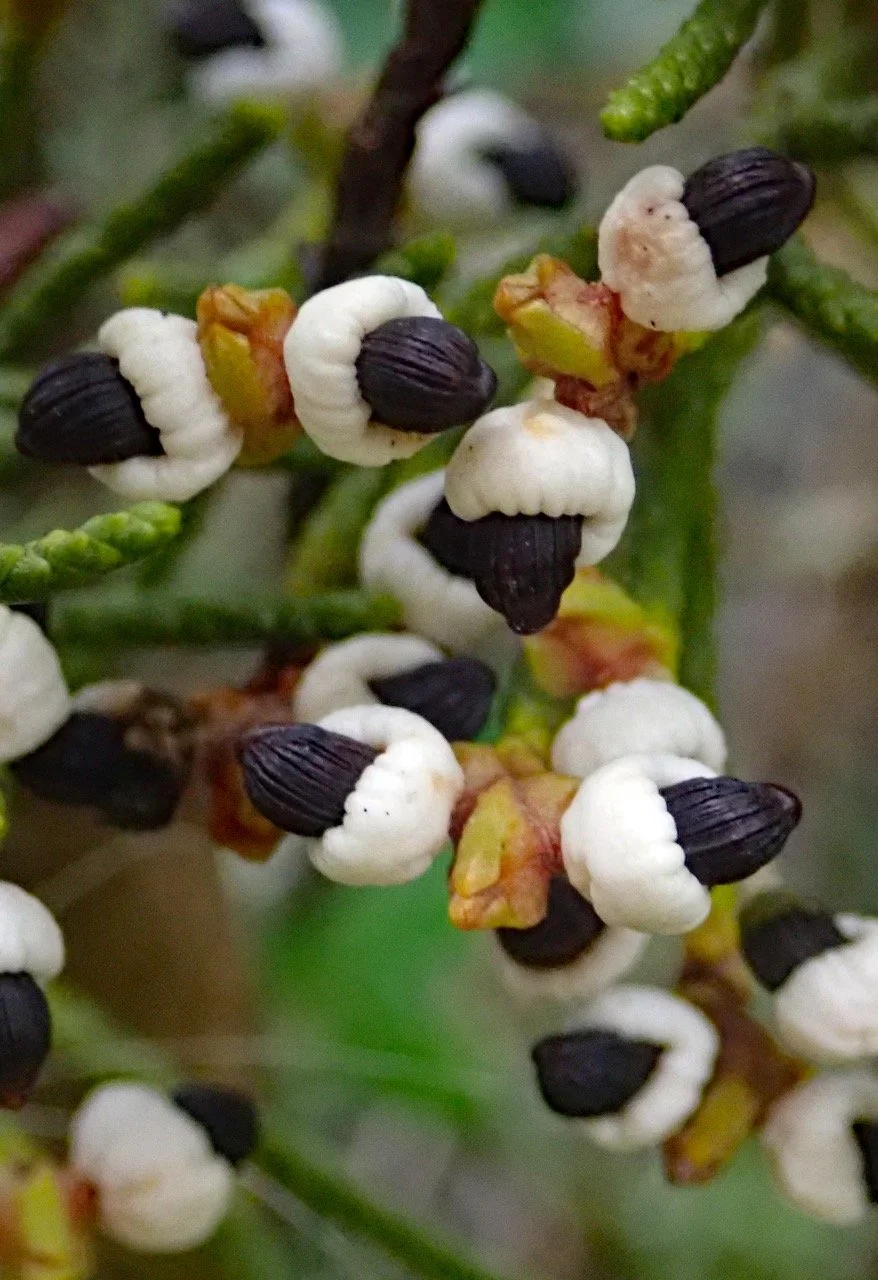

Bog Pine
Botanical name: Halocarpus bidwillii
Synonyms: Dacrydium bidwillii
Common name(s): Bog pine, Mountain pine
About:
A distinctive low-growing native conifer endemic to New Zealand, Halocarpus bidwillii forms a dense, spreading shrub or occasionally a small tree in exposed montane and alpine environments. Despite its common names, it is not a true pine but belongs to the podocarp family. It is remarkably hardy, occurring in environments ranging from cold, waterlogged bogs to exposed, dry and stony ground. Its compact growth, fine scale-like adult foliage and ability to withstand severe frost and wind make it one of New Zealand’s characteristic high-country conifers.
Natural habitat:
Found from montane to subalpine environments in bogs, peatlands, poorly drained ground, tussock grassland, shrubland, frost flats, rocky slopes and dry stony sites. It is particularly characteristic of exposed, nutrient-poor environments where larger forest trees struggle to establish.
Growing environment:
Frost, Sun, Wind, Wet, Drought & Poor Soil tolerant. Adaptable to both wet and relatively dry conditions once established, but generally performs best in an open, sunny position.
Endemic distribution:
Endemic to New Zealand. Occurs in the central and southern North Island and is widespread through the South Island and Stewart Island/Rakiura, particularly in montane and subalpine areas.
Height:
Up to 3.5 m, although frequently much lower in exposed alpine and bog environments.
Width:
Approximately 1–3 m, potentially becoming broader with age where plants develop a spreading, densely branched habit.
Flowering:
Spring – early summer
As a conifer, Halocarpus bidwillii does not produce true flowers. Male and female reproductive structures are small and inconspicuous.
Fruiting:
Summer – autumn
Produces small seeds associated with a fleshy, modified reproductive structure. Viable seed crops can be irregular, with several years sometimes passing between good crops.
Uses:
• Native alpine and subalpine gardens
• Bog and wetland planting
• Frost-flat restoration
• High-country revegetation
• Exposed and windy sites
• Rock gardens
• Low native screening
• Specialist native conifer collections
• Wildlife and biodiversity planting
• Architectural specimen planting
Appearance:
Growth habit:
A slow-growing, densely branched evergreen shrub, occasionally developing into a small tree under favourable conditions. Growth may be upright, spreading or irregular, with plants in highly exposed locations often becoming compact and wind-shaped.
Leaves:
Foliage changes noticeably as the plant matures. Juvenile leaves are narrow, flattened and more obviously leaf-like, while mature foliage becomes much smaller and scale-like, lying closely against the slender branchlets. This gives established plants a fine-textured, somewhat coniferous appearance.
Flowers:
True flowers are absent. Male and female reproductive cones are small and inconspicuous and are produced amongst the foliage.
Fruit:
Rather than producing a conventional woody cone, the female reproductive structure develops a small seed associated with a fleshy structure. Seed production can be irregular, and good viable crops may be separated by several years.
Ecology:
Halocarpus bidwillii is an important component of New Zealand’s montane and subalpine shrublands, bogs and open high-country vegetation.
Its ability to tolerate both saturated peat and comparatively dry, rocky ground demonstrates an unusually broad ecological tolerance. It frequently occupies cold, exposed environments characterised by severe frost, strong winds, nutrient-poor soils and short growing seasons.
Its dense branching provides shelter and structural habitat for small native animals and invertebrates, while established plants contribute to the stability and complexity of low alpine shrub communities.
The species is a member of the Podocarpaceae, linking it botanically with larger New Zealand conifers such as tōtara, rimu, miro and kahikatea, despite its dramatically smaller stature.
Associated habitats:
Montane shrubland, subalpine shrubland, bogs, peatlands, frost flats, tussock grassland, wetland margins, rocky slopes, fellfield margins and exposed stony ground.
How to grow:
A hardy species once established but generally slow growing. Plant in full sun to light partial shade. It can tolerate a surprisingly broad range of soils, from moist or peaty substrates to free-draining rocky ground.
For garden cultivation, a cool open site with good air circulation is ideal. Plants grown in richer garden soil may develop more rapidly and become taller than specimens growing naturally in harsh alpine environments.
Water regularly during establishment, particularly in free-draining sites. Once established, plants are capable of tolerating periods of considerably drier conditions.
Its tolerance of frost and exposure makes it particularly valuable for difficult high-country gardens where less hardy native trees and shrubs may struggle.
Propagation:
Usually propagated from seed, although obtaining viable seed can be difficult because substantial seed crops are irregular and several years may pass between good harvests.
The seed is considered perishable and should not be allowed to dry excessively during storage. Freshly collected and cleaned seed is best sown promptly. If seed has been held under appropriate cold-storage conditions, it should be sown soon after receipt.
Use a free-draining propagation medium and maintain consistent moisture without prolonged waterlogging. Germination can be slow and irregular, so trays should not be discarded prematurely.
Cultural use:
No major traditional Māori practical use specific to Halocarpus bidwillii is widely documented. Its ecological and cultural value today lies particularly in its role as a distinctive component of New Zealand’s indigenous high-country flora.
Garden value:
An excellent specialist native for cold, exposed or difficult sites. Its dense evergreen foliage, naturally compact form and unusual status as one of New Zealand’s small alpine podocarps make it an attractive alternative to introduced dwarf conifers.
It is particularly valuable in alpine gardens, native rockeries, wetland margins and naturalistic high-country plantings. Because it tolerates conditions ranging from boggy ground to relatively dry rocky soils, it can be surprisingly versatile where the climate is suitable.