
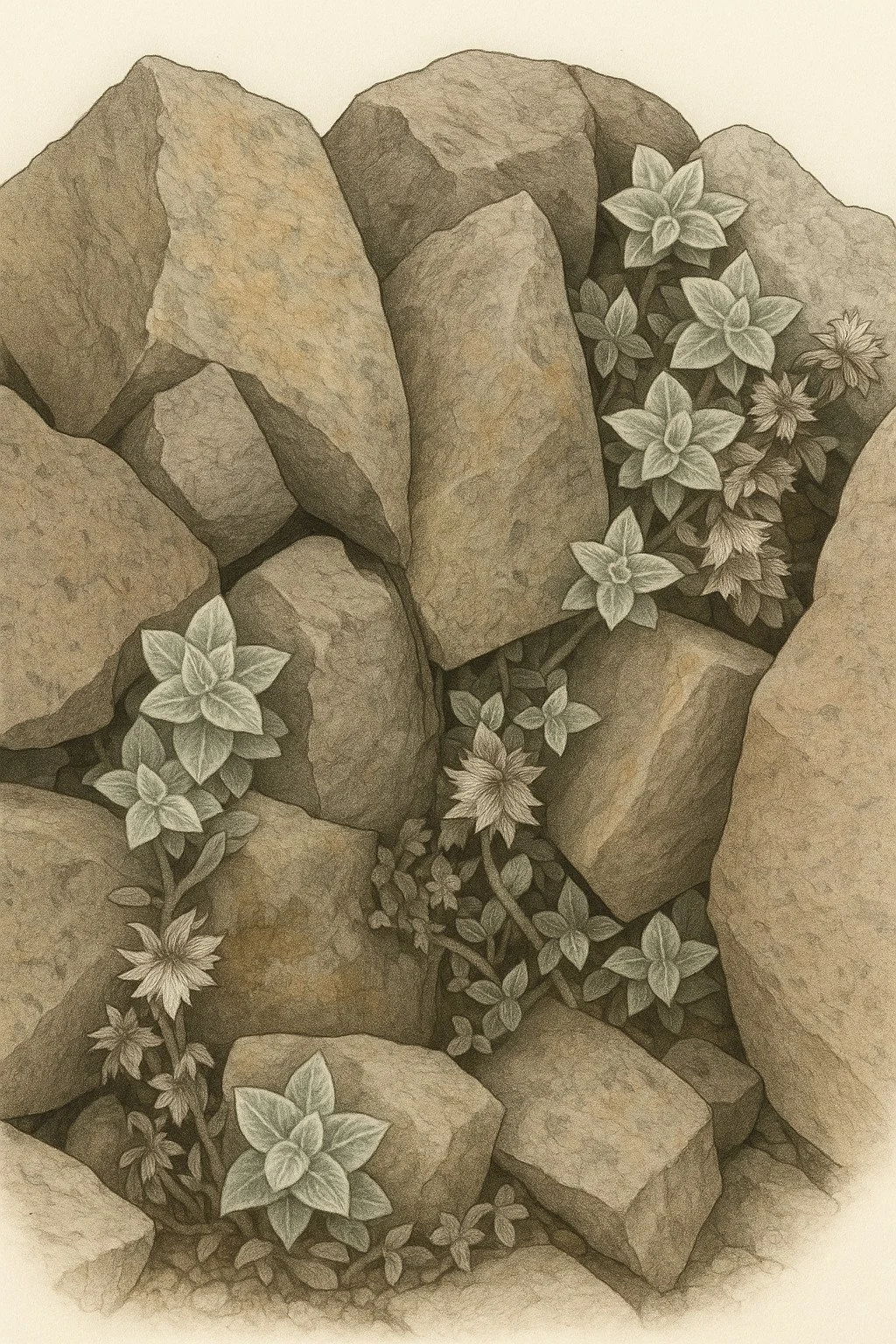
Sinclair’s Haastia
Botanical name: Haastia sinclairii var. sinclairii
Synonyms: Haastia sinclairii
Common name(s): Sinclair’s Haastia
About:
A distinctive alpine perennial endemic to New Zealand, forming open, spreading clumps of woolly grey-white foliage on high-country screes. Unlike the tightly packed vegetable sheep Haastia pulvinaris, H. sinclairii has a much more open, leafy structure, with individual branchlets and leaves clearly visible. Its thickly tomentose leaves help protect it from intense alpine sun, drying winds and freezing temperatures, while its orange-yellow flower heads provide a striking seasonal contrast against the pale foliage.
Natural habitat:
Occurs in subalpine to alpine scree, rocky slopes and other unstable stony habitats. It is particularly characteristic of exposed high-country environments where soils are shallow, drainage is rapid and vegetation is sparse.
Growing environment:
Frost, Sun, Wind, Cold & Extremely Free Draining tolerant. Best adapted to cool alpine climates with high light, low humidity and excellent drainage.
Endemic distribution:
Endemic to the South Island of New Zealand, occurring from Marlborough south to Otago, mainly east of the Main Divide.
Height:
Usually approximately 10–30 cm tall, with branchlets extending to around 30 cm.
Width:
Generally forms open patches approximately 30–60 cm across, although older plants may spread more widely.
Flowering:
November – March
Produces relatively large flower heads approximately 30 mm across, with orange to yellow florets held amongst and above the woolly foliage.
Fruiting:
December – April
Produces narrow, linear achenes approximately 2 mm long, each with a pappus up to about 10 mm long to aid wind dispersal.
Uses:
• Alpine biodiversity conservation
• Specialist alpine collections
• Botanical and educational displays
• Native rock garden interest in suitable climates
• High-country restoration
• Scientific study of alpine plant adaptation
Appearance:
Growth habit:
A sparingly to much-branched perennial with stems that are decumbent to suberect. Branchlets may reach about 300 mm long and are noticeably more open and leafy than those of Haastia pulvinaris.
Leaves:
Leaves are spreading, up to approximately 35 × 15 mm, and oblong-obovate in shape. The tips range from subacute to rounded. Both surfaces are densely clothed in pale grey-white to white tomentum, although the upper surface near the leaf base may be less hairy. The foliage is slightly thickened and somewhat rugose, giving the plant a soft but rugged alpine appearance.
Flowers:
Flower heads are comparatively large, around 30 mm in diameter. The involucral bracts are narrow-oblanceolate, subacuminate and hairy on the lower surface. The orange to yellow flowers contrast strongly with the pale woolly foliage.
Fruit:
The achenes are narrow and linear, about 2 mm long, and topped by long pappus hairs. These act like tiny parachutes, allowing ripe fruits to be carried away by strong alpine winds.
Ecology:
The dense tomentum covering the leaves is a key adaptation to its harsh alpine environment. The hairs help reduce water loss, reflect intense solar radiation, trap insulating air and protect the leaf surface from frost and abrasive wind-blown material.
Its relatively open growth habit distinguishes it ecologically as well as visually from the compact cushion-forming Haastia pulvinaris. It occupies similar scree environments but develops clearly exposed leafy stems rather than forming a sealed woolly hummock.
The species is closely related to Haastia recurva. H. sinclairii differs in having leaves that spread outward rather than recurving strongly, and its hairs lie appressed or nearly appressed rather than forming the loose, floccose covering typical of H. recurva.
Associated habitats:
Subalpine scree, alpine scree, rocky slopes, fellfield, exposed stony ground and sparsely vegetated high-country terrain.
How to grow:
Very difficult in cultivation. It requires conditions that closely resemble those of its natural alpine habitat: very sharp drainage, high light, cool temperatures, strong air movement and low atmospheric humidity.
A gritty, mineral-rich substrate with minimal water retention around the crown is essential. Plants are particularly vulnerable to prolonged warmth, stagnant air and winter wetness in lowland gardens.
It should not be removed from wild populations. Any cultivation should use legitimately propagated material from conservation or specialist alpine collections.
Propagation:
Propagation is difficult. Fresh seed is the most appropriate method where legally and ethically sourced material is available. Sow in a very free-draining alpine mix and provide cool, bright conditions with excellent air movement.
Seedlings should be kept moist enough to establish but never waterlogged. Long-term cultivation is likely to be far more challenging than germination itself.
Cultural use:
No specific traditional Māori practical uses are well documented for Haastia sinclairii. Its significance today lies mainly in its place within New Zealand’s distinctive alpine flora and as an example of extreme adaptation to mountain scree environments.
Garden value:
A highly specialised alpine plant with considerable botanical and ornamental appeal, especially for collectors of New Zealand high-country species. Its woolly silver-white foliage and orange-yellow flowers are striking, but it is not well suited to ordinary garden conditions.
Its greatest value is in specialist alpine collections and in the wild, where it contributes to the distinctive vegetation of South Island scree landscapes.