
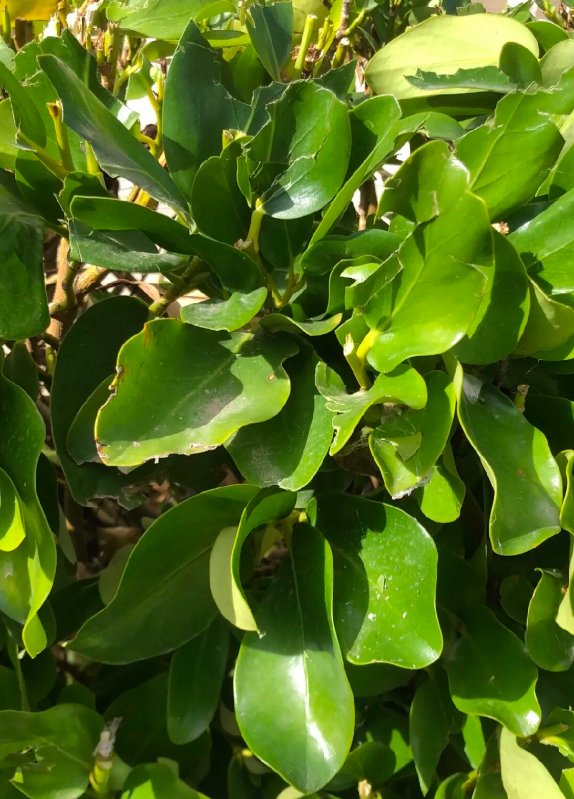
Puka
Botanical name: Griselinia lucida
Synonyms: Scopolia lucida
Common name(s): Puka, Akapuka, Akakōpuka, Shining broadleaf
About:
A distinctive evergreen shrub or small tree best known for its exceptionally large, thick, glossy leaves and unusual epiphytic growth habit. Griselinia lucida commonly begins life high in the forks of mature forest trees, eventually producing stout, woody roots that descend toward the forest floor. These aerial roots develop characteristic longitudinal grooves and rough bark. It can also grow terrestrially, particularly on coastal cliffs, rocky outcrops and other exposed sites. Puka is one of only two native New Zealand species of Griselinia and is readily distinguished from broadleaf (G. littoralis) by its much larger, thicker leaves and strongly epiphytic habit.
Natural habitat:
Primarily found in coastal and lowland forest in mild, moist environments, where it frequently grows as an epiphyte or hemiepiphyte in the canopy of large mature trees. It also grows terrestrially on coastal cliffs, rocky outcrops, lava fields and steep rocky sites. As an epiphyte it favours well-lit positions in mature forest canopies.
Growing environment:
Sun, Partial Shade, Coastal, Wind & Moist conditions tolerant. Prefers mild, humid environments with adequate moisture and good drainage. Young plants establish best where they receive reliable moisture and good light without severe exposure.
Endemic distribution:
Endemic to New Zealand. Widespread through the North Island but more restricted in the South Island, where it occurs mainly in mild coastal and western districts, extending south at least to the Milford Sound area of Fiordland.
Height:
Usually up to 8 m tall, occasionally approaching 10 m when well established.
Width:
Can develop a broad spreading crown approximately 5–8 m wide in favourable situations, particularly when established within a forest canopy.
Flowering:
Spring – Summer
Produces small, inconspicuous cream, yellowish or greenish flowers in branched clusters near the ends of branchlets. Male and female flowers are generally produced on separate plants. Pollination is thought to involve both insects and wind.
Fruiting:
Summer – Winter
Produces small oval fleshy fruits approximately 5–10 mm long. These ripen to dark purple and contain a single seed. Fruit may ripen progressively over an extended period and is readily eaten by native birds.
Uses:
• Native specimen tree
• Coastal planting
• Forest restoration
• Epiphytic and forest-garden planting
• Rocky and cliff gardens
• Native bird food source
• Traditional Māori medicinal use
• Historically used for timber
Appearance:
Growth habit:
An evergreen shrub or small tree with a broad, spreading crown. It frequently begins life as an epiphyte in the forks of established forest trees. As the plant enlarges, stout woody roots descend from the host toward the ground, eventually allowing the plant to function as a hemiepiphyte. Terrestrial plants develop into conventional shrubs or small trees.
Leaves:
Leaves are alternate, exceptionally thick, leathery, smooth and highly glossy dark to bright green above, with a distinctly paler underside. They are broadly ovate to oblong and can reach approximately 18 cm long and 12 cm wide. The base is characteristically uneven or asymmetrical, while the tip is generally rounded. Young foliage may develop reddish-purple margins.
Flowers:
Flowers are small, approximately 1–3 mm long, and cream, yellowish or greenish. They occur in branched terminal flower clusters and are relatively inconspicuous compared with the plant’s dramatic foliage.
Fruit:
Fruits are small, fleshy and oval, approximately 5–10 mm long. They mature to dark purple and retain a small ring-like structure at the tip. Each fruit contains a single seed.
Ecology:
Puka has an unusual ecological role as one of New Zealand’s prominent woody epiphytes. Seed deposited by birds into branch forks and accumulated canopy debris can germinate above ground. Young plants develop within this elevated organic material before producing large descending roots that may eventually reach the soil.
The fruits provide food for native birds including kererū, tūī, korimako/bellbird and tauhou/silvereye, which in turn disperse the seeds. Its canopy habit also contributes to the structural complexity of mature native forest.
Associated habitats:
Coastal forest, lowland broadleaf forest, mature podocarp–broadleaf forest, rocky coastal slopes, cliffs, lava fields and humid forest canopies. In northern and central forests it is often associated with large trees such as tawa and pukatea, whose branch forks provide suitable sites for epiphytic establishment. In coastal South Island habitats it may occur alongside kiekie, nīkau and other moisture-loving forest species.
How to grow:
Grow in a sheltered to moderately exposed position with good light, reliable moisture and freely draining soil. Full sun is suitable in mild coastal climates, while partial shade is useful for young plants or in hotter situations.
Although naturally famous for growing epiphytically, it does not need to be established in another tree in cultivation. It grows successfully as a conventional terrestrial shrub or small tree. Its substantial eventual size and spreading root system should be considered when selecting a permanent position.
Keep young plants consistently moist during establishment. Once established, plants become considerably more robust,
although they perform best where prolonged drought and severe frost are avoided.
Propagation:
Most readily propagated from fresh seed. Collect ripe dark-purple fruit and remove the fleshy outer pulp thoroughly before sowing, as cleaned seed germinates considerably more successfully than seed left within the fruit.
Sow into a moist, free-draining propagation medium and maintain consistent moisture and good light. Fresh seed can have excellent viability and germination may begin relatively quickly under favourable conditions. Seed does not appear well suited to prolonged dry storage, so sowing soon after collection is preferable.
Cultural use:
Puka, akapuka and akakōpuka are recorded Māori names for the species. The inner bark has been associated with traditional preparations for skin complaints. The timber also had limited practical use, including reports of its use for making cartridge holders. European settlers subsequently used the wood for purposes including fence posts and millwright work.
Garden value:
An impressive foliage plant deserving wider cultivation, particularly in mild coastal and northern gardens. Its huge, polished leaves give it a lush, almost subtropical appearance while remaining unmistakably part of New Zealand’s native flora. It makes an excellent specimen for sheltered courtyards, native forest gardens and coastal landscapes.
Its ability to grow terrestrially means gardeners can enjoy the species without recreating its natural epiphytic habitat. Where conditions permit, however, its remarkable descending roots and natural association with mature trees can make it an especially interesting feature in established native forest gardens.