
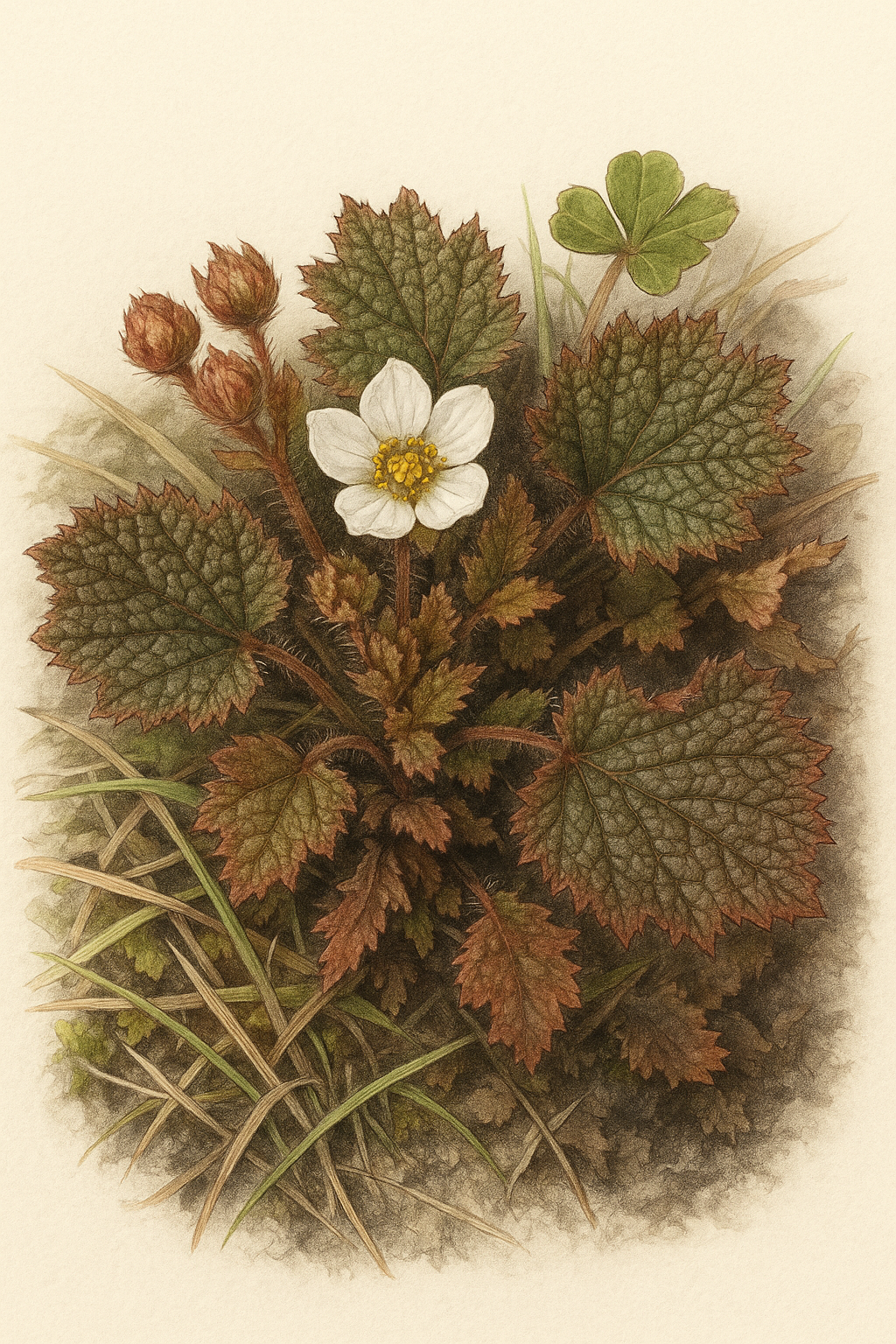
Mountain Avens
Botanical name: Geum leiospermum
Synonyms: Oncostylus leiospermus
Common name(s): Geum, Mountain Avens
About:
A small, delicate perennial herb of New Zealand’s montane and subalpine environments. Geum leiospermum forms a basal rosette of softly hairy, divided leaves and produces slender upright flowering stems carrying small white flowers. Its compact size and ability to inhabit everything from tussock grassland and herbfield to bog margins, snowbanks and fellfield make it a characteristic and adaptable component of New Zealand’s high-country flora.
Natural habitat:
Montane to subalpine environments in scrub, bogs, herbfields, tussock grasslands, fellfields, snowbanks and along stream margins. It occurs in open, cool habitats ranging from relatively moist ground to exposed alpine sites.
Growing environment:
Frost, sun and wind tolerant. Prefers cool conditions and moist but free-draining soil. It performs particularly well where the root zone remains cool and should be protected from excessive heat and prolonged waterlogging.
Endemic distribution:
Endemic to New Zealand. In the North Island it is recorded from Mt Taranaki/Egmont and the Ruahine Range, and it is more widely distributed through the South Island and Stewart Island/Rakiura.
Height:
Up to approximately 25 cm when flowering.
Width:
Approximately 10–20 cm, forming a compact basal rosette.
Flowering:
November–February. Produces small white flowers approximately 6–9 mm across, usually with 2–4 flowers carried on each flowering stem, though occasional plants may produce a solitary flower.
Fruiting:
January–April. Produces numerous narrow, approximately 2 mm long achenes with persistent recurved styles. The fruits are adapted for dispersal by attachment.
Uses:
• Alpine and rock gardens
• Native herbfields
• Tussock garden planting
• Alpine troughs and containers
• Streamside planting in cool climates
• Specialist native plant collections
• High-country restoration
Appearance:
Growth habit:
A small erect perennial herb arising from a relatively slender stock. Leaves are concentrated into a basal rosette, above which slender flowering stems rise to approximately 250 mm. The overall appearance is fine and delicate compared with the more robust Geum cockaynei.
Leaves:
Basal leaves are pinnately divided and reach approximately 120 mm long. They range from sparsely to densely covered in slender white hairs, giving the foliage a softly textured appearance.
Up to 10 pairs of lateral leaflets may be present, although these become strongly reduced and are often minute. The much larger terminal leaflet is approximately 10–25 mm long with distinctly serrated or toothed margins. Stem leaves are few, small and bract-like with deeply toothed margins.
Flowers:
Flowering stems are slender, upright and distinctly hairy, with a mixture of short and long hairs. They are usually simple or only sparingly branched and typically carry 2–4 flowers.
Individual flowers are approximately 6–9 mm across. The small white petals are broadly rounded to almost circular and may reach approximately 5 mm long.
Fruit:
Numerous narrow-oblong achenes develop on an elongated, hairy receptacle. Each achene is approximately 2 mm long and usually smooth and hairless, although occasional hairs may occur around the shoulder. The persistent style is very short, hairless and recurved, assisting attachment and dispersal.
Ecology:
Geum leiospermum occupies a particularly broad range of high-country microhabitats. It can occur amongst tussocks and alpine herbs, beside streams and snowbanks, within boggy ground and in exposed fellfield vegetation.
Its low basal foliage allows it to persist beneath or amongst taller alpine vegetation, while the raised flowering stems position its flowers above the surrounding rosette.
The hooked or recurved fruiting structures enable the achenes to be transported by attachment to passing animals.
Associated habitats:
Montane and subalpine scrub, tussock grassland, alpine herbfield, bogs, fellfield, snowbanks and stream margins.
Associated vegetation varies considerably with altitude and moisture but commonly includes native tussocks, sedges, cushion plants and other low-growing montane and alpine herbs.
How to grow:
Best grown in a cool position with good light and moist but well-drained soil. A gritty alpine mix containing sufficient organic material to retain some moisture provides suitable conditions.
In cooler regions it can be grown successfully in a rock garden amongst other small alpine species. In warmer districts, an alpine trough, pot or alpine house is preferable, allowing better control of root temperature and moisture.
Avoid hot, humid, poorly ventilated situations. The soil should not be allowed to remain saturated for extended periods, but plants should also be protected from severe summer drying.
Propagation:
Best propagated from fresh seed. Sow into a fine, free-draining medium and maintain cool, evenly moist conditions.
Young seedlings should be handled carefully because of their relatively small size. Once established, they can be transferred to individual pots and grown on under cool, well-lit conditions before planting into their permanent position.
Cultural use:
No specific traditional Māori uses for Geum leiospermum are widely documented. Its significance is primarily ecological and botanical as a distinctive endemic component of New Zealand’s montane and subalpine flora.
Garden value:
A charming small native for alpine enthusiasts and naturalistic high-country gardens. Its softly hairy divided foliage, compact rosette and delicate white flowers work particularly well amongst rocks, small tussocks and other alpine herbs.
Its modest size also makes Geum leiospermum particularly suitable for alpine troughs and containers, where the fine detail of its foliage and flowers can be appreciated at close range.