
Small-leaved Geranium
Botanical name: Geranium microphyllum
Synonyms: None
Common name(s): Small-leaved Geranium
About:
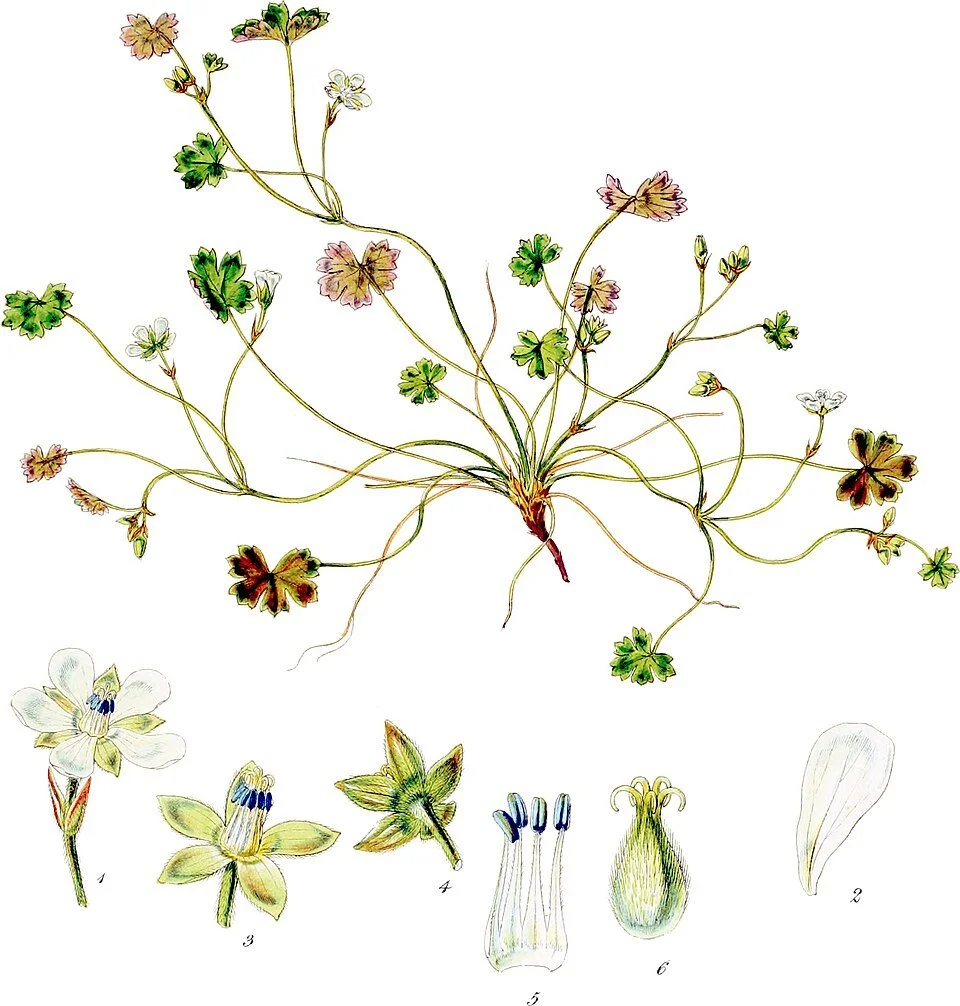
A low-growing perennial geranium endemic to New Zealand’s subantarctic islands. Geranium microphyllum grows from a stout, somewhat woody taproot and produces slender, creeping stems carrying softly hairy, deeply divided leaves.
It is the only native Geranium species naturally occurring on the Auckland Islands and Campbell Island/Motu Ihupuku, making it readily identifiable in the field there. Small white flowers are produced through spring and summer, followed by the elongated beaked fruits typical of the geranium family.
Plants are relatively short-lived but readily set seed and can be straightforward to cultivate from fresh seed.
Natural habitat:
A species of subantarctic herbfields, turfs and open ground.
It grows in cool, exposed environments characterised by persistent wind, high rainfall, low summer temperatures and relatively short growing seasons.
Plants occur amongst low herbs, grasses and turf-forming vegetation rather than beneath dense woody cover.
Growing environment:
Best suited to cool, bright conditions with good air movement.
Prefers moist but free-draining soil and is naturally adapted to cold, exposed environments. It is likely to perform poorly in warm or humid climates.
Full sun to light shade is suitable, particularly where roots remain cool.
Endemic distribution:
Endemic to New Zealand’s subantarctic islands.
Known from the Auckland Islands and Campbell Island/Motu Ihupuku.
True Geranium microphyllum in the strict sense appears confined to these islands. Mainland plants historically placed within this species may represent one or more separate taxa.
Height:
Generally less than 20 cm tall, with stems spreading horizontally
Width:
Approximately 20–50 cm depending on growth conditions
Flowering:
October–February
Fruiting:
Exact seasonal information is limited, but fruits develop following the spring and summer flowering period.
Uses:
• Specialist native plant collections
• Subantarctic-themed gardens
• Rock gardens
• Alpine troughs
• Botanical gardens
• Conservation collections
• Educational planting
• Cool-climate native groundcover
Appearance:
Growth habit:
A perennial herb arising from a thick, somewhat woody taproot.
Stems are slender, prostrate and usually branched, although some may become slightly ascending.
The entire plant is covered with soft, fine hairs that generally lie close to the surface and may point either forwards or backwards.
Basal leaves are not usually retained throughout the entire growing season.
Leaves:
Basal leaves are carried on slender petioles reaching up to approximately 17 cm long.
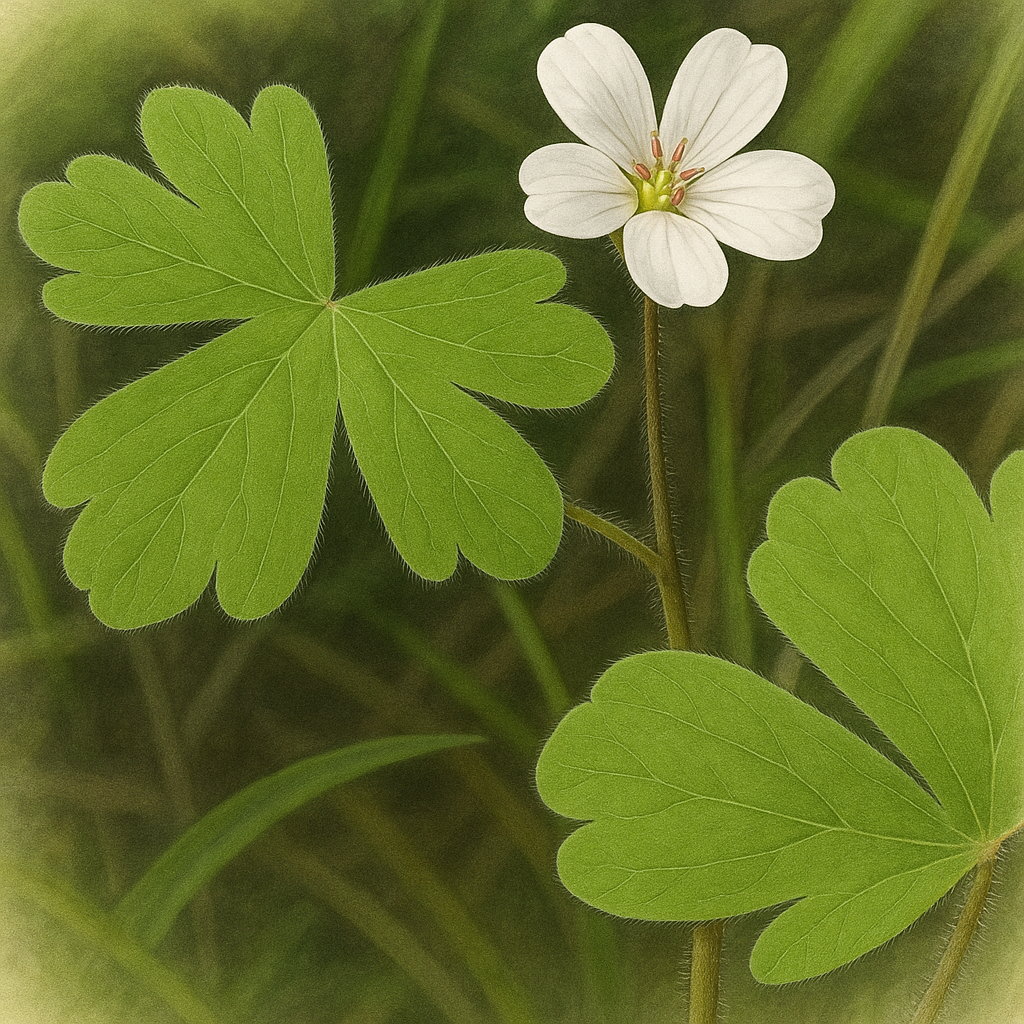
The leaf blade may reach about 4 cm across and ranges from kidney-shaped to circular or broadly ovate.
Leaves are deeply divided, often almost to the midrib, into three to five main lobes. Some leaves may be more shallowly divided.
The lobes vary from narrow to broadly obovate or oblong and are softly hairy on both surfaces.
Tips may be rounded, pointed or end in a very small sharp mucro.
Larger lobes may themselves divide into two secondary lobes.
Leaves produced along the stems are smaller and generally have fewer lobes.
Flowers:
Flowers are carried singly or occasionally in pairs on very slender stalks approximately 1–9 cm long.
The sepals are approximately 3–6 mm long and may be lance-shaped, elliptic or oblong. They commonly have a purple line along the margin and may occasionally become almost entirely purple.
The petals are white, broadly obovate and approximately 4–9 mm long.
The flowers are delicate and relatively large compared with the low, fine-textured foliage.
Fruit:
The developing fruit has the characteristic elongated beak typical of Geranium.
Individual mericarps are approximately 2–2.8 mm long and moderately hairy, while the beak is approximately 6–11 mm long.
At maturity the fruit separates and releases the seeds through the spring-loaded dispersal mechanism characteristic of the genus.
Seeds:
Seeds are approximately 1.5–1.9 mm long, oblong and mostly smooth, although they may occasionally show very fine surface reticulation.
Seed is dispersed by ballistic projection as mature fruits split apart. Wind and possibly attachment to animals may assist secondary dispersal.
Ecology:
Geranium microphyllum is a specialised component of New Zealand’s subantarctic herbfield and turf vegetation.
Its creeping habit keeps much of the plant close to the ground, reducing exposure to persistent winds. The stout rootstock provides a strong perennial base from which new growth can develop during the relatively short growing season.
Although perennial, individual plants may be comparatively short-lived. Regular seed production therefore plays an important role in maintaining populations.
Its Facultative Upland wetland indicator rating reflects its occurrence primarily in non-wetland habitats, although plants may sometimes grow where soils remain consistently moist.
Associated habitats:
Subantarctic herbfield, turf, open grassland, exposed ground and low-growing coastal to upland vegetation.
Associated plants include native grasses, small sedges, cushion plants, creeping herbs and other species adapted to the cool, wet and windy conditions of New Zealand’s subantarctic islands.
How to grow:
Best treated as a specialist cool-climate plant.
Grow in a bright, open position using a free-draining but moisture-retentive mix containing fine gravel, pumice or coarse sand together with moderate organic matter.
Keep the root zone cool and evenly moist during active growth, but avoid stagnant water around the crown.
Excellent ventilation is important, especially outside its naturally cool subantarctic environment.
It is likely to perform best in alpine troughs, specialist containers, cool rock gardens or botanical collections where summer heat can be moderated.
Plants are naturally short-lived, so allowing them to set seed is important for maintaining a cultivated population.
Propagation:
Easily propagated from fresh seed.
Collect mature seed before the fruit has completely sprung open and dispersed it.
Sow into a fine, free-draining seed-raising medium and cover lightly.
Maintain consistent moisture and cool conditions. Exposure to natural winter temperatures may benefit germination.
Seedlings can be pricked out once sufficiently large to handle but should be disturbed as little as practical because of their developing taproot.
Allow some mature plants to seed naturally to maintain successive generations.
Cultural use:
No specific traditional Māori uses are widely documented for Geranium microphyllum.
Its distribution on the remote Auckland and Campbell islands makes it primarily significant as part of New Zealand’s distinctive subantarctic flora.
The name microphyllum means “small-leaved”, referring to the relatively small foliage of the species.
Garden value:
A delicate and unusual native geranium best suited to specialist collections and cool-climate gardens.
Its softly hairy divided foliage, creeping habit and clean white flowers give it a subtle alpine character that works particularly well in troughs and rock gardens.
The plant has additional botanical interest because true Geranium microphyllum appears restricted to New Zealand’s subantarctic islands and is the only naturally occurring geranium there.
For growers able to provide cool summers, good drainage and consistent moisture, it offers an attractive representation of one of Aotearoa’s most remote and distinctive plant communities.