
Ultramafic Gentian
Botanical name: Gentianella stellata
Synonyms: None
Common name(s): Ultramafic Gentian
About:
Ultramafic Gentian is a distinctive, naturally uncommon gentian endemic to the ultramafic landscapes of the northern South Island. It is a biennial herb that forms a basal rosette before producing one or more upright flowering stems, which may reach more than 70 cm tall.
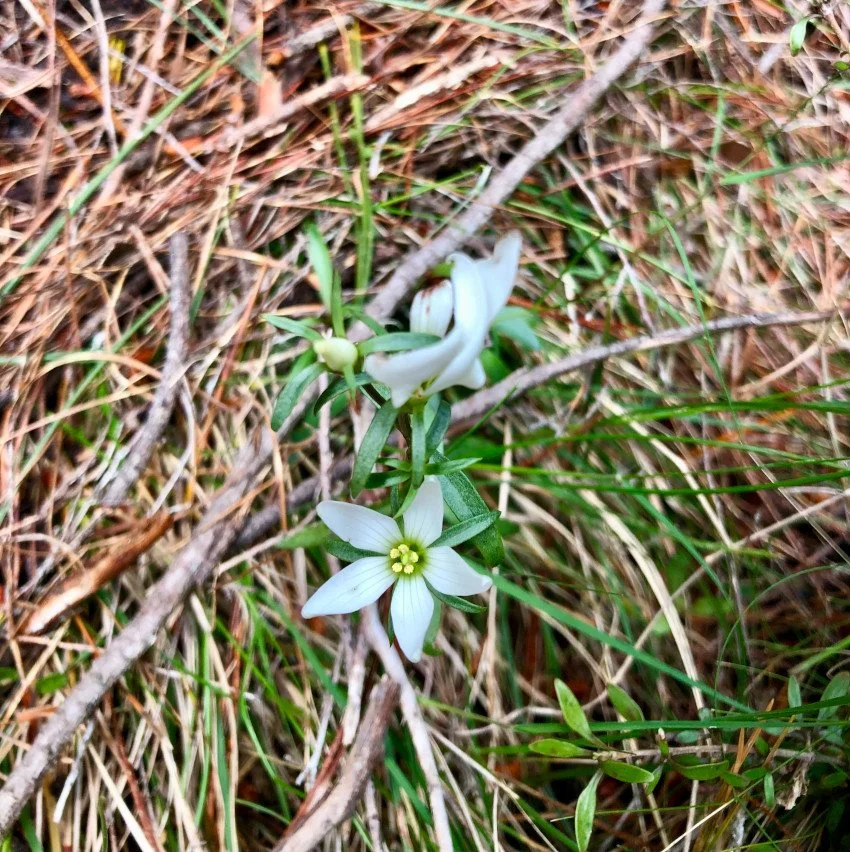
The thick, strongly channelled and recurved leaves are an adaptation to the harsh, nutrient-poor conditions of ultramafic soils. Flowering plants produce numerous comparatively large, star-like white flowers with conspicuous yellow or occasionally blue-black anthers.
Each plant flowers only once before dying, making successful seed production and establishment essential to maintaining populations.
Natural habitat:
Montane shrubland and scrub developed over ultramafic rock and soils.
It occurs particularly amongst mānuka (Leptospermum scoparium) and square-stemmed sedge (Lepidosperma australe) shrubland, as well as open rocky areas and sparsely vegetated ultramafic ground.
These habitats are naturally difficult environments for plants because ultramafic soils are typically nutrient-poor, chemically unusual and often shallow, rocky and prone to drying.
Growing environment:
Requires conditions resembling its specialised ultramafic habitat: open exposure, excellent drainage, low soil fertility and relatively low competition from surrounding vegetation.
Plants occur in full sun to lightly sheltered positions within montane shrubland. They tolerate exposed conditions and poor, rocky substrates but are unlikely to perform well in rich garden soils or warm, humid environments.
Endemic distribution:
Endemic to New Zealand and restricted to the northern South Island.
Nelson and Marlborough: D’Urville Island/Rangitoto ki te Tonga, Bryant Range, Dun Mountain, Mt Starveall and the Red Hills of the Richmond Range.
This extremely localised distribution closely follows the region’s distinctive ultramafic geological formations.
Height:
18–73 cm when flowering
Width:
Approximately 10–25 cm
Flowering:
March–August, principally March–April
Fruiting:
April–September
Uses:
• Specialist native plant collections
• Ultramafic habitat restoration
• Conservation planting
• Botanical gardens
• Educational collections
• Native alpine and montane gardens
• Pollinator planting
• Geological and ecological demonstration gardens
Appearance:
Growth habit:
A biennial, monocarpic herb that flowers once before dying.
Plants develop a distinct basal rosette before flowering. The caudex is usually unbranched, although occasionally it develops short branches approximately 30 mm long.
One to six flowering stems may be produced. A strong central terminal stem is characteristic, with additional erect lateral stems sometimes present.
Flowering stems range from green to crimson, bronze or dark purple-black and carry three to six pairs of leaves.
Leaves:
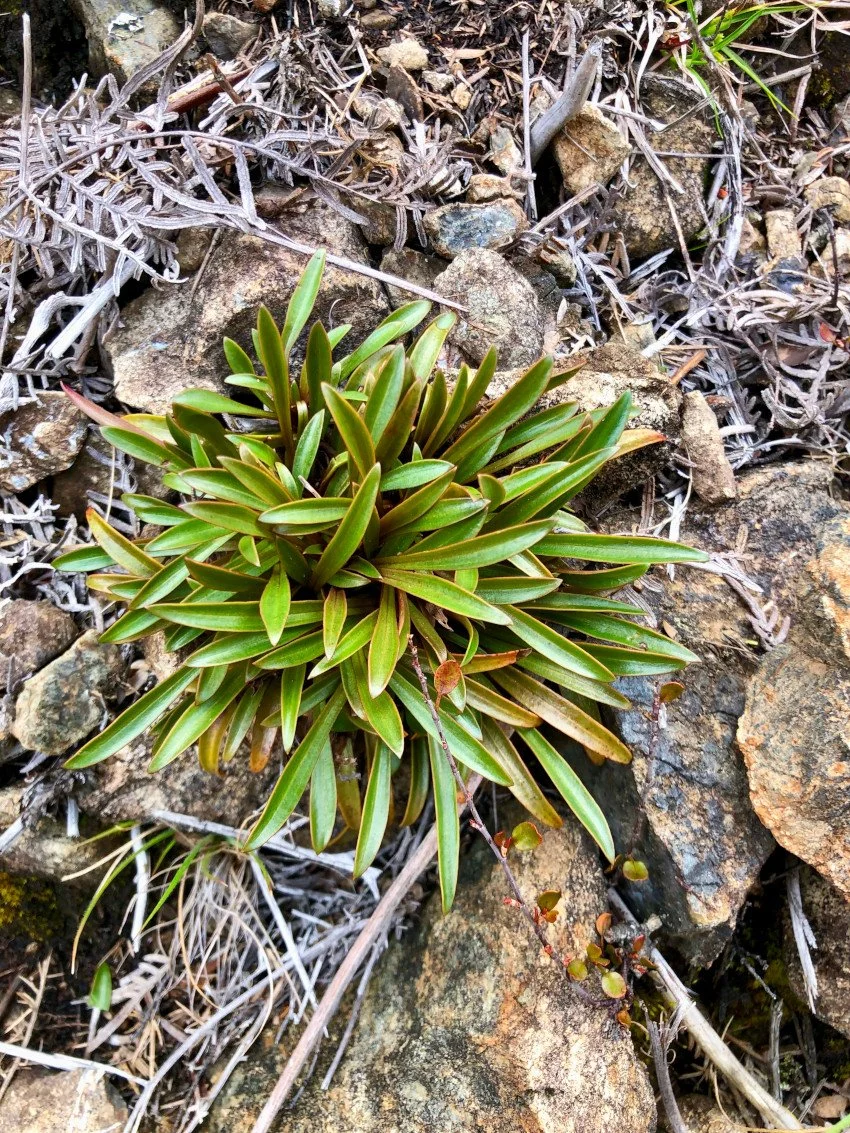
Rosette leaves are narrowly elliptic to elliptic and approximately 12–100 mm long and 4–19 mm wide.
They are unusually thick in texture and may be green, crimson-flushed, bronze or dark purple-black.
The leaves range from slightly to strongly channelled and are characteristically recurved. Tips may be acute or rounded.
There is no distinct petiole, with the leaf blade continuing directly to its relatively broad base.
Leaves on the flowering stems are smaller and usually ovate, strongly channelled and strongly recurved.
The thick, folded foliage is one of the useful characteristics separating this species from related gentians.
Flowers:
Plants usually carry 11–38 flowers, although particularly vigorous specimens may produce nearly 60.
Individual flowers are approximately 14–29 mm long and are borne singly or occasionally in pairs from the leaf axils.
The corolla is white and lacks coloured veins. Its broad lobes are approximately 12–19 mm long and spread widely, producing the star-like appearance reflected in the name stellata.
The calyx is green or crimson and approximately 6–13 mm long. Its narrow, pointed lobes are distinctly recurved.
The anthers are approximately 1.7–3.1 mm long. Their walls may be yellow or blue-black, while the anther mouths are conspicuously yellow.
The stigma is usually colourless but may have a slight blue tint.
Fruit:
The fruit is a dry capsule approximately 12–21 mm long.
As the ovary matures it characteristically develops purple colouring. Mature capsules eventually split open and release numerous small seeds.
Seeds:
Each ovary contains approximately 18–68 ovules.
Seeds are dispersed initially through the springing or ballistic action of the mature capsule. Wind and flowing surface water then assist movement across the open rocky habitat.
Because each plant dies after flowering, successful seed production and the availability of suitable open germination sites are fundamental to population persistence.
Ecology:
Ultramafic Gentian is a specialised component of the distinctive ultramafic flora of Nelson and Marlborough.
Ultramafic soils are derived from magnesium- and iron-rich rocks and typically have low concentrations of essential plant nutrients together with chemical conditions that many plants cannot tolerate. This creates open vegetation containing a distinctive assemblage of specially adapted native species.
The thick, recurved and strongly channelled leaves of Gentianella stellata are characteristic of its adaptation to these exposed, nutrient-poor environments.
Its restriction to ultramafic substrates also helps distinguish it from the closely related Gentianella tenuifolia.
Although naturally uncommon and geographically restricted, populations may vary from sparse to locally abundant where suitable habitat remains intact.
Associated habitats:
Ultramafic shrubland, mānuka scrub, sedgeland, open montane scrub, rocky slopes, exposed mineral soils and sparsely vegetated ultramafic ground.
Characteristic associated plants include mānuka (Leptospermum scoparium), square-stemmed sedge (Lepidosperma australe) and other specialised plants of the Nelson–Marlborough ultramafic zone.
The Dun Mountain, Bryant Range, Richmond Range and Red Hills ultramafic landscapes support particularly distinctive native plant communities.
How to grow:
Ultramafic Gentian is difficult to cultivate and should be regarded primarily as a conservation and specialist botanical species.
Its natural habitat should be replicated as closely as possible using a very freely draining, low-fertility mineral substrate. Rich composts, highly fertilised potting mixes and persistently wet soils should be avoided.
Provide full sun, excellent air movement and cool conditions. The growing medium should remain sufficiently moist to prevent complete desiccation while draining rapidly after watering.
Competition from vigorous surrounding plants should be minimised.
Because of its highly specialised habitat requirements, ordinary garden conditions may not provide the soil chemistry and environmental conditions necessary for long-term success.
Wild plants should never be removed.
Propagation:
Propagation is by seed and is considered difficult.
Fresh, legally and appropriately sourced seed should be sown into a low-fertility, mineral-rich and extremely free-draining medium.
Seed should be covered only lightly, with natural seasonal temperature fluctuations allowed to assist germination.
Seedlings should be maintained in cool, bright and well-ventilated conditions and protected from excessive moisture, fungal disease and competition.
Because the species is monocarpic, cultivation depends upon allowing flowering plants to complete fruit development and produce the next generation of seedlings.
For restoration or conservation purposes, seed should be sourced from the appropriate local population to preserve the genetic integrity of its geographically isolated populations.
Cultural use:
No specific traditional Māori uses are widely documented for Gentianella stellata.
The species nevertheless forms part of the distinctive indigenous flora associated with the mineral-rich ultramafic landscapes of Te Tauihu, the northern South Island.
The botanical name stellata means “starry” or “star-shaped”, referring to the appearance of its widely spreading white flowers.
Garden value:
Ultramafic Gentian is primarily valuable as a specialist conservation and botanical plant rather than a conventional garden species.
Its large star-like white flowers with contrasting yellow anthers, thick recurved foliage and bronze to purple-black pigmentation make it an exceptionally distinctive native herb.
It is especially significant in Nelson–Marlborough because its natural distribution is centred on the region’s remarkable ultramafic landscapes, including Dun Mountain, the Bryant and Richmond ranges and the Red Hills.
Where successfully cultivated, it is best displayed in a specialist rock garden, mineral bed or conservation collection designed specifically to reproduce the open, low-fertility conditions of its natural habitat.\