
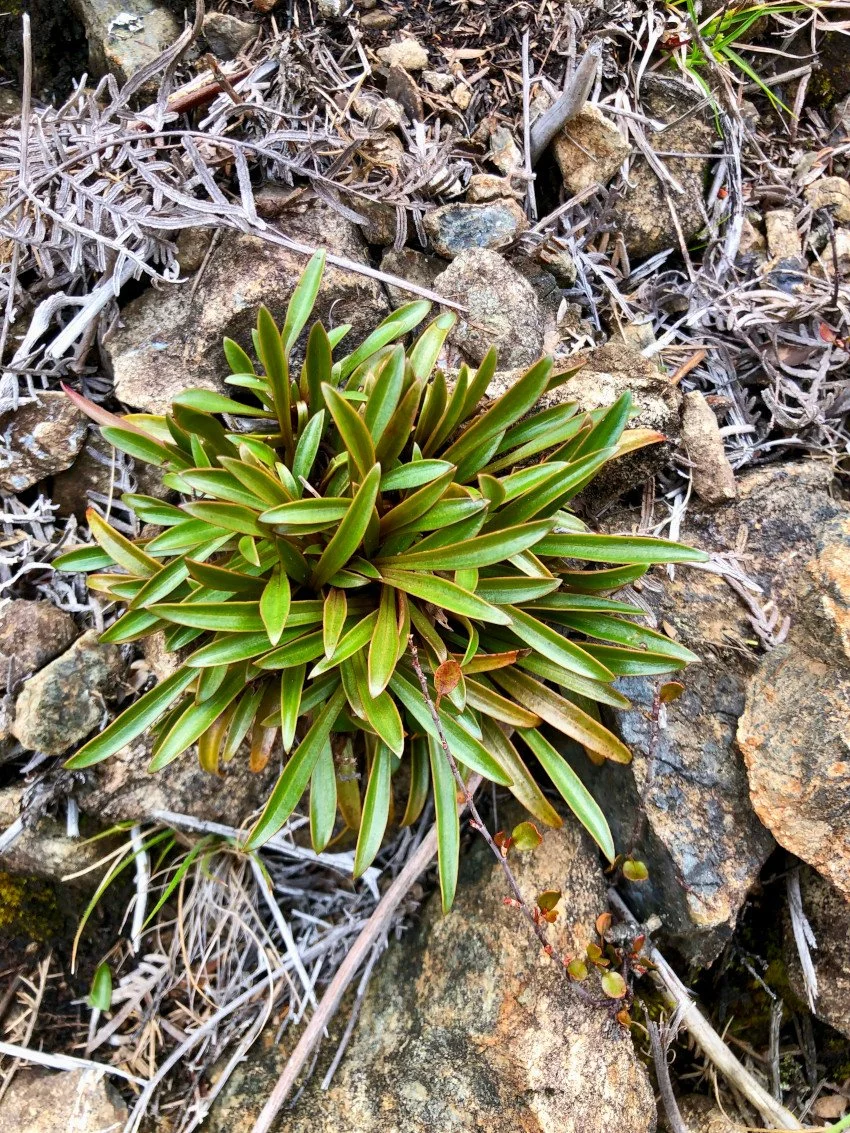

New Zealand Gentian
Botanical name: Gentianella bellidifolia
Synonyms: Gentiana bellidifolia; Gentiana bellidifolia var. australis; Gentiana flaccida; Chionogentias bellidifolia
Common name(s): Gentian, New Zealand Gentian, Mountain Gentian
About:
Gentianella bellidifolia is a beautiful perennial alpine herb producing rosettes of fleshy green leaves and conspicuous white flowers during late summer and autumn. North Island plants may have fine grey-violet veins running through the petals, while South Island flowers are generally pure white.
Unlike many short-lived gentians, it is polycarpic, meaning established plants can flower repeatedly over several years. Flowering stems arise laterally from beneath the leaf rosettes and may carry anything from a single flower to numerous large blooms.
Natural habitat:
Naturally occurs from the subalpine zone into high alpine environments.
It inhabits tussock grasslands, herbfields and fellfields, including open rocky ground and exposed mountain slopes. Plants are adapted to cool conditions, intense sunlight, frost, wind and relatively short growing seasons.
Growing environment:
Requires cool, open conditions with excellent drainage and reliable moisture during active growth.
It grows naturally in exposed subalpine and alpine environments and tolerates severe frost, snow and wind. In cultivation it requires a sharply draining, low-nutrient growing medium and is poorly suited to warm, humid or permanently wet garden conditions.
Endemic distribution:
Endemic to New Zealand.
Occurs in the North and South Islands from the Pureora region southwards through the principal mountain ranges.
Height:
8–37 cm when flowering
Width:
Approximately 10–30 cm
Flowering:
February–April
Fruiting:
March–June
Uses:
• Alpine and rock gardens
• Specialist native collections
• Botanical collections
• Cool-climate gardens
• Alpine restoration using appropriately sourced plants
• Educational planting
• Native herbfields
Appearance:
Growth habit:
A compact perennial alpine herb arising from a short, stout caudex approximately 15–90 mm long.
Plants form distinct basal leaf rosettes and lack stolons. The caudex may remain simple or develop several branches as plants mature.
Between 1 and 13 flowering stems may develop from an established plant. These arise laterally from beneath the apex of the leaf rosette rather than directly from its centre, an important identification feature.
Flowering stems are erect to somewhat spreading or decumbent and may be green, bronze or flushed purple-black.
Leaves:
Basal leaves form conspicuous rosettes and are distinctly larger than those produced on the flowering stems.
Leaves vary considerably in shape, ranging from narrowly elliptic and elliptic to rhomboid or almost circular. They are approximately 11–140 mm long and 4–12.5 mm wide.
The foliage is usually green but may develop bronze or purple-black pigmentation, particularly in exposed alpine conditions. Leaves are somewhat fleshy and channelled, with larger leaves becoming distinctly V-shaped in cross-section.
The leaf tip varies from acute to rounded, and basal leaves usually narrow into a distinct petiole approximately 7–27 mm long.
Flowering stems carry approximately 2–4 pairs of smaller, sessile elliptic to narrowly ovate leaves.
Flowers:
Flowers are large relative to the plant, approximately 12–23 mm long, and may be produced singly or in loose clusters.
Established specimens may carry from 1 to around 45 flowers.
The corolla is approximately 15.6–22.6 mm long and divided deeply into broad spreading lobes. South Island plants generally have white flowers, while North Island populations may have conspicuous fine grey-violet veins.
The calyx is green or may be flushed purple-black, crimson or brown. Its narrow, pointed lobes surround the base of the corolla.
The anthers are particularly distinctive, with blue-black walls contrasting with yellow openings.
Fruit:
Following flowering, an elongated capsule develops, typically measuring approximately 17–24 mm long.
The mature ovary is usually yellow and contains numerous small seeds.
Seeds:
Each ovary contains approximately 16–68 seeds.
Seed dispersal occurs through a combination of ballistic projection, wind and water. Movement of the flexible fruiting stems helps scatter mature seed into surrounding open alpine ground.
Ecology:
Gentianella bellidifolia is characteristic of open subalpine and alpine vegetation where competition from taller plants is limited by cold temperatures, exposure and relatively infertile soils.
Its flowers provide nectar and pollen for alpine insects during the relatively short late-summer flowering season.
The perennial, polycarpic growth habit allows established plants to survive successive alpine seasons and flower repeatedly when conditions are favourable.
Plants are adapted to substantial fluctuations in temperature, strong ultraviolet exposure, frost, snow and persistent mountain winds.
Associated habitats:
Subalpine tussock grassland, alpine herbfield, fellfield, rocky slopes, open mountain vegetation and exposed alpine terraces.
Associated plants may include Chionochloa snow tussocks, Celmisia, Aciphylla, Ourisia, Raoulia, Dracophyllum, native buttercups, alpine Coprosma and other native gentians.
How to grow:
This is a specialist alpine species and can be difficult to maintain successfully in cultivation.
Provide a cool, exposed position with full sun and exceptional drainage. A gritty, low-fertility alpine medium containing pumice, coarse sand or fine gravel is preferable to rich garden soil.
Maintain sufficient moisture during active growth without allowing the root system to remain saturated. Good air circulation is important, particularly in warmer climates.
Plants are much more likely to succeed in cool-climate alpine gardens or specialist containers where drainage, moisture and summer temperatures can be carefully controlled.
Wild plants should not be removed for cultivation.
Propagation:
Propagation is primarily from seed but can be difficult.
Fresh, correctly sourced seed should be sown onto a sharply draining alpine propagation medium and exposed to natural seasonal temperature fluctuations. Cool stratification may assist germination by reproducing the winter conditions experienced in its natural habitat.
Seedlings should be handled carefully and protected from excessive heat, fungal disease and waterlogging.
Plants should be propagated from cultivated or legally collected seed rather than removed from wild populations.
Cultural use:
No specific traditional Māori uses are widely documented for Gentianella bellidifolia.
The species nevertheless forms part of New Zealand’s distinctive alpine flora and is representative of the highly specialised plant communities that occupy the country’s mountain environments.
The specific epithet bellidifolia means “daisy-leaved”, referring to the appearance of its basal foliage.
Garden value:
Gentianella bellidifolia is an outstanding specialist alpine plant valued for its compact rosettes and comparatively large white flowers.
The combination of white petals, sometimes delicately traced with grey-violet veins, dark anthers and occasionally bronze or purple-flushed foliage gives flowering specimens considerable ornamental appeal.
It is best regarded as a plant for dedicated alpine enthusiasts, specialist collections and cool-climate rock gardens rather than conventional landscaping. Where suitable conditions can be provided, it is a striking example of New Zealand’s native alpine flora.