

Hangehange
Botanical name: Geniostoma ligustrifolium var. ligustrifolium
Synonyms: Geniostoma rupestre var. ligustrifolium
Common name(s): Hangehange, Hange Hange, Pāpā, New Zealand Privet
About:
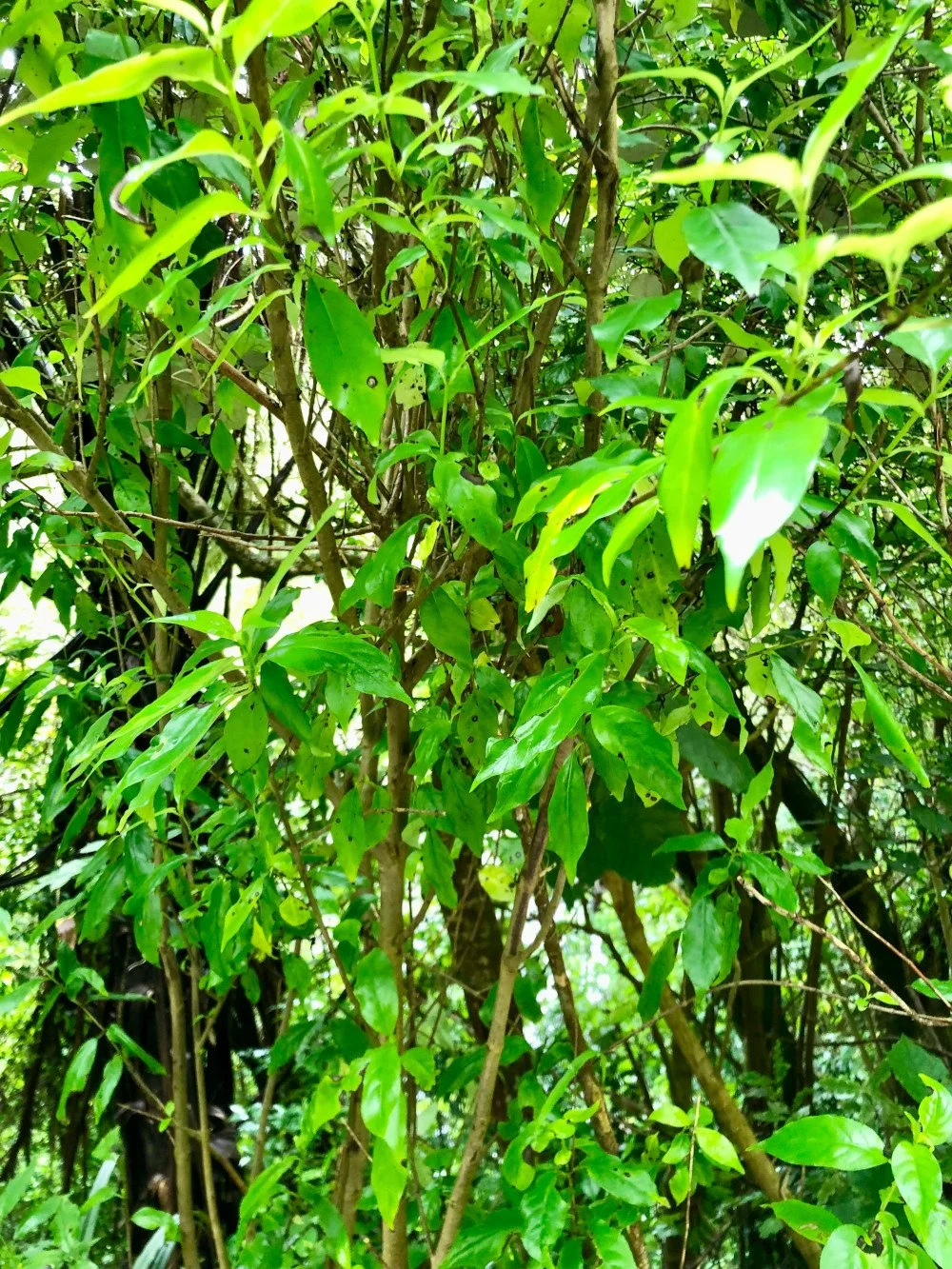
Hangehange is an attractive evergreen shrub or small tree recognised by its soft, pale apple-green foliage, distinctly paler leaf undersides and small clusters of fragrant greenish-white flowers. Its light foliage provides a noticeable contrast against the darker greens typical of New Zealand forest.
The flowers develop into small dry capsules that split open when ripe, exposing conspicuous orange seeds. It is a relatively fast-growing and adaptable native, particularly suited to sheltered forest margins, restoration planting and woodland gardens.
Natural habitat:
Common in coastal and lowland forest, particularly along forest margins, tracks, clearings, stream sides and within regenerating vegetation.
It occurs beneath relatively open forest canopies and in disturbed forest where sufficient light reaches the understorey. Hangehange generally favours sheltered sites with reasonably fertile, moist but freely draining soils.
Growing environment:
Grows best in partial shade to filtered sun in fertile, humus-rich soil with reliable moisture and good drainage.
It tolerates considerable shade but tends to develop more densely where adequate light is available. Young plants benefit from shelter from strong winds and severe frost. Once established it is reasonably hardy and adaptable, although prolonged drought and exposed, dry sites are less suitable.
Endemic distribution:
Endemic to New Zealand.
Widespread through the North Island and extending into the northern South Island, including the Marlborough region.
Height:
Usually 2–4 m, occasionally taller in favourable forest conditions
Width:
Approximately 1.5–3 m
Flowering:
Spring–early summer
Fruiting:
Summer–autumn
Uses:
• Native forest restoration
• Forest-edge planting
• Understorey planting
• Woodland gardens
• Shelter and screening
• Bird-friendly gardens
• Revegetation projects
• Informal native hedging
• Māori medicinal use
Appearance:
Growth habit:
An erect, much-branched evergreen shrub or small tree, usually developing a rounded to spreading crown.
Plants growing in open, sheltered conditions tend to become dense and bushy, while specimens beneath a forest canopy may develop a more open form.
Stems:
Young branchlets are slender, green to greenish-brown and become increasingly woody with age.
Older stems develop relatively smooth grey-brown bark. Branching is generally dense enough to form a leafy, rounded crown under favourable conditions.
Leaves:
Leaves occur in opposite pairs and are typically 5–7 cm long and 2–3 cm wide, although considerable variation occurs.
They are thin, soft and elliptic to ovate or lanceolate, narrowing toward a pointed tip. The upper surface is pale to apple green while the underside is noticeably paler, sometimes appearing silvery or almost whitish.
This pale foliage is one of the easiest features by which hangehange can be recognised in the forest.
Flowers:
Small greenish-white to creamy-white flowers are produced in clusters from the leaf axils.
Individual flowers are relatively inconspicuous and slightly hairy but are often pleasantly musky or sweetly scented. Although visually modest, flowering plants can be noticeably fragrant at close range.
Fruit:
The fruit is a small, dry capsule.
As it matures, the capsule splits into two sections, exposing a cluster of conspicuous orange seeds attached around a central structure. The combination of the opened capsule and bright seeds gives fruiting plants considerable seasonal interest.
Seeds:
Seeds are small and orange when exposed within the opened capsule.
They are eaten by native birds, which provide an important means of seed dispersal. Hangehange may consequently appear naturally beneath perching sites and around established native vegetation.
Ecology:
Hangehange is an important component of coastal and lowland forest understoreys and forest margins.
Its ability to establish in moderately disturbed or regenerating vegetation makes it useful during natural forest succession. Dense foliage provides cover for insects and small birds, while the flowers provide resources for insects.
The exposed seeds are eaten by native birds, which disperse them into surrounding forest and regenerating vegetation.
Associated habitats:
Coastal forest, lowland broadleaf forest, podocarp-broadleaf forest, forest margins, stream margins, regenerating scrub, track edges and sheltered gullies.
It commonly grows alongside species such as māhoe, kawakawa, karamū, pigeonwood, kōhūhū, māpou, putaputawētā, wineberry, tree ferns and young podocarps.
How to grow:
Hangehange is generally straightforward to cultivate when provided with shelter and adequate moisture.
Plant in partial shade or filtered sunlight in fertile, humus-rich soil. It particularly suits woodland gardens and sheltered positions where its naturally pale foliage can contrast with darker-leaved native plants.
Keep young plants consistently moist during establishment and apply organic mulch around the root zone to conserve moisture and maintain cool soil conditions.
Plants respond well to light pruning and can be trimmed to encourage a denser habit. Established plants usually require little maintenance beyond occasional shaping and removal of damaged branches.
Propagation:
Readily propagated from fresh seed.
Collect capsules as they mature and begin to split, revealing the orange seeds. Sow fresh seed into a moist, freely draining propagation medium and maintain in a warm, sheltered position with filtered light.
Seedlings are generally reasonably vigorous once established and can grow rapidly under favourable conditions.
Semi-hardwood cuttings may also be attempted, although seed is usually the most practical propagation method.
Cultural use:
Hangehange has recognised traditional Māori medicinal associations.
Leaves were crushed and applied externally as a poultice to sores, itchy skin and other skin complaints. The soft young foliage has also been recorded in historical accounts, although hangehange should not generally be regarded or promoted as a conventional food plant.
The name New Zealand Privet refers only to the superficial resemblance of its opposite leaves to privet; hangehange is not closely related to true privets (Ligustrum).
Garden value:
Hangehange is an excellent native shrub for sheltered gardens, particularly where a softer, lighter foliage colour is desired.
Its pale apple-green leaves contrast beautifully with dark green forest species, while fragrant spring flowers and orange-seeded capsules provide additional seasonal interest.
It is particularly valuable for establishing a natural forest-edge effect and combines well with ferns, kawakawa, māhoe, karamū, pigeonwood and other shade-tolerant natives.
Its relatively quick growth, tolerance of partial shade, wildlife value and attractive foliage also make it a useful species for native restoration and revegetation projects.