


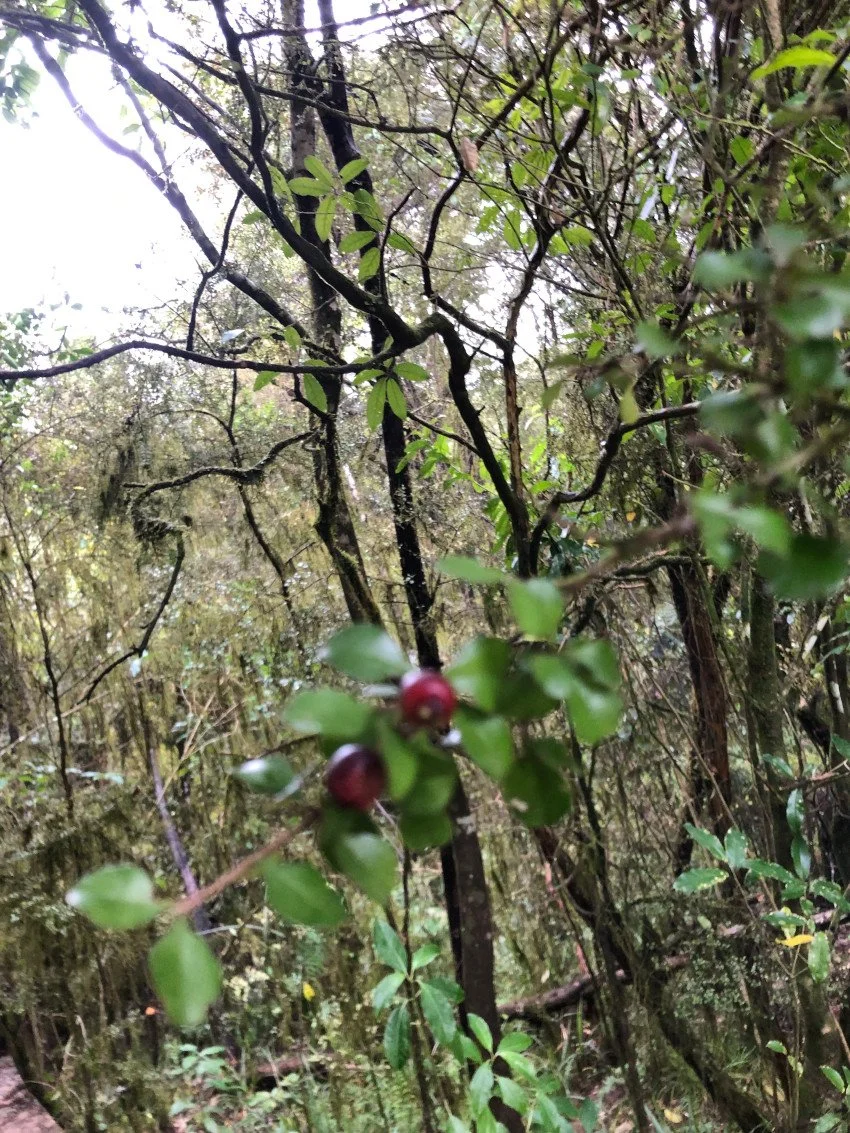

Bush Snowberry
Botanical name: Gaultheria antipoda
Synonyms: Gaultheria epiphyta
Common name(s): Bush Snowberry, Snowberry, Fool’s Beech, Tāwiniwini
About:
Bush Snowberry is a compact evergreen shrub with small, glossy, leathery leaves, delicate white bell-shaped flowers and conspicuous white, pink or red fruit. It forms an upright to spreading bush and is particularly attractive when heavily laden with berries during late summer and autumn.
The species is variable in stature and foliage, reflecting the wide range of rocky, scrubland and upland environments in which it grows. Its dense branching, year-round foliage and colourful fruit make it a valuable native shrub for wildlife gardens and naturalistic planting.
Natural habitat:
Occurs in lowland to subalpine shrubland, open forest margins, rocky places, cliffs, bluffs and exposed scrub.
It is particularly associated with freely drained, open habitats where competition from taller vegetation is limited. Plants may occur in coastal and lowland settings as well as on upland slopes and rocky subalpine sites.
Growing environment:
Prefers full sun or partial shade in moist, humus-rich but freely draining soil.
It performs best in acidic or lime-free soils and tolerates frost, wind and exposed conditions once established. Plants growing in cooler upland environments generally develop a denser, more compact habit.
Endemic distribution:
Endemic to New Zealand.
Found in the North and South Islands, although its distribution is localised in some regions. It occurs from lowland districts into subalpine environments.
Height:
Typically 50 cm–1.5 m, occasionally reaching 2 m
Width:
Approximately 60 cm–1.5 m
Flowering:
October–January
Flowers are often most abundant around November.
Fruiting:
January–May
Fruit may remain on the shrub into autumn.
Uses:
• Native shrub borders
• Rock gardens
• Alpine and subalpine planting
• Wildlife gardens
• Bird and lizard food
• Forest-margin restoration
• Erosion control on rocky slopes
• Edible berry planting
Appearance:
Growth habit:
An evergreen, upright to spreading shrub with numerous densely arranged branches.
Plants growing in exposed sites are usually compact and bushy, while those amongst taller scrub may develop longer, more open branches.
Stems:
The young twigs are characteristically hairy, bearing conspicuous dark or black hairs mixed with shorter, paler hairs.
Older stems become woody and develop pale to dark brown bark. Dense branching creates useful cover for small animals and invertebrates.
Leaves:
Leaves are alternately arranged, rounded to oblong and generally 5–15 mm long, although smaller leaves may occur near the tips of the branches.
They are thick, leathery and glossy green, with several small blunt teeth around the margins. The foliage may develop reddish or bronze tones in cold or exposed conditions.
Flowers:
Small bell-shaped flowers are produced singly from the leaf axils.
They are usually white but may be flushed pale pink or red. Each flower has five fused petals and hangs beneath the leafy branches on a short stalk.
The flowers are bisexual, with both pollen-producing and seed-producing structures present on the same plant.
Fruit:
The fruit is rounded and berry-like, usually white, pink or red, with a distinctly lobed or segmented appearance.
The fleshy outer portion surrounds a dry capsule and has a sweet flavour when fully ripe. Colour may vary between individual plants and populations.
Seeds:
Each fruit contains numerous small seeds.
The fleshy fruit is eaten by birds, lizards and invertebrates, which assist with seed dispersal. Fallen fruit may also establish near the parent plant where suitable open ground is available.
Ecology:
Bush Snowberry provides nectar and pollen for native insects, while its colourful fruit offers seasonal food for birds, lizards and invertebrates.
The dense branching creates shelter for small animals and helps protect the soil surface in exposed rocky and shrubland environments.
Its tolerance of cold, wind and poor soils enables it to occupy sites where taller forest plants struggle to establish.
Associated habitats:
Coastal and lowland scrub, forest margins, rocky cliffs, bluffs, montane shrubland, subalpine scrub and open rocky slopes.
Associated species may include mānuka, kānuka, mingimingi, native broom, Coprosma, Dracophyllum, mountain daisies, tussocks and other native snowberries.
How to grow:
Plant in full sun or partial shade in acidic, humus-rich soil with good drainage.
Water regularly during establishment, but avoid permanently saturated ground. Mulching with leaf mould or fine bark helps maintain a cool root zone and provides the organic conditions naturally favoured by members of the heath family.
Light pruning after fruiting may be used to maintain a compact shape, although established plants generally require little maintenance.
Propagation:
Propagation may be achieved from fresh seed, semi-hardwood cuttings or naturally layered branches.
Clean seed from ripe fruit and surface-sow onto an acidic, free-draining seed mix. Keep evenly moist in a cool, lightly shaded position, as germination may be slow.
Cuttings taken from firm young growth during late summer provide a reliable method of retaining desirable fruit colour and growth habit.
Cultural use:
Tāwiniwini and several other Māori names have been recorded for native snowberries.
The ripe fruit was eaten, while an infusion prepared from foliage identified as tūmingi has been recorded in traditional use for respiratory complaints, including asthma.
The common name Fool’s Beech probably refers to the shrub’s small leathery leaves, which can give it a superficial resemblance to a miniature beech.
Garden value:
Bush Snowberry is an attractive native shrub for rock gardens, shrub borders, forest margins and cool exposed sites.
Its glossy evergreen foliage, delicate bell-shaped flowers and colourful white to red fruit provide interest through several seasons. It is especially valuable in wildlife-friendly gardens where the fruit supports native fauna.
The species combines well with native tussocks, hebes, mountain daisies and other low-growing shrubs in naturalistic upland and alpine-style plantings.