


Hard Beech
Botanical name: Fuscospora truncata
Synonyms: Fagus truncata; Nothofagus truncata
Common name(s): Hard Beech, Tawhairaunui
About:
Hard Beech is a large, long-lived native canopy tree recognised by its massive spreading crown, thick dark bark and glossy leathery leaves with coarse, blunt teeth. Mature trees develop straight cylindrical trunks with strong basal flanges and may become dominant features of lowland and lower montane forests.
Its common name refers to the exceptionally hard timber, which contains enough silica to make it difficult to saw. Hard Beech is closely related to Red Beech but can be distinguished by its thicker leaves, blunter teeth and absence of the small hairy pits usually present beneath Red Beech leaves.
Natural habitat:
Occurs in lowland to montane forest from sea level to approximately 940 metres above sea level.
It commonly grows within mixed broadleaved–podocarp forests and alongside other native beech species. Localised pure stands may develop on ridge crests, knolls, steep slopes and warm northerly faces.
In northern Taranaki it forms extensive forests on rugged sandstone country. Trees in this region may shed a substantial proportion of their leaves near the end of winter.
Growing environment:
Prefers full sun or partial shade in fertile, well-drained soil. It grows particularly well on ridges, slopes and warm forest sites where drainage is reliable.
Young trees benefit from regular moisture during establishment, while mature specimens tolerate wind, frost and periods of moderate dryness. It performs best in cool to mild temperate climates.
Endemic distribution:
Endemic to New Zealand.
Occurs in the North Island from isolated northern populations near Kaitaia and Omahuta south through the Waitākere, Coromandel, Kaimai, Mamaku, Raukūmara, Urewera, Taranaki, Tararua, Remutaka and Aorangi ranges.
In the South Island it occurs through Nelson, Marlborough and northern Westland, extending south to the Taramakau River, with isolated populations near Jackson Bay in South Westland.
Height:
Typically 24–30 m, occasionally reaching approximately 36 m
Width:
Approximately 10–18 m when mature
Flowering:
September–December
Heavy flowering usually occurs during mast years and may temporarily give the canopy a yellow, orange or reddish appearance.
Fruiting:
November–April
The nuts mature during summer and autumn, with especially large crops produced during mast years.
Uses:
• Native forest restoration
• Large-scale revegetation
• Wildlife habitat
• Catchment and erosion protection
• Carbon sequestration
• Specimen tree for parks and large properties
• Timber production
• Shade and shelter
• Honeydew forest establishment
Appearance:
Growth habit:
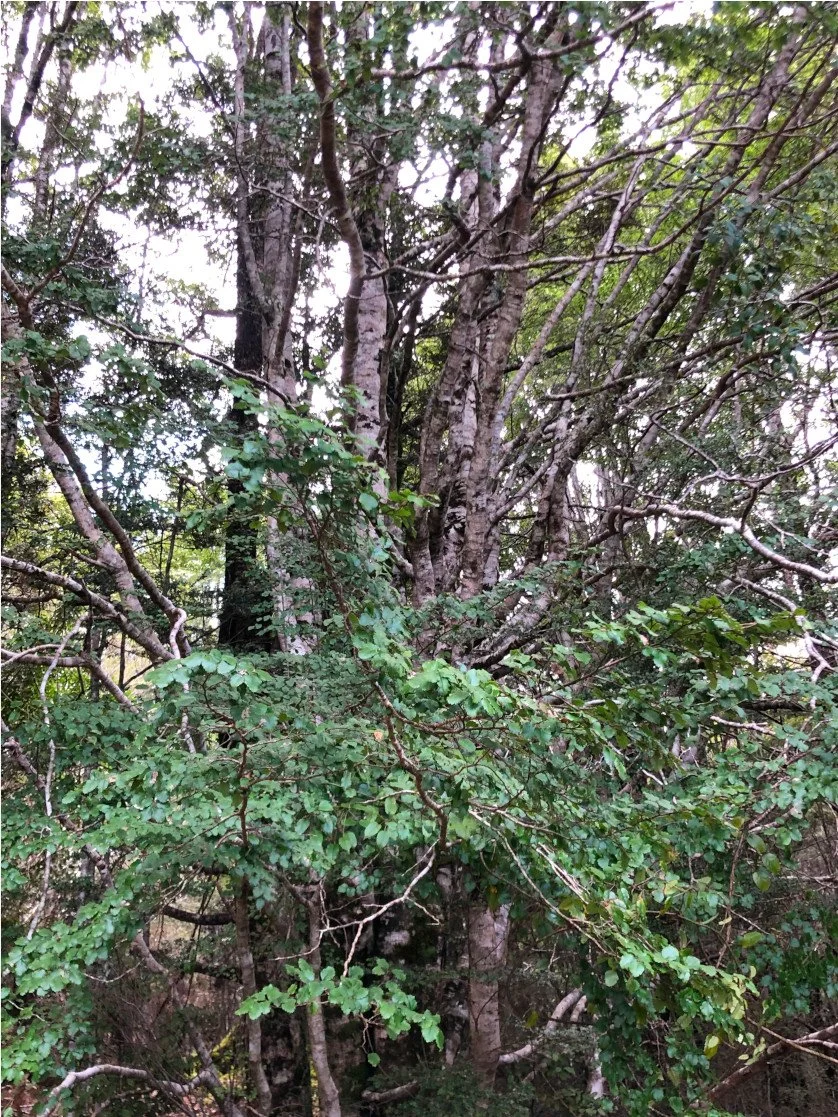
A large evergreen canopy tree with a straight cylindrical trunk and a broad, heavy, spreading crown.
Mature trees often develop pronounced root buttresses and basal flanges. Young trees are more upright and compact, while older specimens form massive crowns with strong horizontal branches.
Trunk/Bark:
The trunk commonly reaches 60 cm–1.2 m in diameter and may occasionally exceed 1.8 m.
Young bark is smooth, thin and ash-grey. With age it becomes thick, fibrous, scaly and deeply fissured, changing to dark slate-grey or almost black.
Fresh sapwood is light yellow-brown, while the heartwood is light pink to pale brown.
Leaves:
Leaves are alternately arranged, broadly oval to almost circular and usually 13–43 mm long.
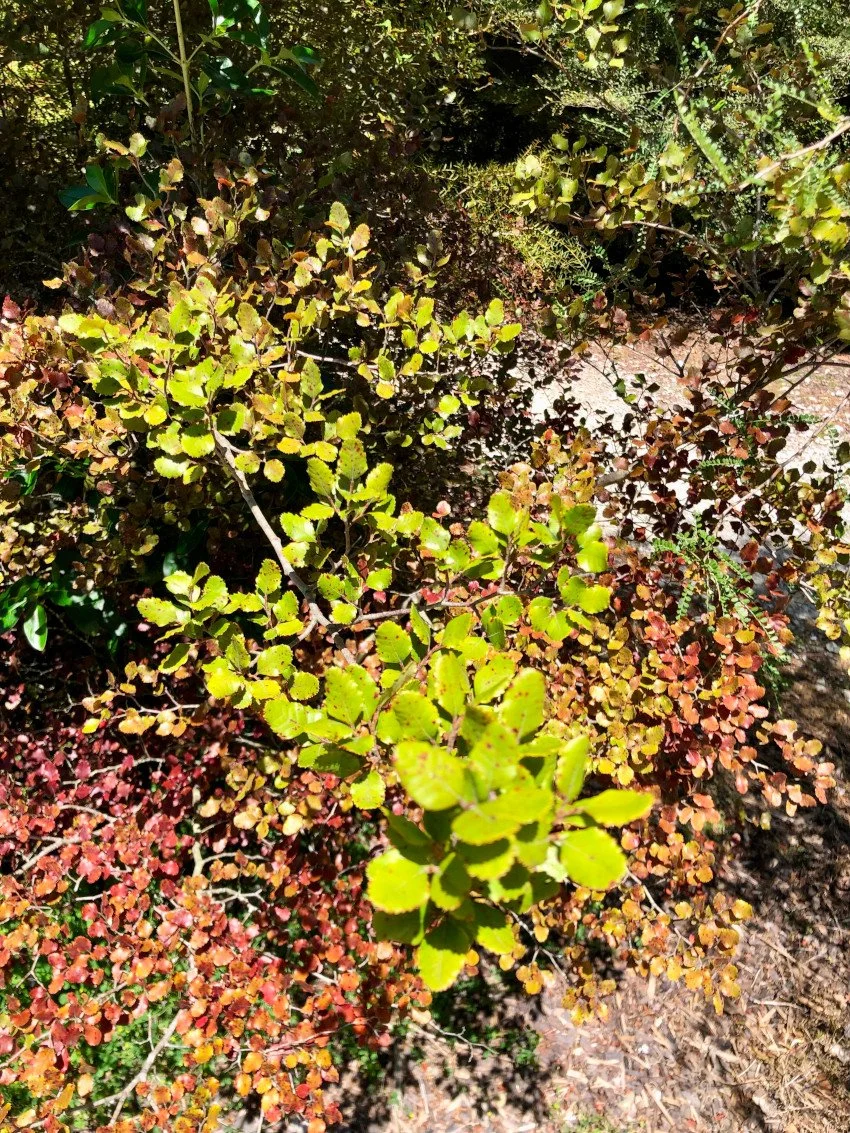
They are thick, leathery and glossy green on both surfaces, although the underside is usually slightly paler. The veins are clearly visible and the base narrows evenly into a short stalk.
The margins bear approximately eight to twelve pairs of coarse, irregular, blunt to slightly pointed teeth. The apex is rounded, blunt or distinctly flattened, giving rise to the species name truncata.
Unlike Red Beech, Hard Beech lacks the fringed hairy pits, or domatia, in the vein axils beneath the leaf.
Juvenile foliage is often smaller and more strongly toothed, with red, bronze or brown colouring.
Flowers:
Small male and female flowers occur separately on the same tree.
Male flowers are produced in clusters on short stalks and contain nine to fourteen stamens. Their anthers may be red, yellow or dark orange and can create a noticeable colour change across the canopy during heavy flowering.
Female flowers occur in groups of three within small cup-like structures that later develop into the fruiting cupules.
The flowers are wind pollinated.
Fruit:
The fruiting cupule is woody, resinous and approximately 7–9 mm long. It divides into four broad triangular valves when mature.
Each cupule usually contains three nuts.
Seeds:
The nuts are approximately 7.5–10 mm long, reddish-brown to brown and either triangular or flattened.
They are dispersed mainly by wind and gravity. During mast years, extremely large seed crops provide food for native birds and invertebrates, although they may also contribute to increases in introduced rodents and mustelids.
Ecology:
Hard Beech is an important canopy tree within northern and central New Zealand forests. Its large crown, deeply fissured bark and extensive root system provide shelter, nesting sites and feeding habitat for native birds, bats and invertebrates.
Like other native beeches, it supports honeydew-producing scale insects. The sugary honeydew is consumed by tūī, korimako / bellbirds, kākā, silvereyes, native wasps, moths and other insects.
The leaves, bark and decaying wood support specialised fungi, mosses, lichens and invertebrates. Dense forests protect catchments, stabilise steep slopes and regulate soil moisture.
Hard Beech hybridises naturally with Black Beech, Fuscospora solandri, producing Fuscospora × apiculata where the two species meet.
Associated habitats:
Lowland forest, montane forest, broadleaved–podocarp forest, mixed beech forest, ridge crests, knolls, sandstone slopes and warm forested faces.
Common associated species include Black Beech, Red Beech, Mountain Beech, rimu, miro, tōtara, kahikatea, kāmahi, broadleaf, māhoe, crown fern and drooping spleenwort.
How to grow:
Plant in full sun or partial shade in deep, well-drained soil. Allow generous room for the broad mature crown and extensive root system.
Water regularly during the first two or three summers and maintain a weed-free area around young trees. A layer of organic mulch helps retain soil moisture, but it should be kept clear of the trunk.
Little pruning is necessary other than removing damaged, crossing or poorly positioned branches while the tree is young.
Hard Beech is unsuitable for small gardens or sites close to buildings, underground services and overhead power lines.
Propagation:
Propagation is most readily achieved from fresh seed collected as the cupules begin to open.
Sow soon after collection because seed viability declines during storage. Use a free-draining seed-raising mix and keep the seed cool and evenly moist until germination.
Cuttings are generally difficult to strike and are rarely used as a practical propagation method.
Cultural use:
The Māori name Tawhairaunui is also used for Red Beech in some regions.
Hard Beech timber was valued for its strength, straight grain and durability. It was used for bridge timbers, railway sleepers, fencing posts, poles, flooring, decking, joinery and cabinetmaking.
The bark contains high concentrations of tannins and was formerly used in leather tanning.
Garden value:
Hard Beech is an impressive specimen tree for parks, farms, reserves and very large gardens. Its glossy toothed foliage, massive crown and deeply textured bark give it strong year-round presence.
It is especially valuable for restoring lowland and montane forest, creating long-lived wildlife habitat and establishing resilient native canopy on ridges and well-drained slopes.