


Kōtukutuku
Botanical name: Fuchsia excorticata
Synonyms: Skinnera excorticata
Common name(s): Kōtukutuku, Kōnini, Tree Fuchsia, Native Fuchsia
About:
Kōtukutuku is New Zealand’s largest native fuchsia and the largest tree-forming species in the genus Fuchsia. It is a graceful, spreading forest tree distinguished by its peeling orange-brown bark, silvery-backed leaves, colourful flowers and edible purple-black berries.
It is also one of the relatively few deciduous native New Zealand trees. Plants in colder regions generally lose their leaves during autumn, while trees in warmer northern districts may remain partly or fully evergreen.
Natural habitat:
Occurs in coastal, lowland and montane forests, particularly beside streams, rivers, forest margins, slips, clearings and other moist or disturbed places.
It is especially common in riparian forest and regenerating woodland, where it may act as an early successional tree. It grows from sea level to approximately 1,050 metres above sea level.
Growing environment:
Prefers moist, fertile soil in full sun, partial shade or open forest conditions. It grows especially well beside streams and in sheltered gullies but can tolerate a surprisingly wide range of soils once established.
It is frost hardy, wind tolerant and suitable for damp ground, although young trees benefit from protection from severe exposure. It has exceptionally low flammability compared with many other native trees.
Endemic distribution:
Endemic to New Zealand.
Widespread throughout the North Island, South Island and Rakiura / Stewart Island, extending naturally as far south as the Auckland Islands. A population on the Chatham Islands is believed to have been introduced.
Height:
Typically 4–13 m
Width:
Approximately 3–8 m, forming a broad spreading crown when mature
Flowering:
August–December
Flowers may occasionally continue outside this period in mild climates.
Fruiting:
December–May
The berries ripen progressively from reddish-purple to deep purple or black.
Uses:
• Riparian restoration
• Stream and wetland margin planting
• Native forest restoration
• Bird habitat and food
• Pollinator planting
• Feature tree
• Edible fruit
• Low-flammability landscaping
• Cultural planting
Appearance:
Growth habit:
A spreading, many-branched tree with a rounded to irregular canopy. Mature trees often develop twisted trunks and branches, especially in exposed or streamside situations.
It may branch from several metres above the ground and can occasionally form small colonies where conditions are favourable.
Trunk/Bark:
The trunk can reach approximately 70 cm in diameter and is often crooked or irregular.
The bark is one of the tree’s most distinctive features. It is coppery orange, reddish-brown or cinnamon-coloured and peels away naturally in thin papery strips, exposing smooth pale green bark beneath. The species name excorticata means stripped or loose-barked.
Leaves:
Leaves are alternately arranged, usually 3–12 cm long and oval to narrowly lance-shaped, with pointed to rounded tips and finely toothed margins.
The upper surface is medium to dark green, while the underside is conspicuously pale silver-grey or white. In colder districts the foliage turns yellow before falling in autumn, with fresh leaves appearing again during late winter or spring.
Flowers:
Flowers are produced singly or in small groups from branches, older stems and occasionally directly from the trunk.
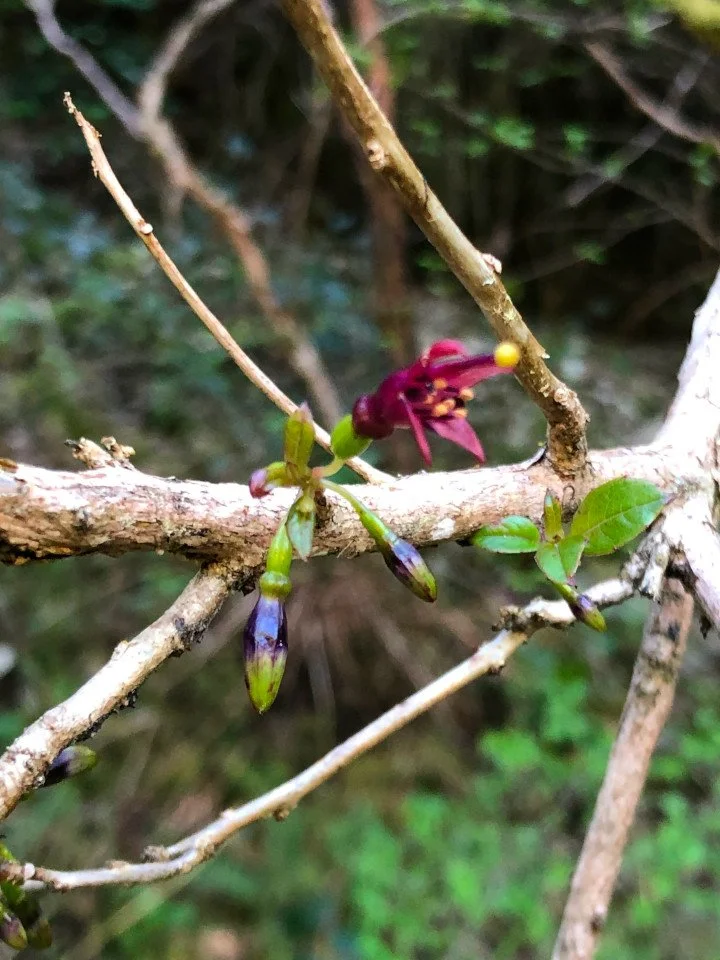
They begin greenish and gradually change through red and crimson as they mature. Four narrow spreading sepals surround four small dark purple petals, while the long style and stamens project prominently beyond the flower.
The pollen is an unusual bright blue colour. Flowers are rich in nectar and are pollinated principally by native birds, including tūī and korimako / bellbird, as well as by insects.
Fruit:
The fruit is a fleshy oblong berry approximately 9–13 mm long. It ripens to dark purple or nearly black and has a mildly sweet, slightly astringent flavour.
The edible berries are traditionally known as kōnini and are produced in abundance on healthy mature trees.
Seeds:
Each berry contains several hundred tiny tan-coloured seeds.
The seeds are dispersed by fruit-eating birds, including kererū, tūī, korimako, silvereye and introduced blackbirds. Seeds may also be carried by other animals that consume the fruit.
Ecology:
Kōtukutuku is an important food tree in native forest ecosystems. Its nectar-rich flowers support native birds and insects during late winter and spring, while its berries provide food through summer and autumn.
Kererū are especially important seed dispersers, but tūī, korimako, kākā, silvereye and other birds also eat the fruit. The tree hosts numerous native invertebrates, including the endemic lemon-tree borer and several moth, beetle and wētā species.
The foliage is highly palatable to introduced brushtail possums. Repeated browsing can completely defoliate mature trees and may eventually kill them, causing local decline in heavily browsed forests.
Kōtukutuku occasionally hybridises naturally with creeping fuchsia, Fuchsia perscandens, producing Fuchsia × colensoi.
Associated habitats:
Riparian forest, broadleaved forest, podocarp forest, beech forest, stream margins, river terraces, forest clearings, slips, gullies and regenerating shrubland.
Common associated species include māhoe, wineberry, koromiko, rangiora, tree ferns, kāmahi, broadleaf, five-finger and various podocarps.
How to grow:
Plant in moist, fertile, well-drained soil in full sun or partial shade. A sheltered position with reliable moisture encourages rapid establishment and a broad, healthy canopy.
Water deeply during dry periods, particularly while young. Mulching helps retain moisture and protects the shallow feeder roots, but keep mulch clear of the trunk.
Little pruning is required beyond removing damaged or crossing branches. Pruning is best undertaken while the tree is dormant or immediately after fruiting.
Possum control may be necessary in rural or forest restoration sites.
Propagation:
Propagation is readily achieved from fresh seed or semi-hardwood cuttings.
Remove seed from ripe berries, wash away the pulp and sow onto a moist, free-draining seed-raising mix. Do not bury deeply, as the seeds are very small. Keep shaded and evenly moist until germination.
Cuttings taken from healthy young growth root readily under humid propagation conditions.
Cultural use:
Kōtukutuku is culturally important to Māori. Its edible berries, known as kōnini, māti, tākawa or hōnā depending on region and stage of ripeness, were gathered as a seasonal food.
The berries also produced a purple dye, while the vivid blue pollen was reportedly used as a cosmetic. Leaves were included in traditional preparations used for bruises, fevers and bathing during childbirth.
Flowering in early spring was used in some regions as a seasonal indicator for planting kūmara.
The soft but durable wood was used by early European settlers for small turned and carved objects, picture frames, fence posts and house blocks. Because it is exceptionally difficult to ignite, it became known as “bucket-of-water wood”.
Garden value:
Kōtukutuku is an outstanding native tree for larger gardens, stream margins and restoration plantings. Its papery copper bark, silver-backed foliage, colourful flowers and edible berries provide interest throughout the year.
It is especially valuable for attracting native birds and supporting forest biodiversity. Its relatively fast growth, tolerance of damp soils and low flammability also make it useful for riparian planting, shelterbelts and landscapes where fire resistance is desirable.