
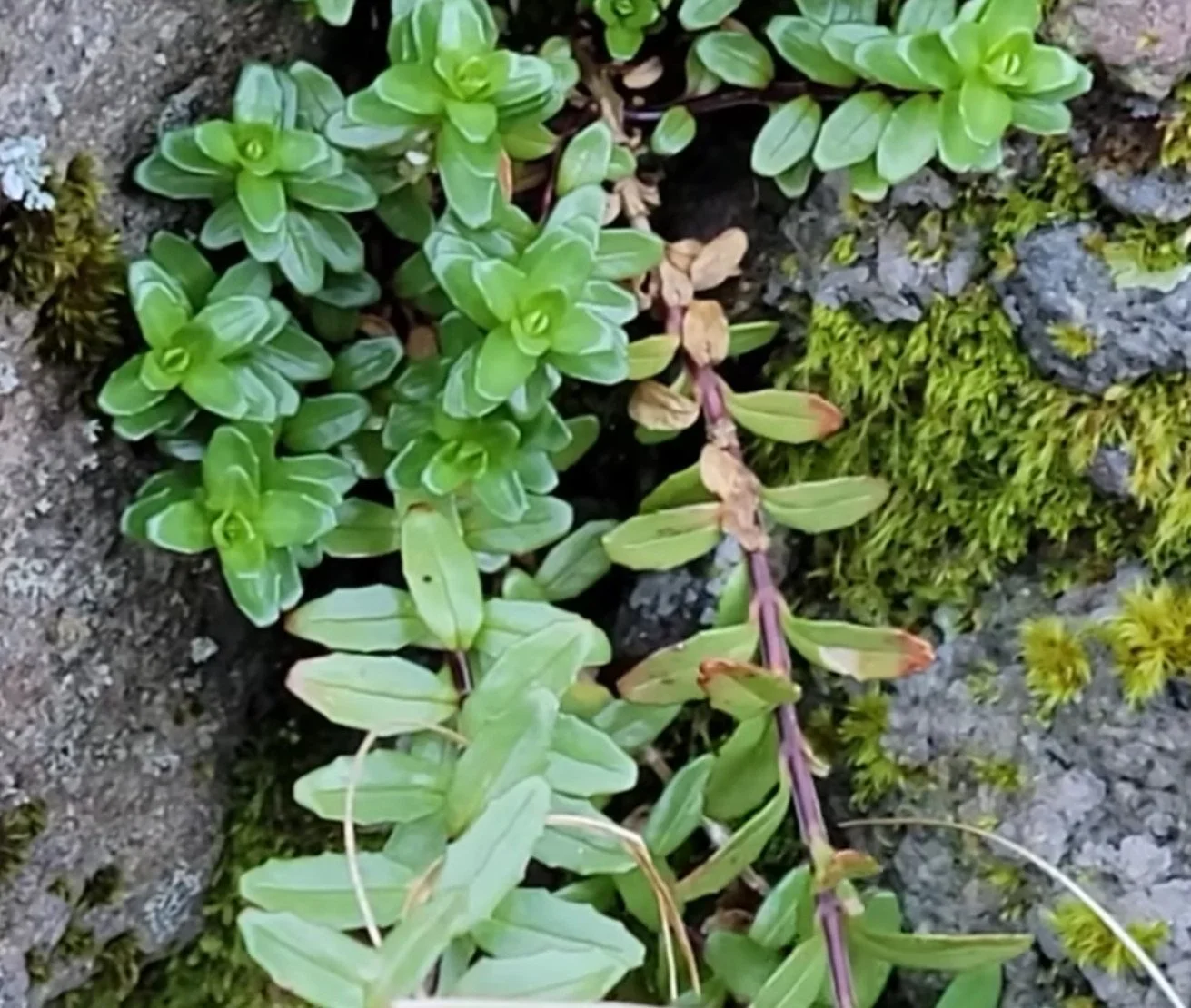
Smooth Willowherb
Botanical name: Epilobium glabellum
Synonyms: None
Common name(s): Smooth Willowherb, Willowherb
About:
Smooth Willowherb is a hardy perennial native herb that grows either as a compact bushy plant or as low spreading mats, depending on its habitat. It is one of New Zealand’s most adaptable willowherbs, occurring from lowland environments to high alpine scree near glaciers.
Its neat glossy foliage and delicate white flowers, which often develop pink or purple tones after pollination, make it an attractive species for rock gardens, alpine plantings and native borders.
Natural habitat:
Occurs naturally throughout the North and South Islands in a wide variety of habitats, including river terraces, grasslands, herbfields, rocky slopes, alpine screes and glacial gravels.
It is an important early coloniser of unstable screefields and other recently disturbed alpine environments.
Growing environment:
Thrives in full sun to partial shade in well-drained soils that retain moderate moisture. It performs best in cool climates and tolerates heavy frosts and exposed conditions.
Although adaptable, it is happiest in free-draining gravelly or loamy soils with regular moisture during active growth.
Endemic distribution:
Endemic to New Zealand.
Found throughout both the North and South Islands from lowland districts to high alpine environments.
Height:
Typically 10–40 cm
Width:
Approximately 20–50 cm
Flowering:
November–May
Fruiting:
December–June
Uses:
• Alpine gardens
• Rock gardens
• Native borders
• Ground cover
• Pollinator plant
• Scree and gravel gardens
• Ecological restoration
• Botanical collections
Appearance:
Growth habit:
A perennial herb forming either compact bushy clumps or spreading mats from a persistent taproot.
Several stems commonly arise from a single rootstock, creating neat colonies.
Stems:
The stems may be smooth or lightly hairy depending on the form and habitat. They are slender, upright to spreading, and branch only lightly.
The floral tubes and seed capsules are characteristically smooth (glabrous), giving rise to the species name glabellum, meaning “hairless.”
Leaves:
Leaves are opposite along most of the stems and become alternate near the flowering tips.
They are narrowly ovate to elliptic, glossy green and often develop attractive reddish or bronze tints, particularly in cooler conditions. The leaves are closely arranged and may slightly overlap, with tiny finely toothed margins.
Flowers:
Small cup-shaped flowers approximately 1 cm across are produced near the stem tips.
They open white and frequently develop soft pink or purple tones after pollination. The delicate flowers are produced over an extended flowering season.
Fruit:
Following flowering, long, slender capsules develop and remain smooth and hairless.
When mature they split open to release numerous fine seeds.
Seeds:
Each tiny brown seed carries a silky white tuft of hairs that allows it to be dispersed efficiently by the wind, sometimes travelling many kilometres from the parent plant.
Ecology:
Smooth Willowherb is an important pioneer species that rapidly colonises bare gravels, scree slopes and glacial deposits.
Its ability to establish in newly disturbed habitats helps stabilise loose soils and initiate ecological succession. The flowers provide nectar and pollen for native insects, while the wind-dispersed seeds allow rapid colonisation of new sites.
Several naturally occurring forms have evolved to suit different habitats across New Zealand.
Associated habitats:
Alpine screefields, glacial gravels, river terraces, herbfields, tussock grasslands, rocky slopes, open shrublands and disturbed mountain environments.
Associated species commonly include Raoulia, Celmisia, alpine buttercups, Ourisia, snow tussocks, mountain daisies and other native alpine herbs.
How to grow:
Plant in full sun or partial shade in free-draining soil enriched with organic matter.
Water regularly while establishing, particularly during dry periods, but avoid prolonged waterlogging. The species performs particularly well in alpine gardens, rockeries and gravel beds where drainage is excellent.
Minimal pruning is required other than removing spent flower stems or dead growth.
Propagation:
Propagation is easily achieved from fresh seed, semi-hardwood cuttings or by dividing established clumps.
Fresh seed germinates readily when sown onto a free-draining seed-raising mix and kept lightly moist. Division is a quick and reliable method for increasing desirable forms.
Cultural use:
Although no specific traditional Māori uses have been widely recorded for this species, Epilobium glabellum is an important member of New Zealand’s native alpine and subalpine flora.
Its ability to rapidly colonise disturbed ground makes it ecologically significant in natural mountain ecosystems.
Garden value:
Smooth Willowherb is an attractive and reliable native perennial well suited to rock gardens, alpine collections and native borders. Its glossy foliage, delicate white flowers and compact growth habit provide interest throughout the growing season.
Its hardiness, adaptability and low-maintenance nature make it an excellent choice for gardeners wanting a resilient native herb for cool temperate gardens.