
Thick-leaved Willowherb
Botanical name: Epilobium crassum
Synonyms: Epilobium antipodum
Common name(s): Thick-leaved Willowherb
About:
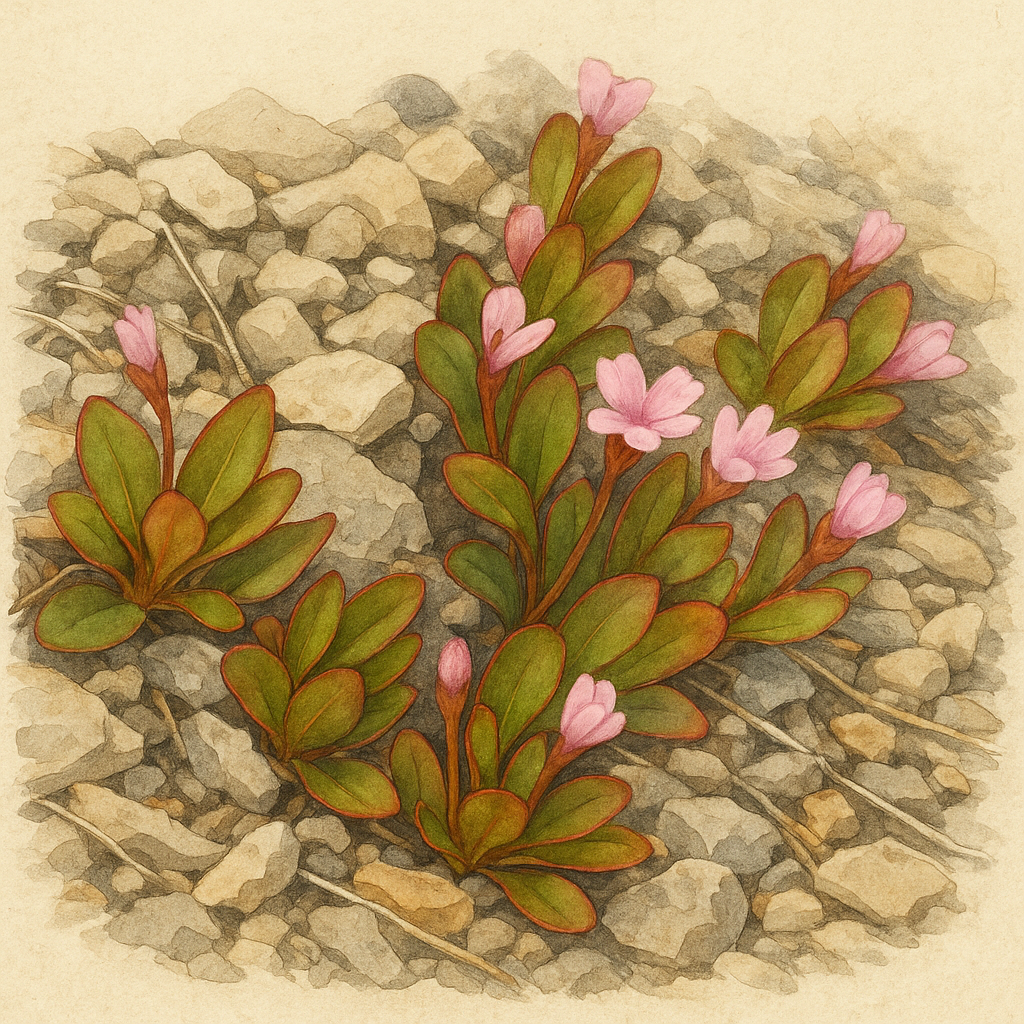
Thick-leaved Willowherb is a compact alpine perennial distinguished by its fleshy, leathery leaves and creeping rhizomatous growth. It forms small colonies among mountain screes and rocky slopes, where it is well adapted to harsh alpine conditions.
Its neat habit, attractive white flowers with delicate pink veins and excellent cold tolerance make it one of New Zealand’s most desirable native alpine willowherbs for rock gardens and alpine collections.
Natural habitat:
Occurs naturally on fine-grained, relatively stable, moist scree slopes and alpine gravels above the bushline.
It is found between approximately 600–1,800 metres above sea level, where it grows amongst rocks, scree and open alpine herbfields in cool mountain environments.
Growing environment:
Prefers full sun or light shade in cool climates with very free-draining, gritty soil. It thrives in alpine conditions with regular moisture but excellent drainage.
It is highly frost tolerant but performs poorly in hot, humid climates. Raised rockeries, alpine troughs and scree gardens provide ideal growing conditions.
Endemic distribution:
Endemic to New Zealand.
Naturally found in the Kaweka Range of the North Island and throughout parts of the South Island along and east of the Main Divide, from the St Arnaud Range and the Clarence and Awatere River catchments south to the Aoraki / Mount Cook region.
Height:
Up to 10 cm
Width:
Typically 20–40 cm, spreading gradually by underground rhizomes
Flowering:
December–February
Fruiting:
January–April
Uses:
• Alpine gardens
• Rock gardens
• Scree gardens
• Native herb gardens
• Botanical collections
• Alpine restoration plantings
• Pollinator plant
Appearance:
Growth habit:
A compact, creeping perennial herb that spreads slowly by underground whitish rhizomes.
Plants are usually low-growing and only occasionally branch, forming neat patches rather than extensive colonies.
Stems:
The stems are smooth, robust and creeping, reaching up to about 10 cm in length.
Following flowering, long underground rhizomes develop, enabling the plant to gradually expand.
Leaves:
Leaves are thick, leathery and closely crowded along the stems, giving the plant its characteristic compact appearance.
They are oblanceolate to narrowly obovate, glossy green and supported by short winged leaf stalks. Their fleshy texture helps reduce moisture loss in exposed alpine habitats.
Flowers:
Delicate white flowers are produced during summer, each marked with fine pink veins.
Following pollination, the petals often develop a soft pink flush before fading. The flowers provide an elegant contrast against the dark green foliage.
Fruit:
The fruit is a long, slender, smooth capsule that develops after flowering.
As it matures it splits open to release numerous tiny seeds.
Seeds:
Each small seed is equipped with a silky white tuft of hairs, allowing it to be carried long distances by the wind.
Ecology:
Thick-leaved Willowherb is adapted to some of New Zealand’s harshest alpine environments, where its creeping rhizomes help stabilise loose scree and gravel.
Its compact leathery foliage withstands frost, snow, drying winds and intense alpine sunlight. The flowers attract native pollinating insects, while the lightweight seeds are dispersed by wind.
Associated habitats:
Alpine scree, rocky slopes, herbfields, fellfields and stable mountain gravels above the bushline.
Associated species commonly include Raoulia, Celmisia, alpine buttercups, Ourisia, mountain daisies, snow tussocks and other specialised alpine herbs.
How to grow:
Plant in full sun in a gritty, sharply drained soil that remains cool throughout the year.
Avoid heavy clay soils and humid lowland conditions. Water during prolonged dry periods but ensure excess water drains away rapidly.
This species is ideally suited to alpine houses, raised scree beds and rock gardens where its natural habitat can be closely replicated.
Propagation:
Propagation is readily achieved from fresh seed or by carefully dividing established rhizomatous clumps.
Fresh seed germinates best when sown onto a free-draining alpine seed mix and kept cool and lightly moist.
Small rhizome divisions establish readily when transplanted into suitable alpine conditions.
Cultural use:
Although it has no widely recorded traditional Māori uses, Thick-leaved Willowherb is valued as part of New Zealand’s unique alpine flora and is highly regarded by native plant and alpine enthusiasts.
Garden value:
Thick-leaved Willowherb is an excellent choice for alpine gardens, troughs and rockeries where its compact habit and attractive foliage provide year-round interest.
Its delicate white flowers with pink veining, exceptional hardiness and ability to thrive in harsh mountain conditions make it one of the finest native willowherbs for specialised alpine collections.