
Sharp Spike Sedge
Botanical name: Eleocharis acuta
Synonyms: Eleocharis acuta var. platylepis, Eleocharis acuta var. tenuis
Common name(s): Sharp Spike Sedge, Common Spikerush, Small Spikerush
About:
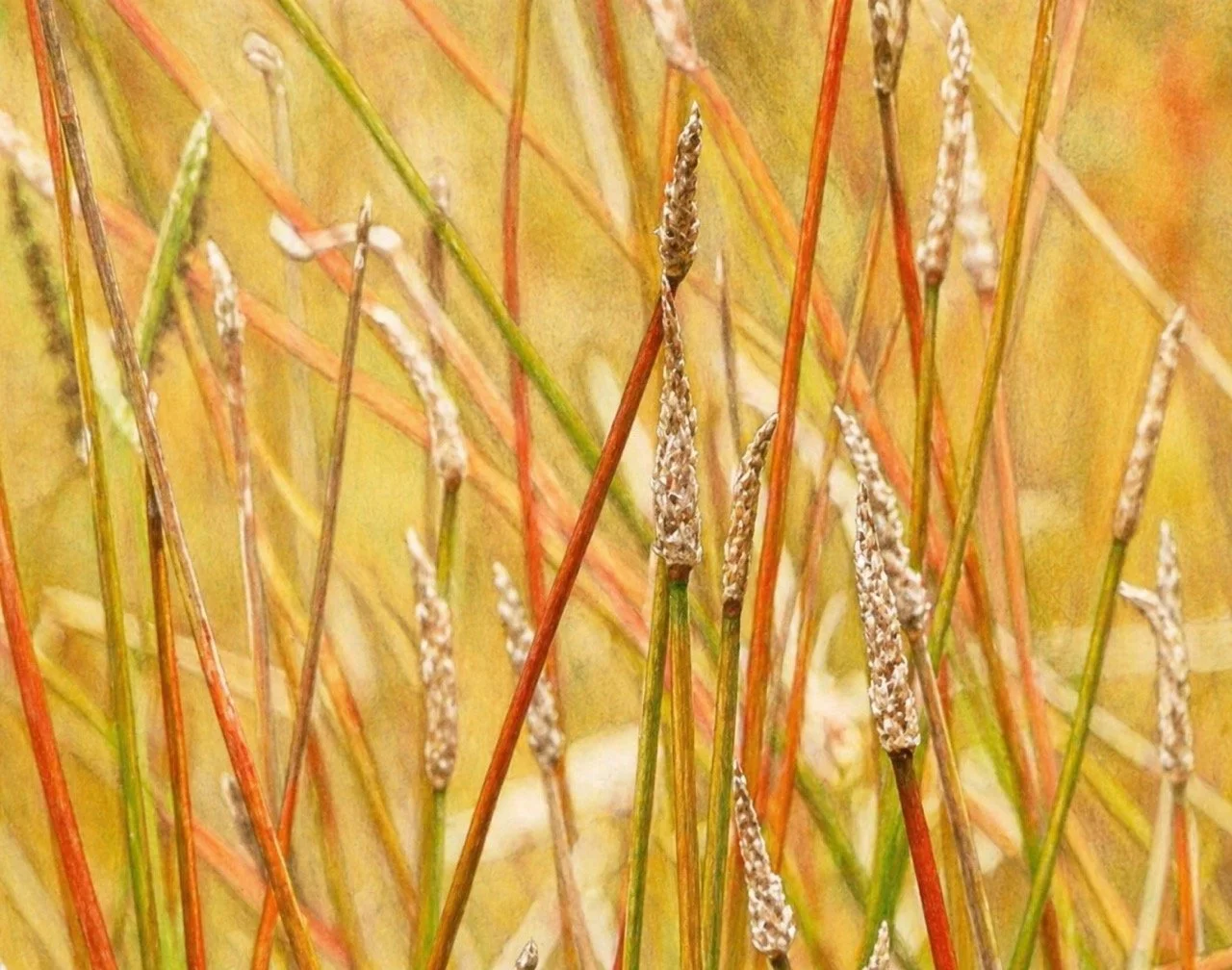
Eleocharis acuta is a slender wetland sedge that forms dense tufts of upright, cylindrical stems arising from spreading underground rhizomes. Unlike many sedges, it has no obvious leaf blades, with the green stems carrying out photosynthesis and ending in narrow brown spikelets.
It is one of New Zealand’s most widespread spike-rushes and is an important species of swamps, lake margins and shallow freshwater wetlands.
Natural habitat:
Occurs from coastal wetlands to montane environments in permanently damp or shallowly flooded habitats. It is common around swamps, marshes, ponds, lakes, streams, rivers, seepages and wet pasture depressions.
It grows in both open and lightly shaded wetlands and often forms extensive colonies along freshwater margins.
Growing environment:
Thrives in full sun and permanently moist to shallowly flooded conditions. It grows best in fertile or peaty soils but also tolerates sandy and silty wetland substrates.
Plants perform well with their roots submerged or growing in saturated mud. Full sun encourages vigorous growth and flowering.
Endemic distribution:
Indigenous to New Zealand but not endemic. Found on the Kermadec Islands, throughout the North, South and Stewart Island/Rakiura, and on the Chatham Islands.
It also occurs naturally in Australia and Norfolk Island.
Height:
Usually 15–70 cm, occasionally reaching 90 cm
Width:
Forms expanding colonies through spreading rhizomes
Flowering:
September–January
Fruiting:
October–May
Uses:
• Wetland restoration
• Pond and lake margins
• Rain gardens
• Constructed wetlands
• Streambank stabilisation
• Wildlife habitat
• Erosion control
• Naturalistic water gardens
Appearance:
Growth habit:
A rhizomatous perennial sedge forming dense or scattered tufts connected by widely creeping underground rhizomes.
Colonies gradually expand into broad patches in suitable wetland habitats.
Rhizomes:
Rhizomes are woody, slender and approximately 1–2 mm in diameter. They spread beneath the soil or mud, producing new tufts at intervals.
Stems (culms):
The upright stems are smooth, cylindrical and distinctly ribbed or striated. They are yellow-green to green and typically 0.5–2.5 mm thick.
At the base, each stem is enclosed by tubular sheaths. The upper sheath ends in a nearly flat, thickened opening with a small pointed extension (mucro), an important feature for identifying the species.
Leaves:
True leaf blades are absent. The basal sheaths surround the lower stems and are dark reddish to maroon near the base, becoming paler higher up.
The green stems carry out the plant’s photosynthesis.
Flowers:
The flowers are tiny and densely packed into a single cylindrical spikelet borne at the tip of each stem.
Spikelets are narrow, 5–25 mm long and composed of numerous overlapping brown glumes with translucent tips. Individual flowers are inconspicuous and wind pollinated.
Fruit:
The fruit is a tiny pale brown nut enclosed within the mature spikelet.
Each fruit is surrounded by six to eight fine bristles which aid dispersal.
Seeds:
The smooth or faintly textured nut contains a single seed. The persistent bristles allow the fruit to be carried by water and may also assist attachment to animals or movement by wind.
Ecology:
Sharp Spike Sedge is an obligate wetland species and an important component of freshwater ecosystems. Its dense root system binds wet soils and helps reduce erosion along water margins.
The stems provide shelter for aquatic insects, amphibians and small fish, while the seed is eaten by various wetland birds. Dense colonies also provide nesting material and cover for waterfowl.
Because it tolerates fluctuating water levels, it is commonly used in wetland restoration and stormwater treatment projects.
Associated habitats:
Freshwater swamps, marshes, shallow lakes, ponds, river and stream margins, seepages, wet meadows, bog margins and constructed wetlands.
Associated species commonly include raupō, jointed twig rush, Carex species, oioi, giant umbrella sedge, swamp millet and other wetland rushes and sedges.
How to grow:
Plant into saturated soil or shallow freshwater, ideally with the crown at or just above the water level.
Grow in full sun for the strongest growth and flowering. Plants establish rapidly where moisture is constant and may also be grown in containers submerged in ponds.
Remove competing weeds during establishment and divide large clumps every few years if required.
Propagation:
Propagation is straightforward from fresh seed or by dividing established clumps.
Division is the quickest method. Lift healthy plants and separate rhizome sections with several stems attached before replanting into wet soil or shallow water.
Fresh seed may be sown onto moist mud or wet seed-raising mix and kept constantly damp until germination.
Cultural use:
Although no widely documented traditional Māori uses are recorded for this species, it is an important native wetland plant that contributes to healthy freshwater ecosystems.
The genus name Eleocharis derives from Greek words relating to marsh plants, while the specific name acuta means “sharp” or “pointed”, referring to the narrow spikelets.
Garden value:
Sharp Spike Sedge is an excellent native plant for ponds, wetlands, rain gardens and naturalistic water features. Its fine upright stems provide year-round texture and movement while stabilising wet soils.
It is particularly valuable in ecological restoration, where it rapidly establishes to create habitat for aquatic wildlife and improves the appearance and function of freshwater environments.