
Bamboo Orchid
Botanical name: Earina mucronata
Synonyms: Earina quadrilobata, Earina aestivalis
Common name(s): Bamboo Orchid, Peka-a-waka, Spring Earina
About:
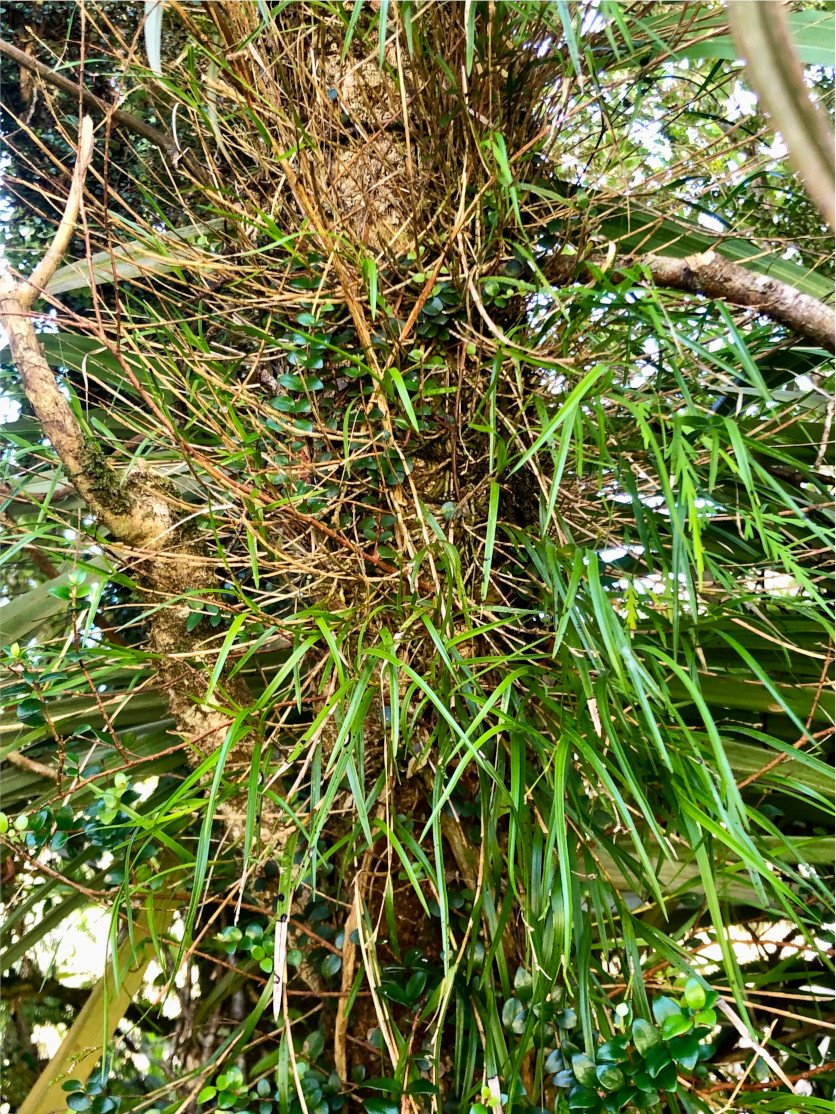
Earina mucronata is one of New Zealand’s most widespread native epiphytic orchids. It forms dense clumps of long, wiry, bamboo-like stems clothed in narrow leaves and produces masses of delicate cream to yellow-green flowers with striking yellow to orange labella. Flowering occurs mainly during spring, making it one of the earliest-flowering native orchids. It commonly grows alongside Easter Orchid (Earina autumnalis) but is readily distinguished by its narrower leaves, drooping flower spikes and lightly scented or almost scentless flowers.
Natural habitat:
Occurs from coastal forests to montane environments. It is most commonly found growing as an epiphyte on the trunks and branches of native trees and shrubs but also grows on fallen logs, rock faces, cliffs, banks and occasionally on brick or concrete walls in urban environments.
It is especially common in humid native forest where mosses help retain moisture around its rhizomes.
Growing environment:
Thrives in semi-shade with good air circulation, high humidity and excellent drainage. It prefers cool, moist conditions but tolerates short dry periods once established.
Plants grow best when mounted on bark or grown in free-draining orchid media where the roots remain moist but never waterlogged.
Endemic distribution:
Endemic to New Zealand. Found throughout the North, South and Stewart Island/Rakiura, and on the Chatham Islands.
Height:
Leafy stems commonly 30 cm–1 m long
Width:
Variable, with mature colonies spreading extensively across trunks, branches or rocks
Flowering:
August–January, most commonly September–December
Fruiting:
September–April
Uses:
• Native orchid collections
• Hanging baskets
• Mounted orchid displays
• Shade gardens
• Botanical collections
• Educational displays
Appearance:
Growth habit:
A rhizomatous perennial producing numerous slender, unbranched, cane-like stems that usually arch or hang downward. Mature plants gradually develop impressive cascading clumps.
Rhizomes:
The rhizomes are fleshy, spongy and extensively branched, firmly attaching the plant to bark, rock or other surfaces. Young rhizomes are creamy white, becoming buff-yellow with age.
Stems:
The wiry stems remain persistent for many years and are densely clothed with overlapping leaf sheaths. Older stems often become leafless near their bases while remaining alive.
Leaves:
Leaves are narrow, linear-lanceolate and generally 6–20 cm long but only 3–5 mm wide. They are green to dark green and often slightly curved or flexuous toward their tips.
Unlike Earina autumnalis, the leaf bases do not flare where they join the stem, and the leaves lack the deep central groove characteristic of Earina aestivalis. Mature leaves are relatively short-lived and fall away, leaving the persistent sheathing bases behind.
Flowers:
The flowers are produced in graceful, pendulous panicles carrying several well-spaced racemes. Individual flowers are approximately 10–12 mm across and are cream, pale greenish-cream, greenish-yellow or occasionally pure white.
The broad labellum is particularly conspicuous and varies from yellow to orange, deep apricot or occasionally white. It is broadly divided into lobes connected by a narrow central waist and often bears a visible droplet of nectar near its base.
The flowers have only a light fragrance or may be almost scentless.
Fruit:
The fruit is an elliptic to ovoid capsule with deep longitudinal grooves. It matures from green to grey before releasing seed.
Seeds:
Seeds are minute, dust-like and dispersed by wind. Like other orchids, successful germination depends upon association with suitable mycorrhizal fungi.
Ecology:
Bamboo Orchid is an important member of New Zealand’s forest epiphyte communities. It grows without parasitising its host tree, obtaining moisture from rainfall, humidity and accumulated organic debris.
Its flowers attract small insects that act as pollinators, while the tiny wind-blown seeds colonise moss-covered trunks, branches and rock faces where suitable fungal partners occur.
It frequently grows alongside Earina autumnalis, sharing similar habitats while flowering earlier in the season.
Associated habitats:
Coastal forest, lowland forest, montane forest, regenerating scrub, moss-covered trees, rock faces, cliffs, banks and fallen logs. Associated species commonly include Earina autumnalis, Winika cunninghamii, filmy ferns, mosses, lichens and other epiphytic plants.
How to grow:
Grow in hanging baskets using a coarse orchid mix or mount securely onto cork, hardwood or the trunk of a suitable tree.
Provide semi-shade, excellent air circulation and regular watering during dry weather while allowing excess water to drain freely. Mounted plants establish well when lightly packed with sphagnum moss around the roots until they become attached.
Protect from prolonged drought and severe frost. Feed only lightly with a dilute orchid fertiliser if required, although healthy plants often grow well without supplementary feeding.
Propagation:
Propagation is most successful by dividing large established cultivated clumps. Each division should include healthy rhizomes, several stems and active growing points.
Seed propagation is possible only under specialised laboratory conditions or with compatible mycorrhizal fungi because orchid seeds contain virtually no food reserves.
Only nursery-propagated plants should be cultivated. Wild plants must never be removed from their natural habitat.
Cultural use:
The Māori name peka-a-waka refers to this elegant native orchid. It is an important component of New Zealand’s forest flora and has long been appreciated for its graceful appearance and prolific spring flowering.
The name Earina mucronata refers to the minute pointed tip (mucro) found at the ends of the leaves.
Garden value:
An outstanding native orchid for shaded gardens, hanging baskets and mounted displays. Its long arching stems, narrow bamboo-like foliage and masses of delicate spring flowers create an elegant display over many weeks.
It is relatively easy to cultivate under suitable conditions and is one of the finest native orchids for bringing colour and texture to shaded native plant collections.