

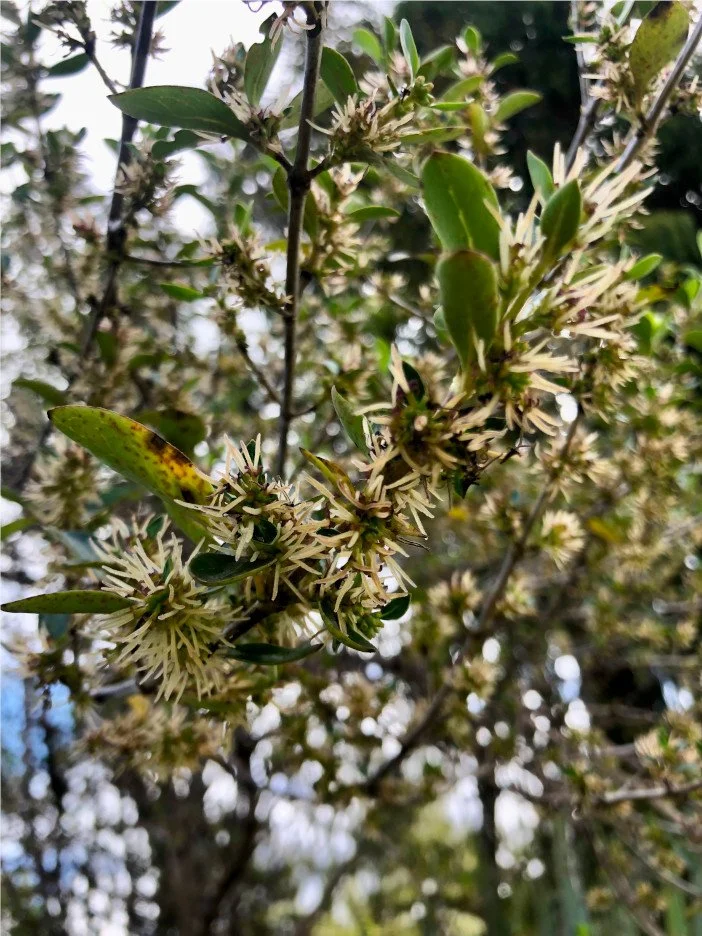

Karamū
Botanical name: Coprosma robusta
Synonyms: Coprosma coffaeoides
Common name(s): Karamū
About:
Coprosma robusta is one of New Zealand’s most widespread and recognisable native shrubs. It is a fast-growing evergreen species with glossy green leaves, prominent black-tipped stipules and abundant clusters of bright orange-red fruit. Karamū is an important pioneer plant in regenerating forests and is widely used in ecological restoration projects because of its rapid growth, hardiness and attractiveness to native birds.
Natural habitat:
Occurs naturally in coastal, lowland and lower montane habitats. Common in shrublands, forest margins, regenerating forest, stream edges, swamps and open areas within native forest.
Growing environment:
Thrives in full sun to partial shade and grows in a wide range of soil types, including moist, poorly drained and relatively infertile soils. Tolerates frost, wind and coastal conditions.
Endemic distribution:
Endemic to New Zealand. Found throughout the North Island and South Island south to Banks Peninsula. Naturalised populations also occur in Otago, Southland and the Chatham Islands.
Height:
3–6 m
Width:
2–4 m
Flowering:
July–November, peaking from August to September.
Fruiting:
March–July, peaking from April to May.
Uses:
• Native revegetation and restoration planting
• Shelter and screening
• Wildlife habitat and bird food source
• Riparian and wetland margins
• Traditional Māori medicine (rongoā)
• Traditional yellow dye production from bark
• Erosion control and succession planting
Appearance:
Growth habit:
A large, bushy evergreen shrub or small tree with a dense crown and vigorous growth. Often one of the first woody species to colonise disturbed sites.
Trunk and branches:
Branches are stout, numerous and upright to spreading. Bark is grey-brown, while younger stems are smooth and greenish. Plants develop a strong framework that supports dense foliage.
Leaves:
Leaves are glossy, leathery and borne in opposite pairs. They are elliptic to broadly ovate, 70–120 mm long and 30–50 mm wide. The upper surface is dark green and shiny, while the underside is paler green. A distinctive feature is the dark-tipped stipule between each leaf pair. The leaf margins are finely toothed, a useful feature for identification. The upper surface has a central groove, while the underside has a raised midrib.
Flowers:
Flowers are small, greenish-white and borne in clusters. Plants are usually dioecious, with male and female flowers occurring on separate plants. Male flowers are more conspicuous, with prominent stamens.
Fruit:
The fruit is an oblong fleshy drupe, typically orange-red to red when ripe, though occasionally yellow. Fruits are produced in dense clusters along the stems and are highly attractive to birds.
Ecology:
The fruit is an important food source for kererū, tūī, bellbirds, silvereyes, blackbirds and thrushes, which disperse the seeds. Karamū is a fast-growing secondary succession species and plays a major role in native forest regeneration. It also forms beneficial associations with mycorrhizal fungi.
Associated habitats:
Coastal scrub, lowland forest, regenerating forest, shrubland, riparian margins, wetlands, swamps, forest edges and lower montane forest.
How to grow:
Grow in full sun or partial shade in almost any soil. Karamū is extremely adaptable and tolerates wind, frost, coastal exposure and poor drainage. It grows rapidly and establishes easily, making it ideal for restoration projects and shelter planting.
Propagation:
Very easy to propagate from fresh seed and semi-hardwood cuttings. Seed germinates readily and seedlings establish quickly in open ground.
Cultural use:
Karamū has long been important in Māori culture. Branches were used in ceremonial rites, including naming and blessing ceremonies. The bark provided a yellow dye for colouring flax fibre, while leaves, bark and young shoots were used in traditional rongoā medicine. The berries were also eaten and the leaves sometimes used in hāngī preparation.
Garden value:
Karamū is highly valued as a fast-growing native shrub for screening, shelter and restoration planting. Its glossy foliage, abundant fruit and ability to attract native birds make it one of the most useful and rewarding New Zealand native plants for gardens and ecological projects.