
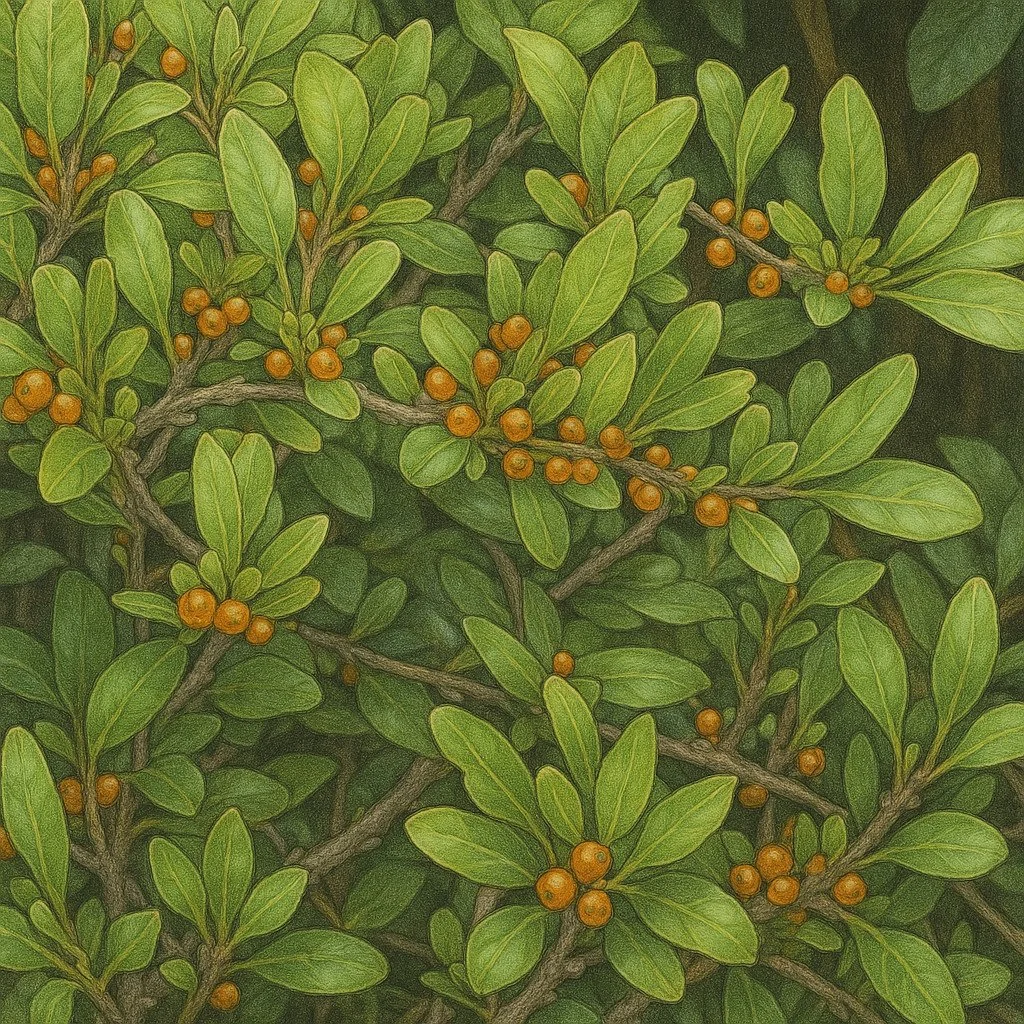
Large-seeded coprosma
Botanical name: Coprosma macrocarpa subsp. macrocarpa
Synonyms: None
Common name(s): Large-seeded coprosma, Coastal karamū
About:
Coprosma macrocarpa subsp. macrocarpa is a handsome large shrub or small tree notable for its glossy, leathery leaves and conspicuous orange-red fruit. Endemic to the remote Three Kings Islands, it is one of New Zealand’s most distinctive large-leaved coprosmas. The species is now widely cultivated in northern New Zealand and has naturalised in parts of Auckland and Wellington. Its bold foliage, colourful fruit and adaptability make it an attractive ornamental and restoration species.
Natural habitat:
Occurs naturally in coastal forest and scrub, especially in gullies, stream margins and sheltered forested slopes.
Growing environment:
Prefers fertile, free-draining soils in full sun to partial shade. Tolerates coastal exposure and moderate drought once established but performs best with regular moisture.
Endemic distribution:
Endemic to New Zealand. Naturally confined to the Manawatāwhi / Three Kings Islands. A single population recorded on Aorangi Island in the Poor Knights group is believed to be naturalised. It is now widely cultivated and naturalised around Auckland and Wellington.
Height:
5–10 m
Width:
3–5 m
Flowering:
May to July, occasionally extending into September.
Fruiting:
August to February.
Uses:
• Ornamental specimen shrub or small tree
• Coastal and subtropical gardens
• Shelter planting
• Bird-attracting gardens
• Ecological restoration in suitable regions
Appearance:
Growth habit:
A robust evergreen shrub or small tree with a rounded crown and stout branches. Plants are dioecious, with male and female flowers occurring on separate plants.
Trunk and branches:
Branches and branchlets are thick, smooth and hairless. Young growth is sturdy and supports the large leathery foliage.
Leaves:
Leaves are arranged in opposite pairs on stout stalks 12–25 mm long. They are broadly elliptic to ovate, 90–130 mm long and 40–80 mm wide, with a glossy dark green upper surface and a slightly paler underside. The leaves are leathery with a distinctly raised midrib and visible secondary veins, giving the surface a softly bulging appearance. Tiny domatia are present beneath the leaves where the lateral veins join the midrib.
Between the leaf stalks is a broad papery stipular sheath formed by fused stipules, tipped by a long sharp denticle. These sheaths dry and fall away as the branches mature.
Flowers:
Male flowers are borne in dense clusters on short axillary stalks. Female flowers occur in groups of two to five on longer stalks and are green and inconspicuous.
Fruit:
The fruit is a large fleshy drupe, orange to orange-red when ripe, measuring about 17 × 12 mm. It is borne in clusters on short stalks and contains two exceptionally large seeds. These seeds are distinctive, with a crescent-shaped cross-section and strongly curved ridges.
Ecology:
The fleshy fruit is dispersed by birds (frugivory). On the Three Kings Islands it is a common component of forest and scrub communities, where it provides food and shelter for native wildlife.
Associated habitats:
Coastal forest, coastal scrub, stream gullies, sheltered valleys and island forest ecosystems.
How to grow:
Grow in full sun or light shade in fertile, well-drained soil. It tolerates wind and coastal exposure but grows fastest in sheltered sites with regular moisture. Suitable as a specimen shrub, small tree or feature plant in native gardens.
Propagation:
Readily propagated from fresh seed. Semi-hardwood cuttings may also be rooted successfully. Because plants are dioecious, both male and female plants are required for fruit production.
Cultural use:
Although naturally restricted to the Three Kings Islands, Coprosma macrocarpa has become an increasingly popular cultivated native due to its attractive foliage and striking fruit.
Garden value:
Large-seeded coprosma is among the boldest and most ornamental of New Zealand’s coprosmas. Its glossy foliage, large colourful fruit and handsome growth habit make it an excellent feature plant for coastal gardens, native collections and subtropical landscapes.