
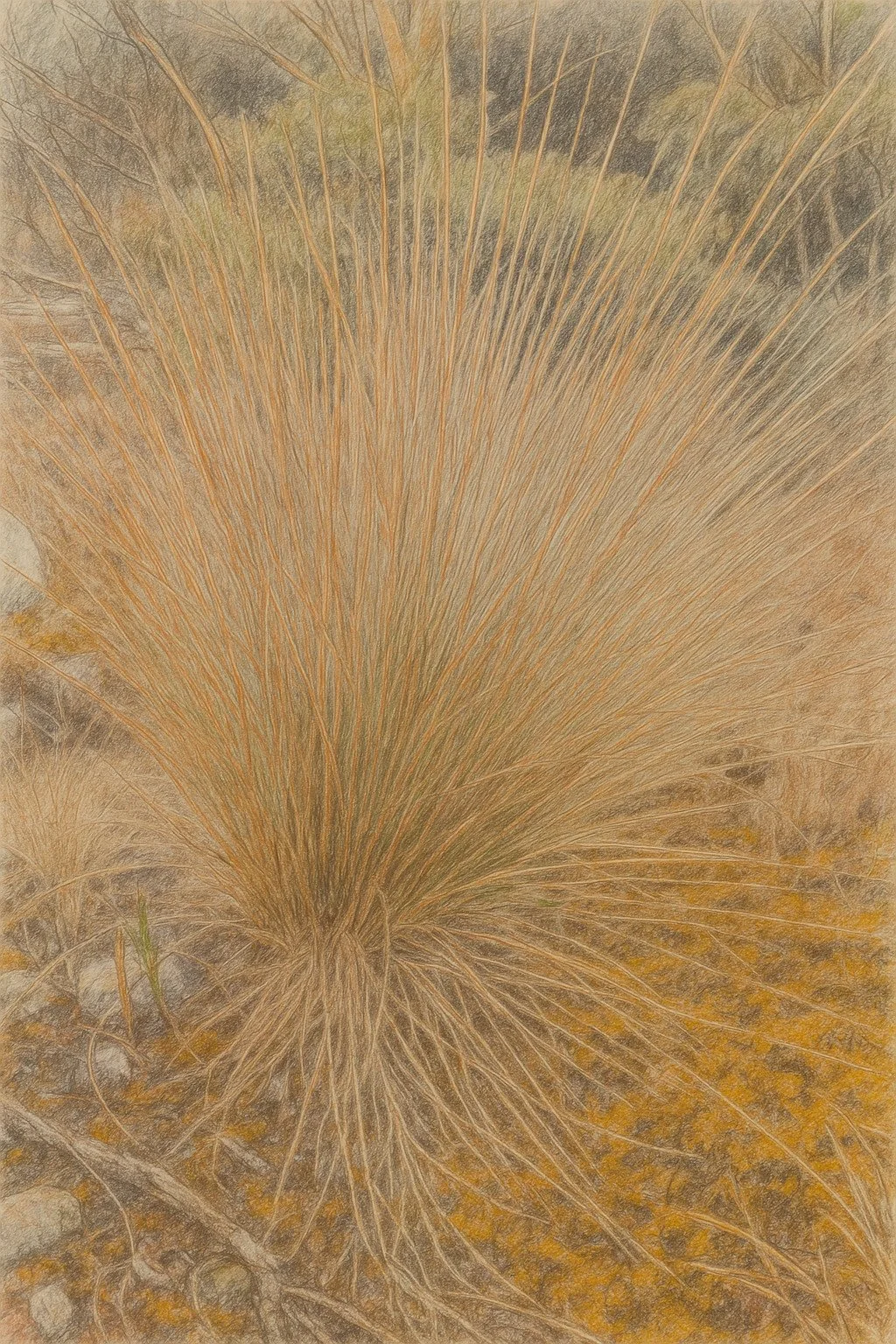
North Westland Snow Tussock
Botanical name: Chionochloa juncea
Synonyms: Danthonia raoulii var. teretifolia, Danthonia rigida var. teretifolia
Common name(s): North Westland Snow Tussock
About:
An unusual and highly distinctive snow tussock endemic to the coal plateaus of North Westland. Unlike most tussocks, it has fine rush-like foliage and reddish-brown bases that form dense clumps. Its slender, wiry leaves and open purple-tinged flower heads give it a graceful appearance, making it one of New Zealand’s most distinctive native grasses.
Natural habitat:
Montane to subalpine tussock grasslands, scrub, wetlands and seepages over coal measures.
Growing environment:
Prefers acidic, moist but free-draining soils in full sun or partial shade. Requires reliable moisture and cool conditions. Does not tolerate drought, prolonged heat or humid climates.
Endemic distribution:
Endemic to New Zealand. Restricted to the Denniston and Stockton Plateaus of North Westland.
Height:
700–900 mm
Width:
500–800 mm
Flowering:
October–December
Fruiting:
November–April
Uses:
• Native grass collections
• Alpine and bog gardens
• Wetland margins
• Specialist container plantings
• Coal plateau restoration
• Architectural foliage feature
Appearance:
Growth habit:
A tall, rush-like tussock with swollen reddish bases clothed in old leaf sheaths. Forms dense clumps of erect, fine-textured foliage.
Leaves:
Leaves are slender, cylindrical and rush-like, up to 700 mm long but only about 1 mm thick. They are dark green to reddish at the base, with a prominent hollow keel and sparse hairs near the leaf base.
Flowers:
Produces open flower panicles up to 200 mm long with long, flexible branches bearing purple-tinged spikelets. The airy inflorescences contrast beautifully with the stiff foliage.
Fruit:
Small wind-dispersed seeds develop during summer and autumn and are released from the mature flower heads.
Ecology:
A slow-growing species adapted to nutrient-poor coal measure soils. Florets are dispersed by wind and mature tussocks provide habitat and shelter for alpine invertebrates and wetland species.
Associated habitats:
Coal plateaus, montane scrub, tussock grasslands, acidic bogs, seepages and wet rocky slopes.
How to grow:
Plant in full sun or light shade in acidic, damp soil with excellent drainage. Keep evenly moist and avoid allowing plants to dry out. Best suited to cooler climates and alpine-style gardens.
Propagation:
Usually grown from fresh seed. Germination is slow and plants are very slow to mature. Established clumps can be divided carefully, although this is rarely attempted.
Cultural use:
An important endemic species of the North Westland coal plateaus and a characteristic component of these unique upland ecosystems.
Garden value:
A remarkable and unusual tussock valued for its rush-like foliage, reddish bases and elegant flowering stems. An excellent specimen for specialist native, alpine and wetland gardens where its distinctive form can be appreciated year-round.