
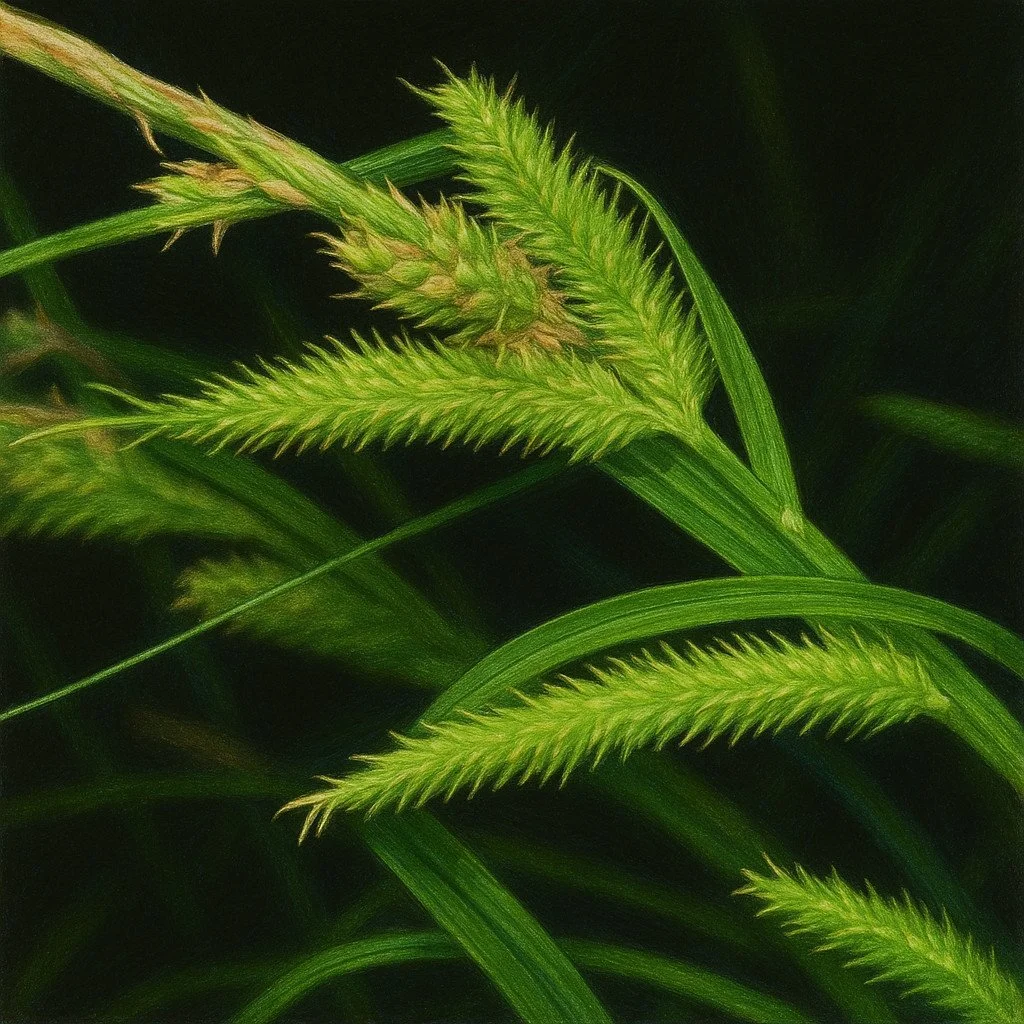
Three Kings Sedge
Botanical name: Carex elingamita
Synonyms: None
Common name(s): Three Kings Sedge
About:
A robust forest sedge endemic to the remote Three Kings Islands. This distinctive species forms leafy tussocks with tall green flowering spikes and is adapted to shaded coastal forest habitats and petrel-burrowed slopes.
Natural habitat:
Shaded forested slopes, boulder fields, petrel colony ground and coastal forest rubble within the Three Kings Islands.
Growing environment:
Prefers warm semi-shaded conditions with free-draining but moist soils. Frost sensitive and best suited to mild coastal climates.
Endemic distribution:
Endemic to the Three Kings Islands, including Great Island (Manawa Tawhi), North East, South West and West Islands, as well as parts of the Princes Group. Naturalised in parts of Auckland.
Height:
Up to 1 m tall
Width:
Forms medium to large leafy tussocks
Flowering:
September – December
Fruiting:
October – May
Uses:
• Native forest restoration
• Coastal revegetation
• Shaded wetland plantings
• Native sedge collections
• Subtropical gardens
• Erosion control on shaded slopes
Appearance:
Growth habit:
Leafy tussock-forming sedge with erect smooth triangular culms arising from dense basal clumps.
Foliage:
Leaves broad, double-folded and finely roughened along the margins. Foliage ranges from light to dark green and is softer textured than many open-country sedges.
Flowers:
Numerous green to grey-green spikes carried on erect stems, with the upper portions of most spikes containing male flowers.
Flower colours:
Green, Grey-green, Brown
Fruit:
Grey-green strongly nerved utricles with elongated beaks surrounding red-brown nuts.
Ecology:
Occurs naturally beneath dense coastal forest where it is often associated with petrel burrows and rocky slopes. Nuts are dispersed by wind and animals.
Associated habitats:
Commonly found with coastal broadleaf forest, seabird-influenced soils, boulder fields and shaded island slopes.
How to grow:
Easy to grow from fresh seed and adaptable to a range of soils. Performs best in warm semi-shaded sites with regular moisture. Tolerates full sun in cooler climates but is sensitive to frost and prolonged cold.
Propagation:
Readily propagated from fresh seed and by division of established plants.
Cultural use:
An important component of the unique flora of the Three Kings Islands and representative of New Zealand’s northern subtropical sedge communities.
Garden value:
An attractive large sedge suited to shaded native gardens and subtropical landscapes. Its graceful spikes and lush green foliage provide excellent texture and structure in sheltered plantings.