Māori onion
Botanical name: Bulbinella modesta
Synonyms: None
Common name(s): Māori onion
About:
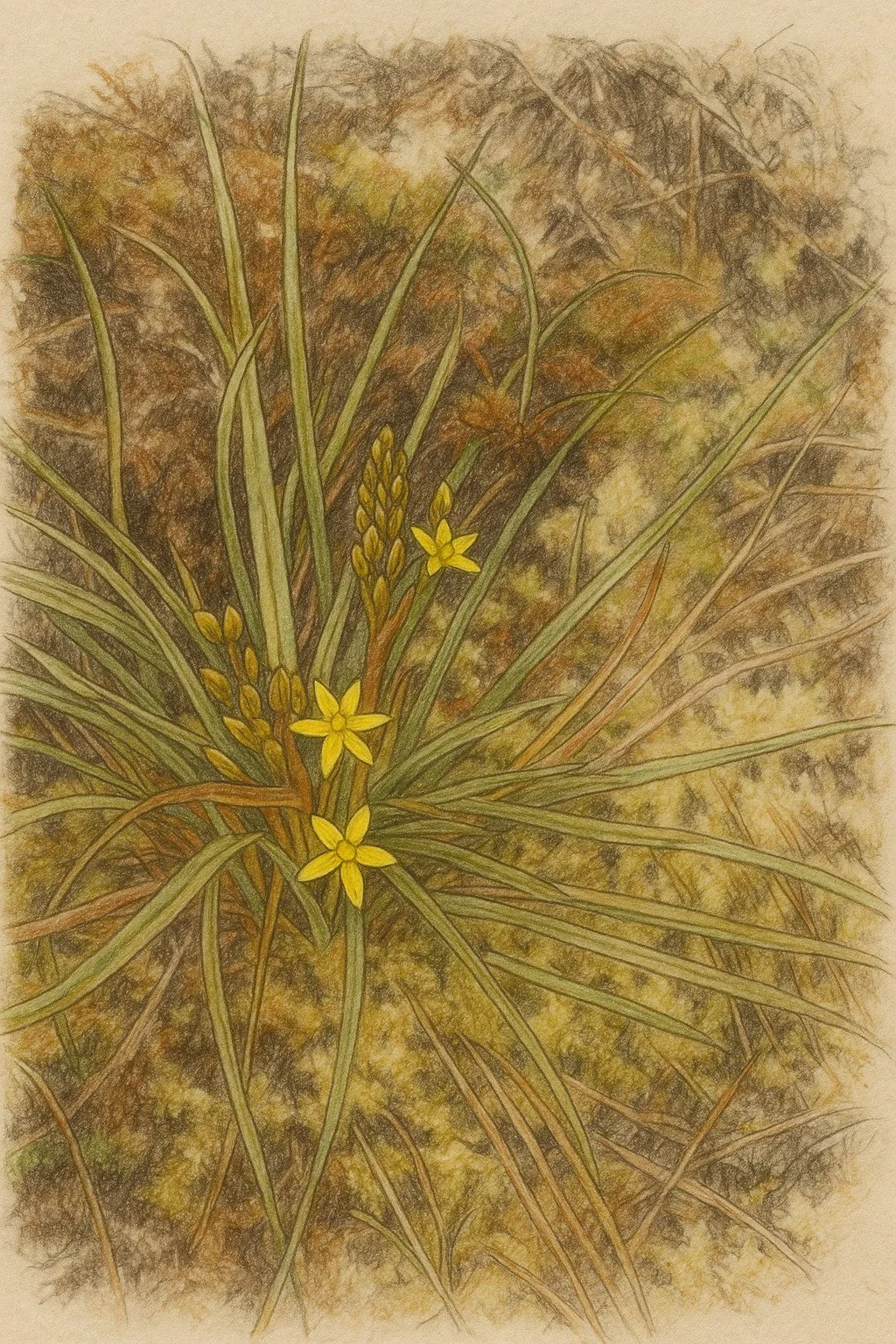
A slender summer-green perennial herb with narrow grass-like leaves and delicate yellow star-shaped flowers arranged along open flower spikes. A naturally uncommon wetland species of the West Coast lowlands.
Natural habitat:
Lowland pakihi, damp bogs, seepages, wet hollows, swamp margins and associated wetland forest.
Growing environment:
Wetland tolerant, Moist soil tolerant, Frost tolerant & Cool climate tolerant.
Prefers open sunny sites with damp acidic soils and little competition from taller vegetation.
Endemic distribution:
Endemic to the South Island of New Zealand, confined to scattered sites on the West Coast from south of Westport to Ōkārito.
Height:
Up to 30 cm tall
Width:
Forms small spreading clumps
Flowering:
December – January
Fruiting:
December – March
Uses:
• Wetland restoration planting
• Pakihi and bog garden plantings
• Native wetland collections
• Damp meadow gardens
• Ecological restoration projects
Appearance:
Growth habit:
Slender perennial herb forming loose clumps from swollen underground roots.
Leaves:
Bright green, narrow linear-lanceolate leaves less than 10 mm wide, soft and somewhat flaccid, tapering gradually to a pointed tip.
Flowers:
Open racemes of yellow star-shaped flowers borne on slender often twisted flowering stems. Flowers widely spaced with long spreading pedicels.
Fruit:
Rounded capsules containing smooth brown wingless seeds.
Ecology:
A specialised wetland species adapted to low fertility pakihi and swamp habitats. Seeds are dispersed by wind and plants establish best in open moist ground with little competition.
Associated habitats:
Often associated with pakihi vegetation, rushlands, sedgelands, swamp forest margins, Austroderia richardii and Phormium tenax communities.
How to grow:
Best grown in damp permanently moist soils in full sun. Suitable for bog gardens and wetland plantings where taller plants will not outcompete it.
Propagation:
Easily propagated from fresh seed or by division of established clumps.
Cultural use:
Part of the native wetland flora traditionally referred to as Māori onion due to the bulb-like underground structures shared by species within the genus.
Garden value:
A delicate and unusual wetland perennial valued for its fine foliage and airy yellow flower spikes. Ideal for naturalistic bog gardens and specialist native wetland collections.