
Kirk’s Tree Daisy
Botanical name: Brachyglottis kirkii var. angustior
Synonyms: Senecio kirkii var. angustior, Urostemon kirkii var. angustior
Common name(s): Kohurangi, Kirk’s Tree Daisy
About:
A fleshy-leaved native shrub with reddish-purple brittle branches and large white daisy flowers surrounding yellow centres. This narrow-leaved form is usually terrestrial and flowers mainly through autumn and early winter.
Natural habitat:
Lowland and coastal forest floors, forest margins, and sheltered northern forest habitats.
Growing environment:
Shade tolerant, Frost tender, Humus-rich soil tolerant, Coastal tolerant, Wind sheltered, Free-draining soil tolerant.
Endemic distribution:
Endemic to the North Island of New Zealand from Te Puke and Ngaruawahia north to Te Paki.
Height:
Up to 3 m tall
Width:
Approximately 1–2 m wide
Flowering:
Late summer–Winter ((January–) March–June)
Fruiting:
Autumn–Winter ((February–) April–August)
Uses:
• Native forest restoration
• Coastal and woodland gardens
• Epiphytic and shade garden plantings
• Ornamental native shrub collections
• Wildlife and pollinator gardens
Appearance:
Growth habit:
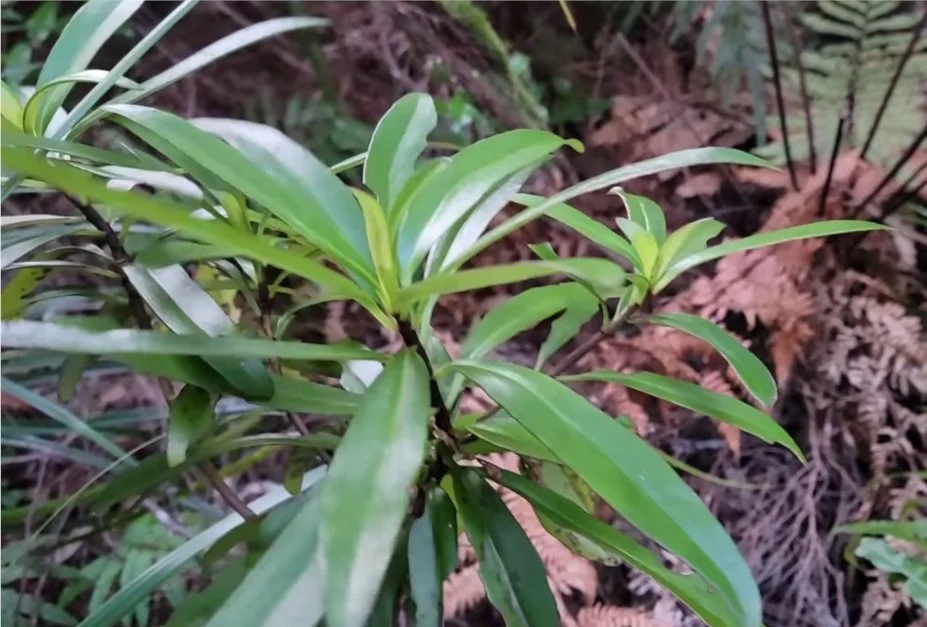
Soft wooded shrub with brittle reddish-purple branches and obvious leaf scars along older stems.
Leaves:
Narrow lanceolate to narrow-oblong fleshy leaves, glossy green, hairless, and slightly wavy along the margins.
Flowers:
Large white daisy-like flower heads with long radiating white petals surrounding yellow central disc florets, borne in broad terminal clusters.
Fruit:
Linear grooved achenes topped with stiff barbellate pappus hairs adapted for wind dispersal.
Ecology:
An important forest understorey shrub of northern New Zealand forests. Unlike the broader-leaved variety, this form is usually terrestrial rather than epiphytic.
Associated habitats:
Occurs in lowland broadleaf forest, coastal forest, and sheltered northern forest interiors.
How to grow:
Best grown in moist but free-draining soil with protection from severe frost and drying winds. Performs well in part shade or bright filtered light.
Propagation:
Usually propagated from fresh seed or semi-hardwood cuttings.
Threats:
Naturally uncommon in parts of its range and vulnerable to forest clearance, browsing animals, and habitat fragmentation.
Cultural significance:
Part of the distinctive northern New Zealand forest flora and valued for its attractive foliage and unusually large white flowers.
Garden value:
Highly ornamental native shrub ideal for shaded gardens, valued for its fleshy glossy foliage, colourful stems, and showy white daisy flowers during cooler months.