


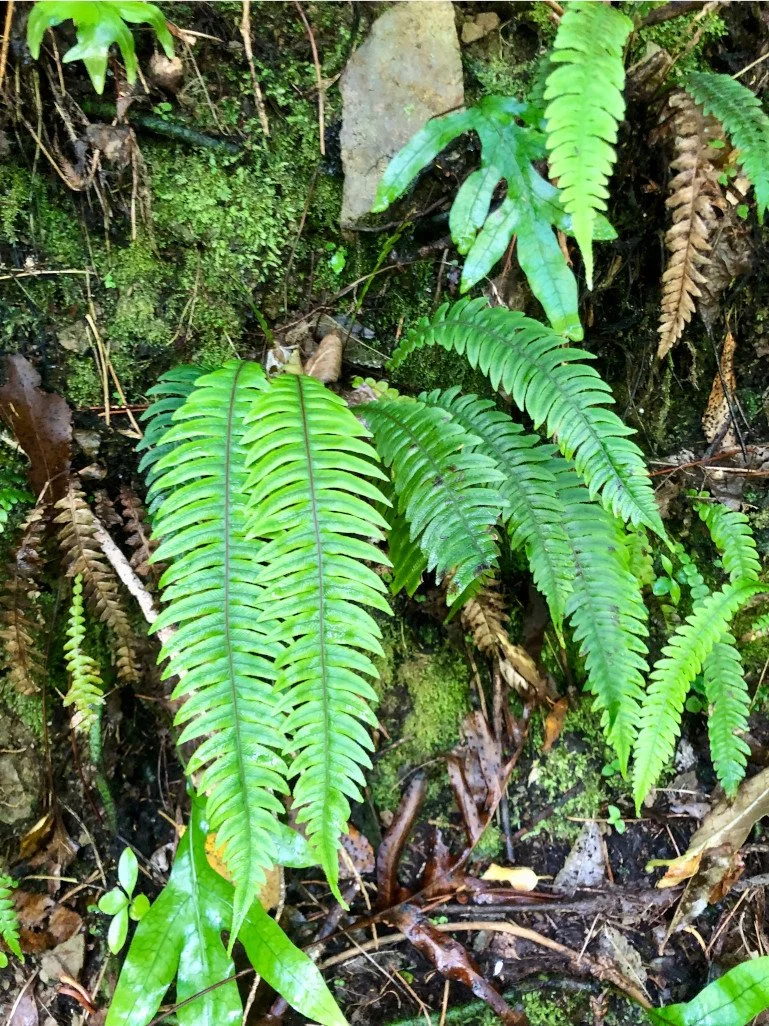
Lance Fern
Botanical name: Austroblechnum lanceolatum
Synonyms: Blechnum chambersii, Blechnum lanceolatum, Blechnum doodioides
Common name(s): Lance Fern, Lance Water Fern, Nini, Rereti
About:
A lush forest fern indigenous to New Zealand, Australia, and parts of the Pacific. This species is recognised by its lance-shaped dark green fronds, pinkish young growth, and strongly dimorphic fertile and sterile fronds.
Natural habitat:
Occurs naturally in shaded forest gullies, stream banks, river margins, waterfall spray zones, damp cliff faces, limestone cave entrances, rock overhangs, and riparian forest.
Growing environment:
Partial shade to full shade, Moist soils, Humid conditions & Lime tolerant.
Thrives in deep moist soils and shaded sites with reliable humidity.
Indigenous distribution:
Indigenous to New Zealand, Australia, Samoa, and Fiji.
In New Zealand found throughout the North, South, Stewart, and Chatham Islands.
Height:
Approximately 0.12–0.65 m tall
Width:
Forms spreading colonies approximately 0.4–1 m across
Flowering:
Not applicable — spore producing fern
Fruiting:
Not applicable — reproduces via spores
Uses:
• Shaded fern gardens
• Streamside planting
• Riparian restoration
• Damp bank stabilisation
• Native understory planting
• Limestone garden planting
Appearance:
Growth habit:
A tufted to spreading fern forming colonies from erect to suberect rhizomes.
Leaves:
Sterile fronds are narrow, lance-shaped, dark green, sometimes maroon-tinged, with many pairs of small serrated pinnae.
Fertile fronds:
Fertile fronds are narrower and more upright, with slender pinnae carrying spore-producing sori.
New growth:
Emerging fronds are often green with a pinkish tinge, maturing to dark green or maroon-tinged foliage.
Ecology:
An important fern of moist forest and riparian habitats, helping stabilise shaded banks and contributing to dense fern cover along waterways.
Associated wildlife:
Host plant for the New Zealand endemic moth Batrachedra litterata.
How to grow:
Best grown in shaded conditions with deep, moist, humus-rich soil. Responds well to regular lime applications and performs especially well in damp limestone areas.
Propagation:
Easily propagated from fresh spores or by division of established rhizomes.
Garden value:
A reliable and attractive native fern for shaded wet areas, valued for its lush lance-shaped foliage, pinkish new growth, and ability to form elegant colonies in damp forest-style gardens.