


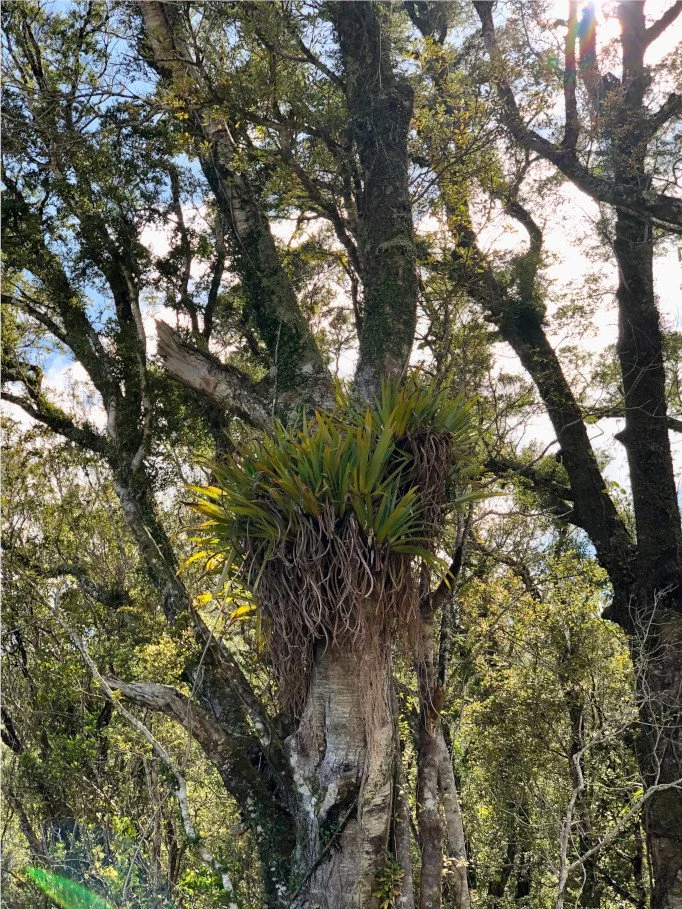
Tank Lily
Botanical name: Astelia hastata
Synonym: Collospermum hastatum
Common name(s): Tank Lily, Perching Lily, Kahakaha, Widow Maker
About:
A large epiphytic native lily endemic to New Zealand, forming massive suspended clumps high within forest canopies. This species stores water and organic matter within overlapping leaf bases, creating miniature canopy wetlands that support insects, frogs, lizards, and other forest life.
Natural habitat:
Occurs naturally in coastal and lowland forest where it grows as an epiphyte on large trees, occasionally forming enormous suspended colonies high in the canopy.
Growing environment:
Part shade to shade, Free-draining conditions, Humid environments & Frost sensitive.
Thrives in sheltered forest conditions with excellent drainage and good airflow.
Endemic distribution:
Endemic to New Zealand.
Found throughout the North Island and the upper South Island.
Height:
Approximately 0.6–1.7 m tall
Width:
Forms large spreading clumps often exceeding 2 m across
Flowering:
Summer
Produces cream to pale yellow flowers from January to March.
Fruiting:
Autumn to winter
Orange-red translucent berries mature from March to August.
Uses:
• Epiphytic forest gardens
• Subtropical native landscaping
• Architectural foliage planting
• Wildlife habitat creation
• Shade garden specimen planting
• Specialist native collections
Appearance:
Growth habit:
A robust tufted epiphyte forming dense suspended colonies with interlocking root systems.
Leaves:
Long arching strap-like leaves arranged in fan-shaped clusters. Upper surfaces dull green while undersides are bronze-green with dark-centred scales. Leaf bases form water-holding reservoirs.
Flowers:
Cream to pale yellow flowers borne on pendulous branched racemes. Male and female flowers occur on separate plants.
Fruit:
Rounded translucent orange to red berries containing numerous black seeds surrounded by a thick mucilaginous aril.
Ecology:
An important canopy ecosystem species creating water reservoirs and habitat for insects, amphibians, lizards, and birds. Fruit is dispersed by birds and by attachment.
Associated wildlife:
Often associated with native birds, lizards, frogs, and forest insects using the water-holding leaf bases as habitat.
How to grow:
Best grown in sheltered semi-shaded conditions with excellent drainage. Can be grown epiphytically mounted on trees or within large free-draining containers. Prefers dry shade and humid conditions.
Propagation:
Can be propagated from fresh seed or by division of established clumps.
Cultural uses:
• Fruit traditionally eaten by Māori
• Leaves used for weaving baskets, sandals, and headbands
• White fibres from leaves used as hair ornamentation
Garden value:
An extraordinary architectural native species prized for its dramatic suspended growth habit and bold tropical appearance. Particularly effective in subtropical native gardens, forest plantings, and epiphytic displays.