

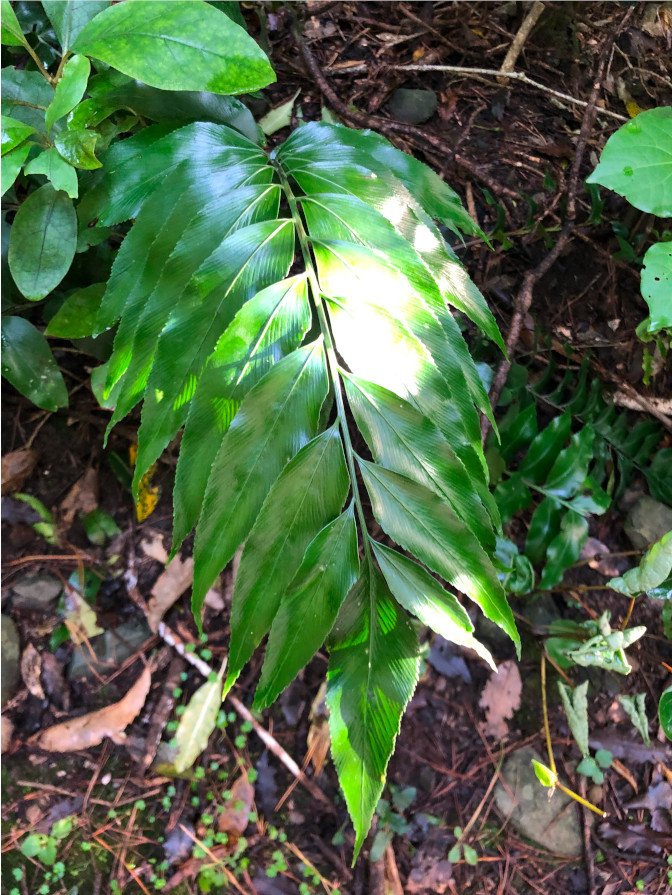

Shining Spleenwort
Botanical name: Asplenium oblongifolium
Synonyms: Asplenium lucidum, Tarachia lucida
Common name(s): Shining Spleenwort, Huruhuruwhenua
Plant facts:
A handsome endemic New Zealand fern valued for its large glossy fronds and bold architectural appearance. This species ranges from coastal cliffs to lowland and montane forests and is one of the most widely cultivated native spleenworts.
Natural habitat:
Occurs naturally on coastal cliffs, rock stacks, forest floors, tree trunks, rocky slopes, and shaded lowland to montane forest.
Growing environment:
Shade to partial shade, Moist free-draining soils, Humid & Sheltered.
Thrives in fertile organic soils with regular moisture and protection from prolonged dry conditions.
Endemic distribution:
Endemic to New Zealand.
Found on the Kermadec Islands, Three Kings Islands, North Island, South Island, and Chatham Islands.
Height:
Approximately 0.3–1 m tall
Width:
Forms clumps approximately 0.5–1 m across
Uses:
• Native forest gardens
• Shaded mass plantings
• Large container specimens
• Coastal and subtropical gardens
• Woodland landscaping
• Indoor conservatory displays
Appearance:
Growth habit:
A robust evergreen fern forming upright clumps from a stout woody rhizome.
Fronds:
Fronds are dark glossy green, leathery, and pinnate with a bold tropical appearance.
Leaflets:
Pinnae are narrow to broad lanceolate with pointed tips and finely toothed to nearly entire margins.
Rhizome and stems:
Rhizomes are thick and often woody above ground, covered in pale brown scales. Stipes are stout, dark brown, and densely scaled with long hair-like tips.
Sori:
Long narrow sori develop beneath the fronds and remain well clear of the frond margins.
Ecology:
An adaptable forest fern occupying a wide variety of habitats from exposed coastal rock stacks to humid inland forest.
Cultural uses:
Known traditionally by the Māori name huruhuruwhenua and valued as part of New Zealand’s native forest flora.
How to grow:
Easy to cultivate in moist shaded conditions with fertile free-draining soil. Tolerates coastal exposure once established but performs best in sheltered humid gardens.
Propagation:
Propagated from spores or division of established clumps. Slow initially but develops into a long-lived specimen fern.
Garden value:
One of New Zealand’s finest foliage ferns, prized for its glossy fronds and strong structural form. Excellent for lush shaded gardens, subtropical plantings, pots, and native landscaping.