
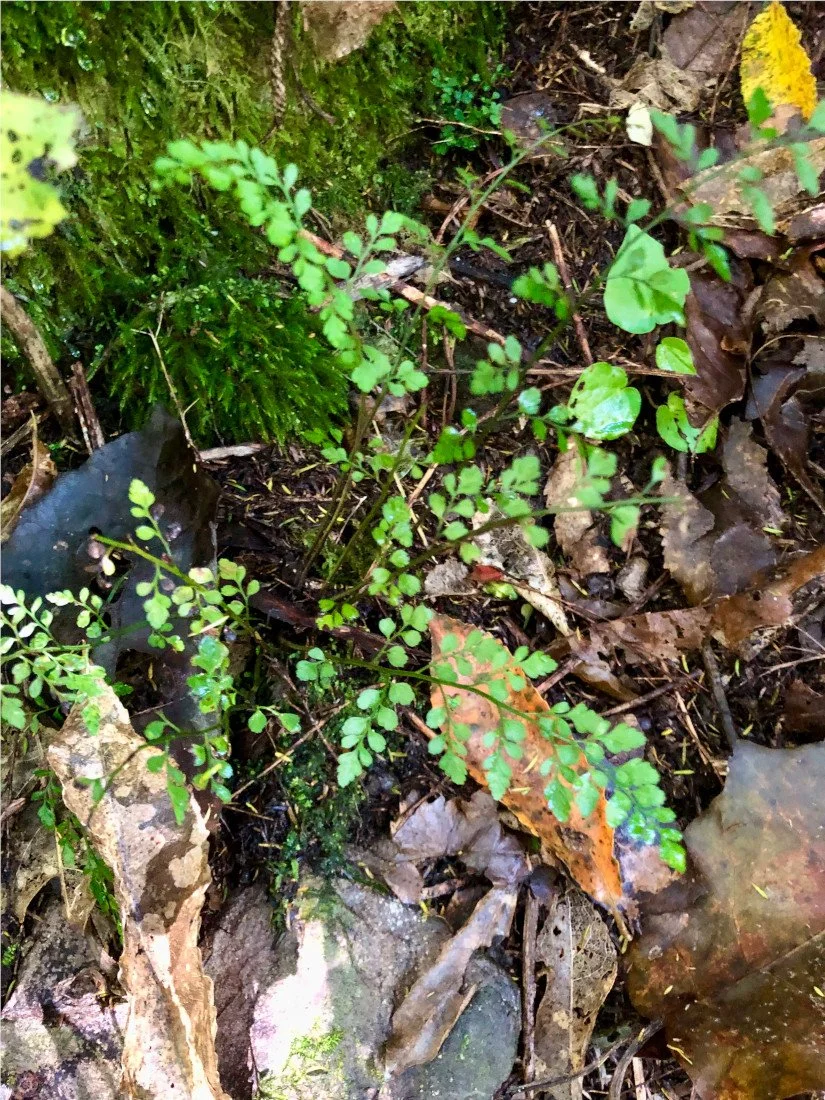
Hooker’s Spleenwort
Botanical name: Asplenium hookerianum var. hookerianum
Common name(s): Hooker’s Spleenwort, Rocklax, Maidenhair Fern
Synonyms: Asplenium adiantoides, Asplenium adiantoides var. minus, Asplenium adiantoides var. hookeriana, Asplenium ornatum, Asplenium symmetricum, Asplenium hookerianum
Plant facts:
A delicate finely divided fern valued for its soft textured fronds and graceful appearance. This adaptable species naturally grows on shaded banks, rocky outcrops, and forest margins throughout much of New Zealand and is especially admired as an ornamental native pot fern.
Natural habitat:
Occurs naturally on shaded clay banks, rocky outcrops, forest remnants, scrub margins, and moist sheltered ground from coastal districts to alpine areas.
Growing environment:
Shade to partial shade, Moist free-draining soils, Sheltered & Humid.
Thrives in cool humid positions with fertile organic-rich soil and protection from harsh drying conditions.
Indigenous distribution:
Indigenous to New Zealand and south-eastern Australia.
Found throughout the North Island, South Island, Stewart Island/Rakiura, and the Chatham Islands.
Height:
Approximately 0.1–0.4 m tall
Width:
Approximately 0.2–0.5 m wide
Uses:
• Woodland and fern gardens
• Native container planting
• Shaded rock gardens
• Forest understory restoration
• Indoor and conservatory planting
• Moist shaded landscaping
Appearance:
Growth habit:
A small tufted evergreen fern forming neat clumps from a short erect rhizome.
Fronds:
Fronds are finely divided, dark green, and soft textured, ranging from bipinnate to almost tripinnate in mature plants.
Stems and scales:
Stipes are slender and densely covered in narrow brown scales with long thread-like tips.
Leaflets:
Pinnae and pinnules are stalked and delicate, often held outward at near right angles in mature fronds.
Sori:
Small elongated sori occur near the margins beneath the pinnules.
Ecology:
An important small forest fern occupying shaded banks, rocky crevices, and disturbed forest remnants across a wide elevational range.
Associated wildlife:
Provides humid shelter for native forest invertebrates and contributes to diverse fern understory communities.
How to grow:
Easy to cultivate in shaded or semi-shaded positions with moist free-draining soil rich in leaf litter or organic matter. Best protected from direct afternoon sun and prolonged drought.
Propagation:
Easy from spores or division, though relatively slow growing once established.
Garden value:
A refined and elegant native fern prized for its delicate divided foliage and compact habit. Excellent for pots, shaded rockeries, ferneries, and detailed woodland planting schemes.