


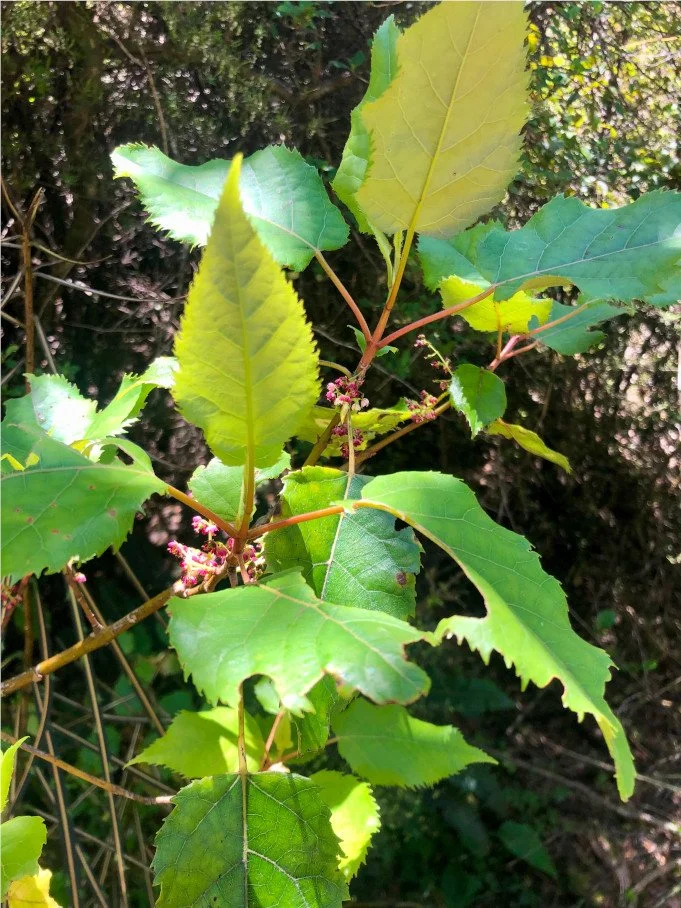
Wineberry
Botanical name: Aristotelia serrata
Common name(s): Makomako, Wineberry
Synonyms: Dicera serrata, Aristotelia racemosa, Friesia racemosa, Triphalia rubicunda
Plant facts:
A fast-growing small tree endemic to New Zealand, valued for its colourful branchlets, sharply toothed foliage, and masses of bird-attracting berries. Wineberry is an important pioneer species that rapidly colonises disturbed forest margins, slips, and regenerating landscapes.
Natural habitat:
Occurs naturally in disturbed lowland to montane forest, stream margins, forest clearings, slips, alluvial terraces, and regenerating scrub.
Growing environment:
Full sun to partial shade, Moist fertile soils, Wind tolerant & Frost tolerant once established.
Thrives in open disturbed ground and regenerating native forest environments.
Endemic distribution:
Endemic to New Zealand.
Found throughout the North, South, and Stewart Islands, though less common in drier eastern districts.
Height:
Approximately 5–10 m tall
Width:
Forms broad spreading crowns approximately 3–5 m across
Flowering:
Spring to early summer
Produces masses of white to pink-red flowers from September to December.
Fruiting:
Summer
Bright red berries ripen dark purple-black from November to January.
Uses:
• Pioneer and regeneration planting
• Native forest restoration
• Bird habitat creation
• Riparian and erosion control planting
• Traditional Māori medicinal uses
• Edible fruit for jams, jellies, and wine
Cultural uses:
Māori traditionally ate the fruit raw and used bark and leaf infusions medicinally for burns and sore eyes. The bark also produced a blue-black dye. Wood was used for fishing net handles and poi rākau sticks. Early European settlers used the fruit for wine, jams, and jellies, and occasionally utilised the timber for cabinetmaking and woodturning.
Appearance:
Growth habit:
A fast-growing much-branched small tree with upright trunks and spreading crowns.
Bark:
Smooth grey to pale brown bark marked with pale lenticels.
Leaves:
Thin broad-ovate leaves with sharply serrated margins and pointed tips. Upper surfaces bright green, undersides paler and frequently flushed pink or purple.
Flowers:
Small flowers produced in drooping panicles. Petals white through pale pink to deep red, often darkening with age.
Fruit:
Small fleshy berries ripening from bright red to dark purple-black, heavily sought after by native birds.
Ecology:
An important pioneer species that rapidly establishes after disturbance including slips, fire, windthrow, and forest clearance. Dense thickets provide shelter for regenerating native forest species.
Associated wildlife:
Fruit consumed by kererū, tūī, bellbird, silvereye, and kākā. Also hosts several native moths, beetles, and aphids.
How to grow:
Easy and fast growing in moist fertile soils with reasonable light. Performs best in full sun to partial shade and readily self-seeds in suitable environments.
Propagation:
Very easy from fresh seed.
Garden value:
An attractive and highly useful native tree valued for its colourful stems, seasonal flowers and berries, rapid growth, and ecological restoration benefits. Excellent as a nurse crop species in revegetation projects.