

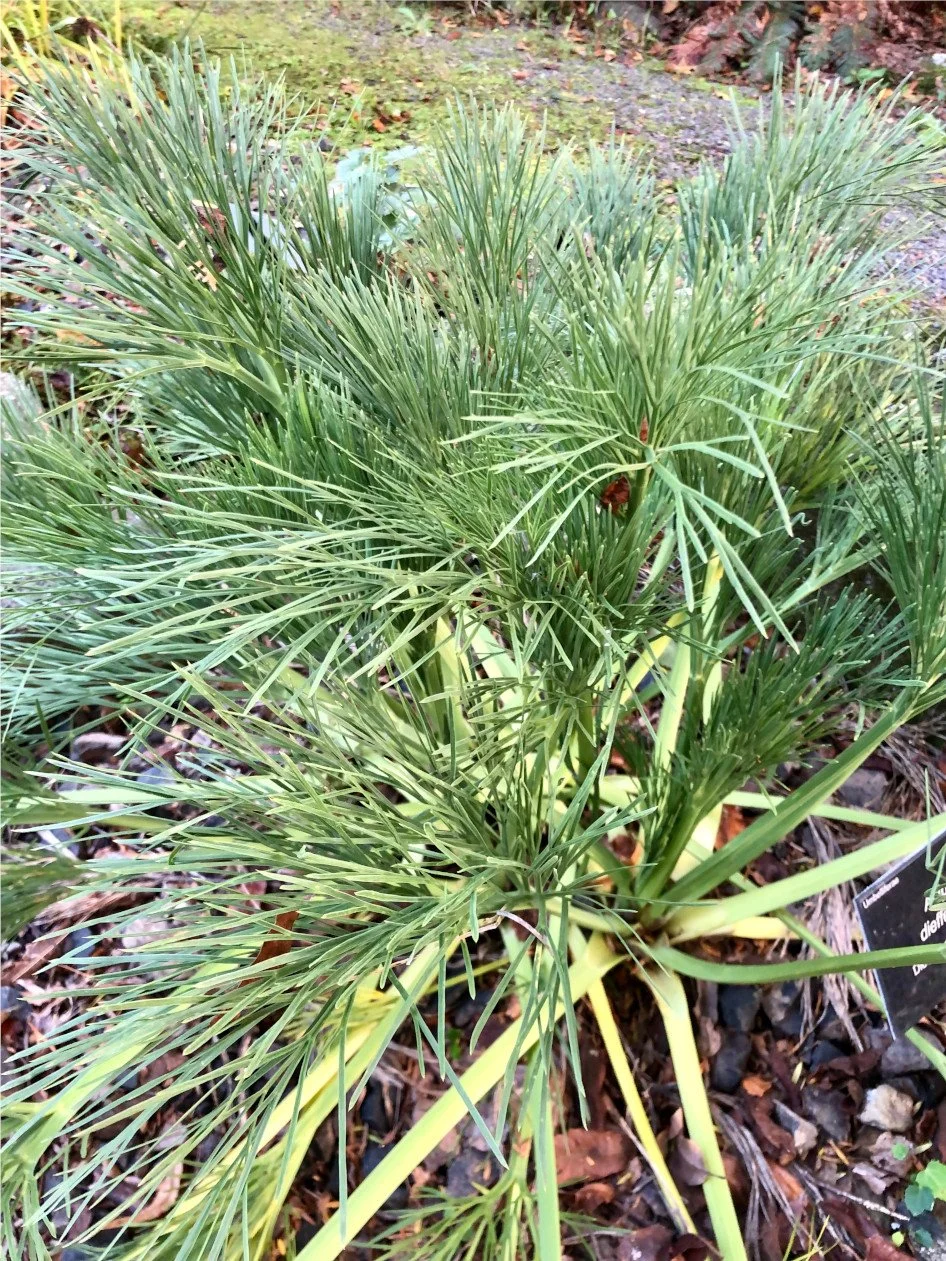
Dieffenbach’s Speargrass
Botanical name: Aciphylla dieffenbachii
Common name(s): Dieffenbach’s Speargrass, Soft Speargrass, Coxella
Plant facts:
A distinctive Chatham Islands speargrass with soft, drooping blue-green foliage and large golden flower spikes. Unlike many speargrasses, this species has flexible, less rigid leaves and is highly adapted to cool coastal environments.
Natural habitat:
Strictly coastal, growing on cliffs, rocky scarps, coastal slopes, and petrel-burrowed ground. Often associated with basalt coastal substrates.
Growing environment:
Coastal, Wind, Sun & Free draining tolerant.
Endemic distribution:
Endemic to the Chatham Islands, including Chatham, Pitt, Mangere, Little Mangere, Rangatira, and surrounding offshore islands.
Height:
Foliage up to 70 cm long, flowering stems reaching around 1 m tall
Flowering:
November – February
Produces dense golden-yellow flower clusters on stout upright stems.
Fruiting:
January – June
Large winged fruits mature from golden-yellow to pale brown-grey.
Uses:
• Coastal specimen planting
• Chatham Islands restoration projects
• Architectural foliage plant
• Habitat plant for native insects
Appearance:
Growth habit:
A tufted perennial with a very thick taproot and spreading clumps of soft foliage.
Leaves:
Leaves are glaucous blue-green, soft, and drooping rather than rigid. The leaflets are narrow with blunt tips and arranged in several pairs along the leaf stem.
Flowers:
Large upright flower spikes carry dense clusters of golden-yellow flowers. Male and female flowers occur on separate plants.
Sap:
When damaged, the plant exudes a sticky white latex.
Fruit:
Produces large flattened winged fruits that split into two sections when mature.
How to grow:
Easy to grow from fresh seed, though seed viability is short-lived. Best grown in full sun with fertile, free-draining soil that retains some moisture. Particularly suited to cool coastal gardens. Dislikes humidity and prolonged dryness, and may die after heavy flowering.