
Sea Rush
Botanical name: Juncus kraussii subsp. australiensis
Synonyms: Juncus maritimus var. australiensis
Common name(s): Sea rush, saltmarsh rush
About:
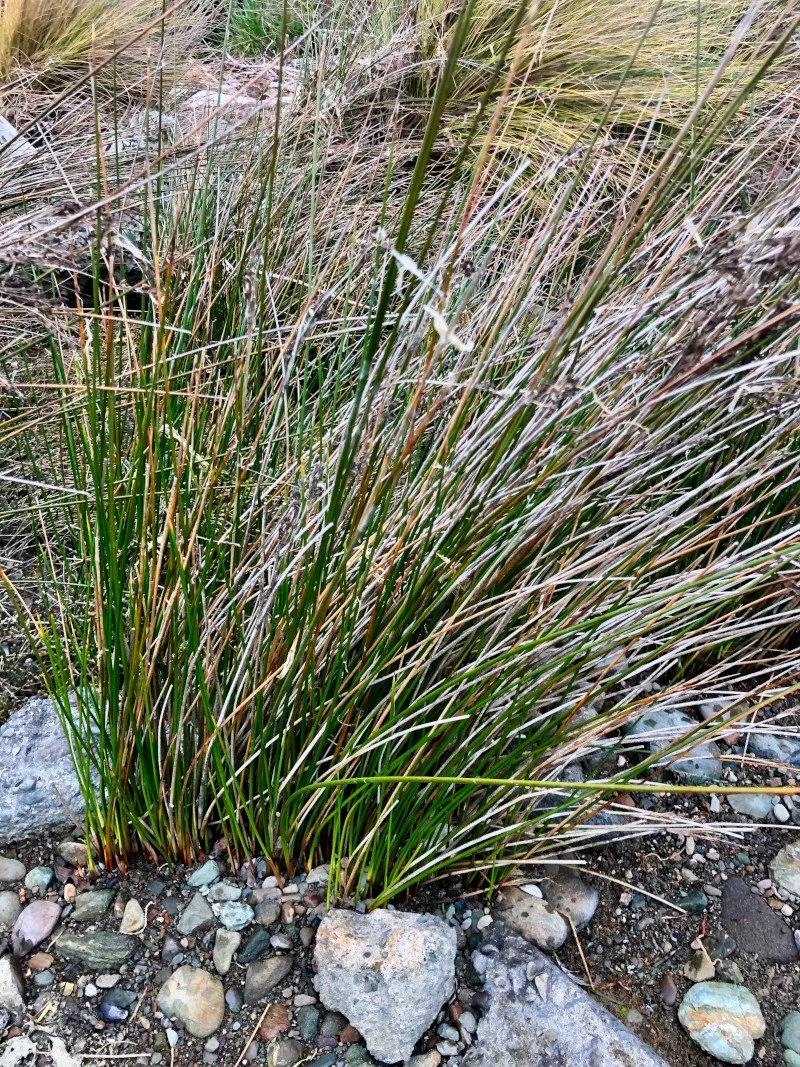
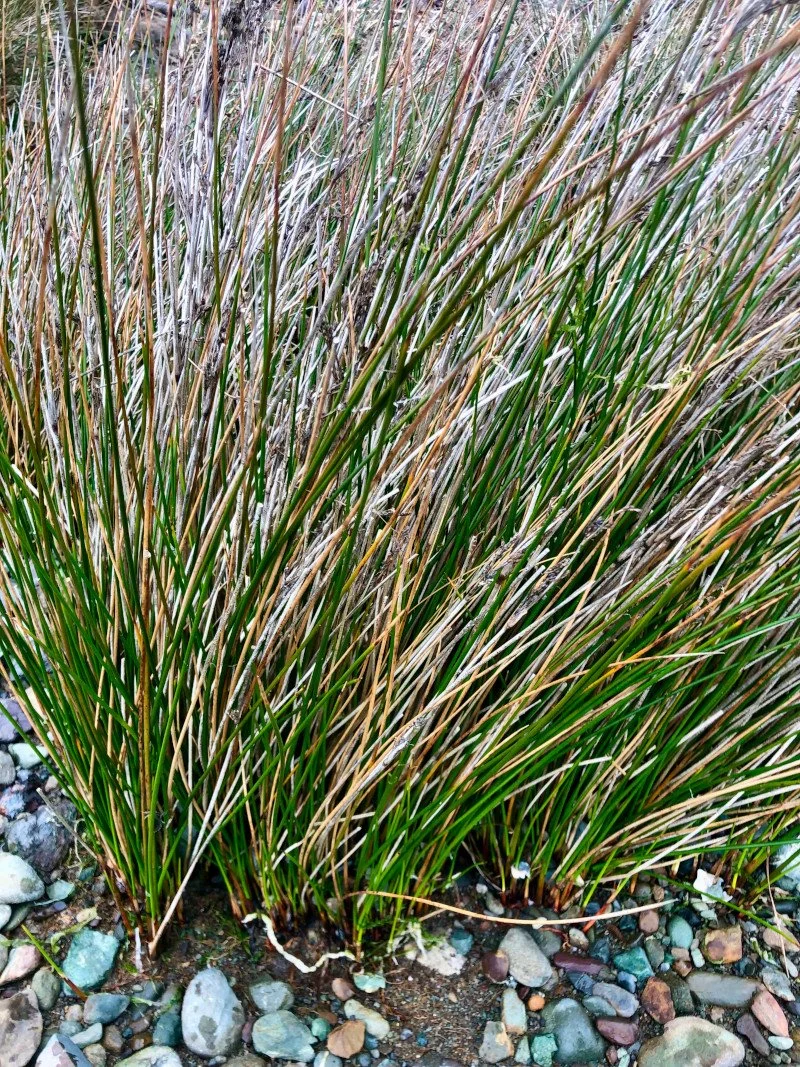
A robust, salt-tolerant perennial rush characteristic of New Zealand estuaries, saltmarshes and other brackish coastal wetlands. Juncus kraussii subsp. australiensis forms dense to relatively open tussocks of rigid stems arising from a strong creeping rhizome.
It is particularly valuable ecologically because it occupies the transition between terrestrial and estuarine environments, where its rhizomes bind soft substrates and help protect shorelines from erosion. Its combination of salt tolerance, structural form and ability to withstand periodically saturated ground makes it an excellent species for coastal restoration, estuary margins and constructed stormwater wetlands.
Natural habitat:
Primarily coastal.
Found in saltmarshes, estuaries and along the margins of brackish streams, rivers and coastal lagoons. It grows in damp to waterlogged substrates ranging from sand and silt to alluvial soils.
Unusually, some populations also occur well inland, including around geothermal areas at Rotorua and Ōrākei Kōrako and in the upper Rangitata River catchment.
Growing environment:
Full Sun, Salt, Coastal Exposure, Wind, Wet Soil, Brackish Water, Periodic Inundation & Poor Drainage tolerant.
Best suited to open, damp to wet ground. It is particularly valuable where freshwater and saline influences overlap and tolerates substrates ranging from sand to heavy estuarine sediment.
Endemic distribution:
Indigenous but not endemic to New Zealand.
Occurs in the North Island, South Island and Chatham Islands, extending from Te Paki south to approximately Ōkārito on the western South Island and Dunedin in the east.
Also occurs outside New Zealand.
Height:
30 cm–1.2 m.
Width:
Approximately 50 cm–1 m or more, with established plants gradually spreading through horizontal rhizomes to form substantial colonies.
Flowering:
September–December.
Small reddish-brown flowers are produced in open, irregularly branched inflorescences that appear to arise laterally from the flowering stems.
Fruiting:
November–April.
Produces glossy dark brown to almost black capsules, slightly longer than the surrounding tepals.
Uses:
• Saltmarsh restoration
• Estuary rehabilitation
• Coastal revegetation
• Erosion control
• Estuary bank stabilisation
• Brackish riparian margins
• Coastal stormwater systems
• Biofiltration systems
• Rain gardens
• Constructed wetlands
• Wildlife habitat
• Coastal rock gardens
• Naturalistic landscaping
It combines particularly well with native coastal wetland species such as Apodasmia similis and Ficinia nodosa.
Appearance:
Growth habit:
A dense to loosely tufted perennial rush arising from a horizontal, sparsely branched rhizome approximately 5–8 mm in diameter.
Individual flowering stems are relatively widely spaced along the rhizome, allowing established plants to gradually develop into broad colonies.
The overall appearance can vary from dark brownish-green to almost black around the bases, with upright green to yellow-brown stems above.
Leaves:
Unlike many apparently leafless native rushes, Juncus kraussii usually produces one or two true leaves.
These are bright green, cylindrical and stem-like, with sheathing bases. They resemble the flowering stems but are generally shorter.
Basal bracts are stiff, pointed and reddish-brown. The upper bracts become noticeably larger and broader and terminate in a short pointed tip.
Flowers:
Flowering stems are approximately 0.3–1.2 m tall and 1.5–3 mm in diameter.
They are rigid and cylindrical, varying from light or dark yellow-brown through dark brown to brownish-black. Internally, the stem contains continuous pith.
The apparently lateral inflorescence is open and irregularly branched, with numerous rigid branchlets. Flowers occur in small clusters at the ends of these branches.
Individual flowers are approximately 3 mm long.
The tepals are stiff and reddish-brown with a green to pale brown midrib. There are usually three functional stamens accompanied by three aborted stamens, although occasionally one or more of the normally aborted inner stamens may develop.
Fruit:
The capsule is ovoid, glossy and dark brown to almost black.
It is slightly longer than the tepals and terminates in a small pointed tip.
The seeds become mucilaginous when wet and may be dispersed by water, wind and attachment to animals or other surfaces.
Ecology:
Juncus kraussii subsp. australiensis is an important structural species of saltmarsh and estuarine vegetation.
Its extensive rhizome system binds soft, periodically inundated substrates and helps reduce erosion caused by tidal movement, surface runoff and wave action. Dense stands can also trap sediment and organic material, contributing to the development and stability of saltmarsh environments.
The upright stems create shelter and habitat complexity for estuarine invertebrates and other wetland fauna.
Its exceptional tolerance of salt, saturated soils and fluctuating water levels makes it particularly useful within the upper and middle margins of estuarine restoration projects.
Associated habitats:
Saltmarshes, estuaries, tidal creek margins, brackish lagoons, coastal river margins, dune wetlands, damp coastal flats, geothermal wetlands and occasionally inland river systems.
Typical associated vegetation may include Apodasmia similis, Ficinia nodosa, Plagianthus divaricatus, Samolus repens and other salt-tolerant coastal wetland plants.
How to grow:
An easy and robust species where adequate moisture and light are available.
Plant in full sun in damp to permanently wet soil. It performs particularly well around estuary margins, saltmarsh restoration sites, brackish wetlands and coastal swales.
It tolerates saline conditions extremely well and can be planted into sandy, silty or alluvial substrates.
For restoration planting, position plants where the root zone remains moist but where prolonged deep submergence is limited. Once established, the spreading rhizomes provide excellent soil and sediment stabilisation.
In garden situations it can also be grown around ponds or in consistently damp rockeries, although adequate space should be provided for its gradual spread.
Propagation:
Easily propagated from fresh seed or division.
Fresh seed can be surface-sown onto consistently moist growing media and maintained under bright conditions.
Vegetative propagation is straightforward by dividing established plants or separating healthy sections of rhizome carrying shoots and roots.
Division is particularly useful when rapidly establishing larger restoration plantings.
Cultural use:
No well-documented traditional Māori use specific to Juncus kraussii subsp. australiensis should be assumed from the general uses recorded for rushes.
Elsewhere within its international range, however, Juncus kraussii has a long history as a fibre plant. Its tough stems and leaves have been harvested for weaving, cordage, mats, baskets and other practical items by Indigenous peoples in Australia and southern Africa.
Within Aotearoa, its greatest recognised value today is as an indigenous component of saltmarsh and estuarine ecosystems.
Garden value:
An attractive and exceptionally useful rush for coastal and wetland landscapes.
Its upright, fine-textured stems provide strong vertical structure while the darker flower clusters and brown to almost black mature capsules add subtle seasonal interest.
It is particularly valuable for difficult coastal sites where salt spray, brackish water, saturated soil and exposure limit the choice of suitable plants.
For ecological landscaping, rain gardens and coastal restoration, it is one of the more useful native rushes because it combines ornamental form with excellent erosion-control and habitat value.